
Pulp Fiction, 1924 · page 163 of 172
Argosy All-Story Weekly, October 25, 1924 — page 163: what you’re looking at
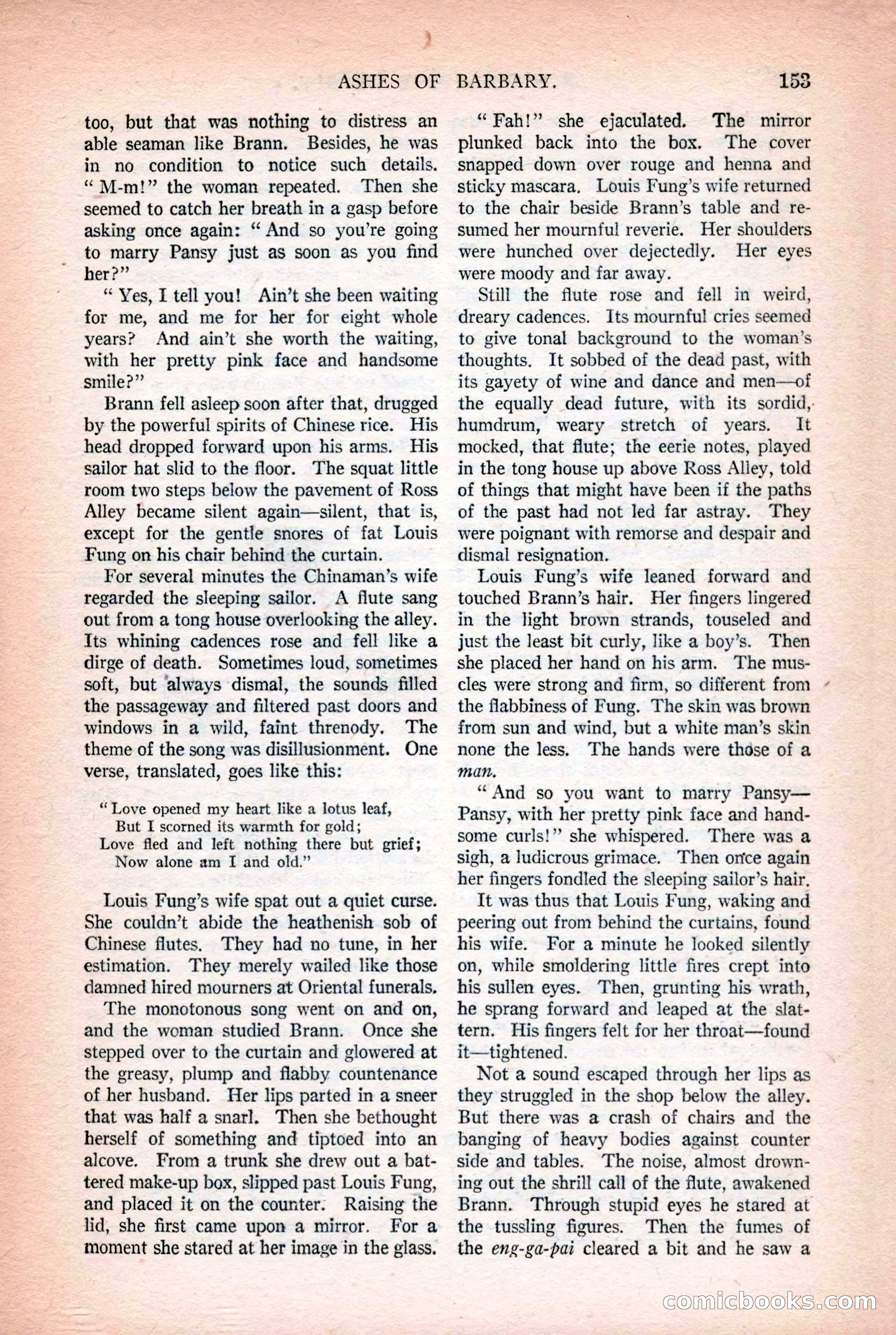
A restored page from Pulp Fiction, 1924. Page through the whole issue in the reader above.
📄 Transcribed text from this page (OCR, searchable)
Machine-transcribed from the original scan — historical spelling and the odd misread are preserved.
rd ° ) ASHES OF too, but that was nothing to distress an able seaman like Brann. Besides, he was in no condition to notice such details. “ M-m!” the woman repeated. Then she seemed to catch her breath in a gasp before asking once again: “And so you’re going to marry Pansy just as soon as you find her?” “ Yes, I tell you! Ain’t she been waiting for me, and me for her for eight whole years? And ain’t she worth the waiting, with her pretty pink face and handsome smile?” Brann fell asleep soon after that, drugged by the powerful spirits of Chinese rice. His head dropped forward upon his arms. His sailor hat slid to the floor. The squat little room two steps below the pavement of Ross Alley became silent again—silent, that is, except for the gentle snores of fat Louis Fung on his chair behind the curtain. For several minutes the Chinaman’s wife regarded the sleeping sailor. A flute sang out from a tong house overlooking the alley. Its whining cadences rose and fell like a dirge of death. Sometimes loud, sometimes soft, but always dismal, the sounds filled the passageway and filtered past doors and windows in a wild, faint threnody. The theme of the song was disillusionment. One verse, translated, goes like this: “Love opened my heart like a lotus leaf, But I scorned its warmth for gold; Love fled and left nothing there but grief; Now alone am I and old.” Louis Fung’s wife spat out a quiet curse. She couldn’t abide the heathenish sob of Chinese flutes. They had no tune, in her estimation. They merely wailed like those damned hired mourners at Oriental funerals. The monotonous song went on and on, and the woman studied Brann. Once she stepped over to the curtain and glowered at the greasy, plump and flabby countenance of her husband. Her lips parted in a sneer that was half a snarl. Then she bethought herself of something and tiptoed into an alcove. From a trunk she drew out a bat- tered make-up box, slipped past Louis Fung, and placed it on the counter. Raising the lid, she first came upon a mirror. For a moment she stared at her image in the glass. BARBARY, 1538 “Fah!” she ejaculated. The mirror plunked back into the box. The cover snapped down over rouge and henna and sticky mascara, Louis Fung’s wife returned to the chair beside Brann’s table and re- sumed her mournful reverie. Her shoulders were hunched over dejectedly. Her eyes were moody and far away. Still the flute rose and fell in weird, dreary cadences. Its mournful cries seemed to give tonal background to the woman’s thoughts. It sobbed of the dead past, with its gayety of wine and dance and men—of the equally dead future, with its sordid, humdrum, weary stretch of years. It mocked, that flute; the eerie notes, played in the tong house up above Ross Alley, told of things that might have been if the paths of the past had not led far astray. They were poignant with remorse and despair and dismal resignation. Louis Fung’s wife leaned forward and touched Brann’s hair. Her fingers lingered in the light brown strands, touseled and just the least bit curly, like a boy’s. Then she placed her hand on his arm. The mus- cles were strong and firm, so different from - the flabbiness of Fung. The skin was brown from sun and wind, but a white man’s skin none the less. The hands were those of a man. “And so you want to marry Pansy— Pansy, with her pretty pink face and hand- some curls!” she whispered. There was a sigh, a ludicrous grimace. Then orice again her fingers fondled the sleeping sailor’s hair, It was thus that Louis Fung, waking and peering out from behind the curtains, found his wife. For a minute he looked silently on, while smoldering little fires crept into his sullen eyes. Then, grunting his wrath, he sprang forward and leaped at the slat- tern. His fingers felt for her throat—found it—tightened. Not a sound escaped through her lips as they struggled in the shop below the alley. But there was a crash of chairs and the banging of heavy bodies against counter side and tables. The noise, almost drown- ing out the shrill call of the flute, awakened Brann. Through stupid eyes he stared at the tussling figures. Then the fumes of the eng-ga-pai cleared a bit and he saw a COmMiclboooks (C@