
Pulp Fiction, 1924 · page 35 of 172
Argosy All-Story Weekly, October 25, 1924 — page 35: what you’re looking at
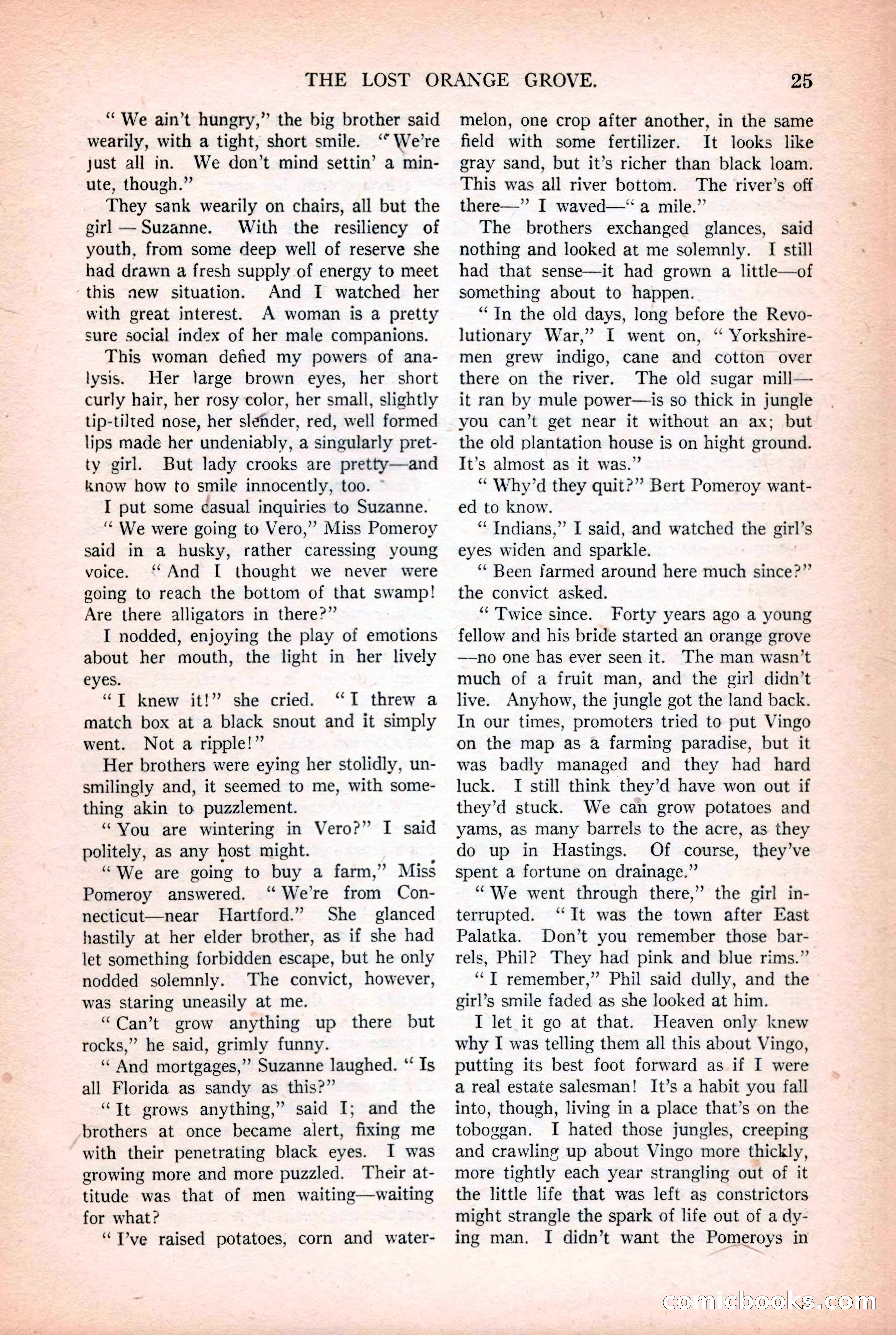
A restored page from Pulp Fiction, 1924. Page through the whole issue in the reader above.
📄 Transcribed text from this page (OCR, searchable)
Machine-transcribed from the original scan — historical spelling and the odd misread are preserved.
THE LOST ORANGE GROVE. “We ain’t hungry,” the big brother said wearily, with a tight, short smile. ‘“* We’re just all in. We don’t mind settin’ a min- ute, though.” They sank wearily on chairs, all but the girl — Suzanne. With the resiliency of youth, from some deep well of reserve she had drawn a fresh supply of energy to meet this aew situation. And I watched her with great interest. A woman is a pretty sure social index of her male companions. This woman defied my powers of ana- lysis. Her large brown eyes, her short curly hair, her rosy color, her small, slightly tip-tilted nose, her slender, red, well formed lips made her undeniably, a singularly pret- ty girl. But lady crooks are pretty—and know how to smile innocently, too. I put some casual inquiries to Suzanne. ‘“ We were going to Vero,” Miss Pomeroy said in a husky, rather caressing young voice. ‘And I thought we never were going to reach the bottom of that swamp! Are there alligators in there?” I nodded, enjoying the play of emotions about her mouth, the light in her lively eyes. ‘“T knew it!” she cried. “I threw a match box at a black snout and it simply went. Not a ripple!” Her brothers were eying her stolidly, un- smilingly and, it seemed to me, with some- thing akin to puzzlement. “Vou are wintering in Vero?” I said politely, as any host might. “We are going to buy a farm,” Miss Pomeroy answered. ‘“ We’re from Con- necticut—near Hartford.” She _ glanced hastily at her elder brother, as if she had let something forbidden escape, but he only nodded solemnly. The convict, however, was staring uneasily at me. “Can’t grow anything up there but rocks,” he said, grimly funny. “ And mortgages,”’ Suzanne laughed. “‘ Is all Florida as sandy as this?” “Tt grows anything,” said I; and the brothers at once became alert, fixing me with their penetrating black eyes. I was growing more and more puzzled. Their at- titude was that of men waiting—waiting for what? “Tve raised potatoes, corn and water- 25 melon, one crop after another, in the same field with some fertilizer. It looks like gray sand, but it’s richer than black loam. This was all river bottom. The river’s off there—” I waved—‘“a mile.” The brothers exchanged glances, said nothing and looked at me solemnly. I still had that sense—it had grown a little—of something about to happen. ‘“‘In the old days, long before the Revo- lutionary War,” I went on, “ Yorkshire- men grew indigo, cane and cotton over there on the river. The old sugar mill— it ran by mule power—is so thick in jungle you can’t get near it without an ax; but the old plantation house is on hight ground. It’s almost as it was.” “ Why’d they quit?” Bert Pomeroy want- ed to know. “ Indians,” I said, and watched the girl’s eyes widen and sparkle. ‘“‘ Been farmed around here much since?” the convict asked. ‘“‘ Twice since. Forty years ago a young fellow and his bride started an orange grove ——no one has ever seen it. The man wasn’t much of a fruit man, and the girl didn’t live. Anyhow, the jungle got the land back. In our times, promoters tried to put Vingo on the map as a farming paradise, but it was badly managed and they had hard luck. I still think they’d have won out if they’d stuck. We can grow potatoes and yams, as many barrels to the acre, as they do up in Hastings. Of course, they’ve spent a fortune on drainage.” “We went through there,” the girl in- terrupted. ‘‘It was the town after East Palatka. Don’t you remember those bar- rels, Phil? They had pink and blue rims.” ‘““T remember,” Phil said dully, and the girl’s smile faded as she looked at him. I let it go at that. Heaven only knew why I was telling them all this about Vingo, putting its best foot forward as if I were a real estate salesman! It’s a habit you fall into, though, living in a place that’s on the toboggan. I hated those jungles, creeping and crawling up about Vingo more thickly, more tightly each year strangling out of it the little life that was left as constrictors might strangle the spark of life out of a dy- ing man. I didn’t want the Pomeroys in Gomichdooks (E@)