
Pulp Fiction, 1925 · page 108 of 172
Argosy All-Story Weekly, April 18, 1925 — page 108: what you’re looking at
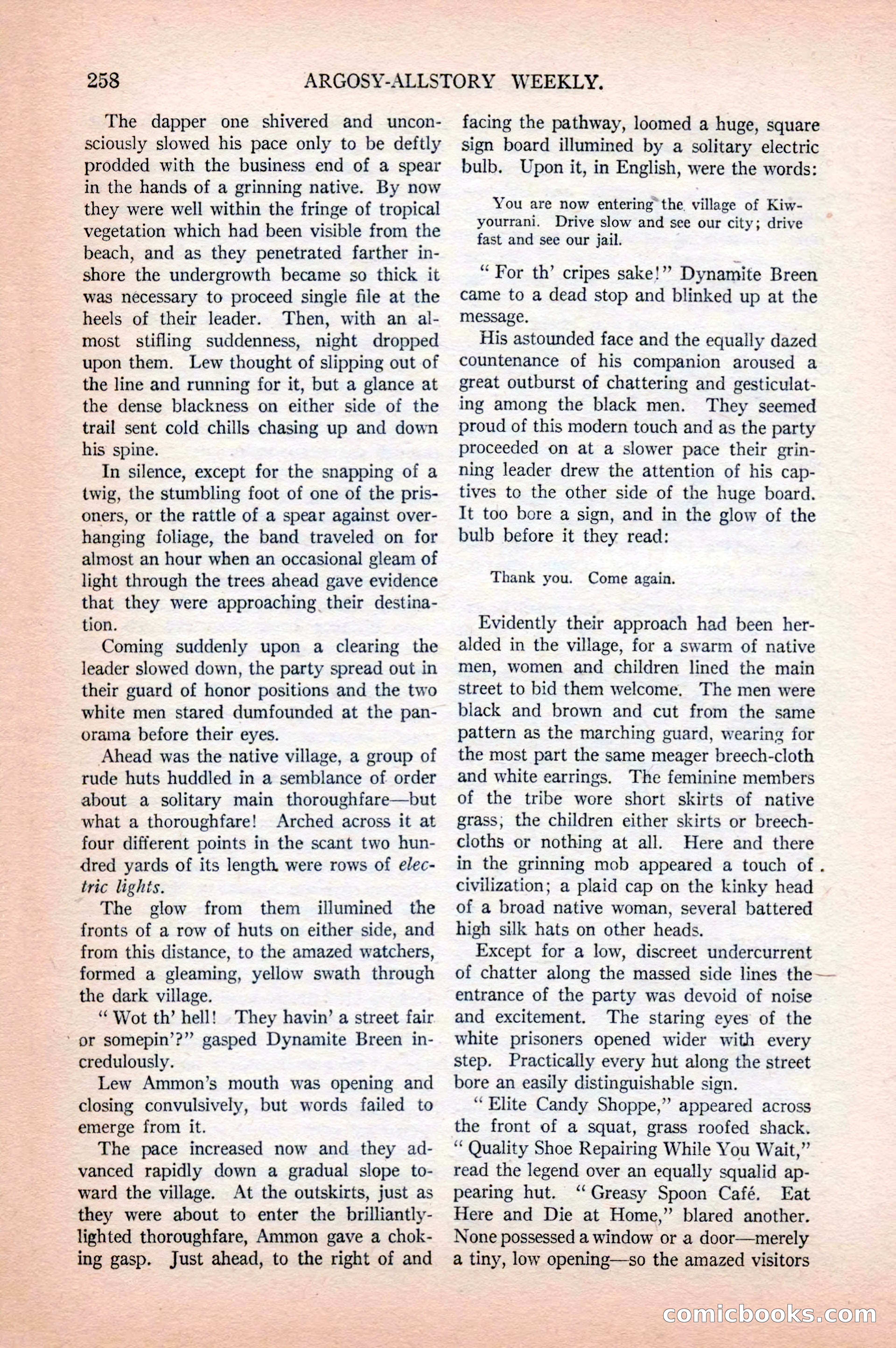
A restored page from Pulp Fiction, 1925. Page through the whole issue in the reader above.
📄 Transcribed text from this page (OCR, searchable)
Machine-transcribed from the original scan — historical spelling and the odd misread are preserved.
258 The dapper one shivered and uncon- sciously slowed his pace only to be deftly prodded with the business end of a spear in the hands of a grinning native. By now they were well within the fringe of tropical vegetation which had been visible from the beach, and as they penetrated farther in- shore the undergrowth became so thick it was nécessary to proceed single file at the heels of their leader. Then, with an al- most stifling suddenness, night dropped upon them. Lew thought of slipping out of the line and running for it, but a glance at the dense blackness on either side of the trail sent cold chills chasing up and down his spine. In silence, except for the snapping of a twig, the stumbling foot of one of the pris- oners, or the rattle of a spear against over- hanging foliage, the band traveled on for almost an hour when an occasional gleam of light through the trees ahead gave evidence that they were approaching their destina- tion. Coming suddenly upon a clearing the leader slowed down, the party spread out in their guard of honor positions and the two white men stared dumfounded at the pan- orama before their eyes. Ahead was the native village, a group of rude huts huddled in a semblance of order about a solitary main thoroughfare—but what a thoroughfare! Arched across it at four different points in the scant two hun- dred yards of its length were rows of elec- tric lights. The glow from them illumined the fronts of a row of huts on either side, and from this distance, to the amazed watchers, formed a gleaming, yellow swath through the dark village. ‘Wot th’ hell! They havin’ a street fair ‘or somepin’?” gasped Dynamite Breen in- credulously. Lew Ammon’s mouth was opening and closing convulsively, but words failed to emerge from it. The pace increased now and they ad- vanced rapidly down a gradual slope to- ward the village. At the outskirts, just as they were about to enter the brilliantly- lighted thoroughfare, Ammon gave a chok- ing gasp. Just ahead, to the right of and ARGOSY-ALLSTORY WEEKLY. facing the pathway, loomed a huge, square sign board illumined by a solitary electric bulb. Upon it, in English, were the words: You are now entering the village of Kiw- yourrani. Drive slow and see our city; drive fast and see our jail. ‘For th’ cripes sake!” Dynamite Breen came to a dead stop and blinked up at the message. His astounded face and the equally dazed countenance of his companion aroused a great outburst of chattering and gesticulat- ing among the black men. They seemed proud of this modern touch and as the party proceeded on at a slower pace their grin- ning leader drew the attention of his cap- tives to the other side of the huge board. It too bore a sign, and in the glow of the bulb before it they read: Thank you. Come again. Evidently their approach had been her- alded in the village, for a swarm of native men, women and children lined the main street to bid them welcome. The men were black and brown and cut from the same pattern as the marching guard, wearing for the most part the same meager breech-cloth and white earrings. The feminine members of the tribe wore short skirts of native grass; the children either skirts or breech- cloths or nothing at all. Here and there in the grinning mob appeared a touch of. civilization; a plaid cap on the kinky head of a broad native woman, several battered high silk hats on other heads. Except for a low, discreet undercurrent of chatter along the massed side lines the entrance of the party was devoid of noise and excitement. The staring eyes of the white prisoners opened wider with every step. Practically every hut along the street bore an easily distinguishable sign. ‘“ Elite Candy Shoppe,” appeared across the front of a squat, grass roofed shack. ‘“ Quality Shoe Repairing While You Wait,” read the legend over an equally squalid ap- pearing hut. ‘Greasy Spoon Café. Eat Here and Die at Home,” blared another. None possessed a window or a door—merely a tiny, low opening—so the amazed visitors Gomichooks f (E@)