
Pulp Fiction, 1925 · page 163 of 172
Argosy All-Story Weekly, April 18, 1925 — page 163: what you’re looking at
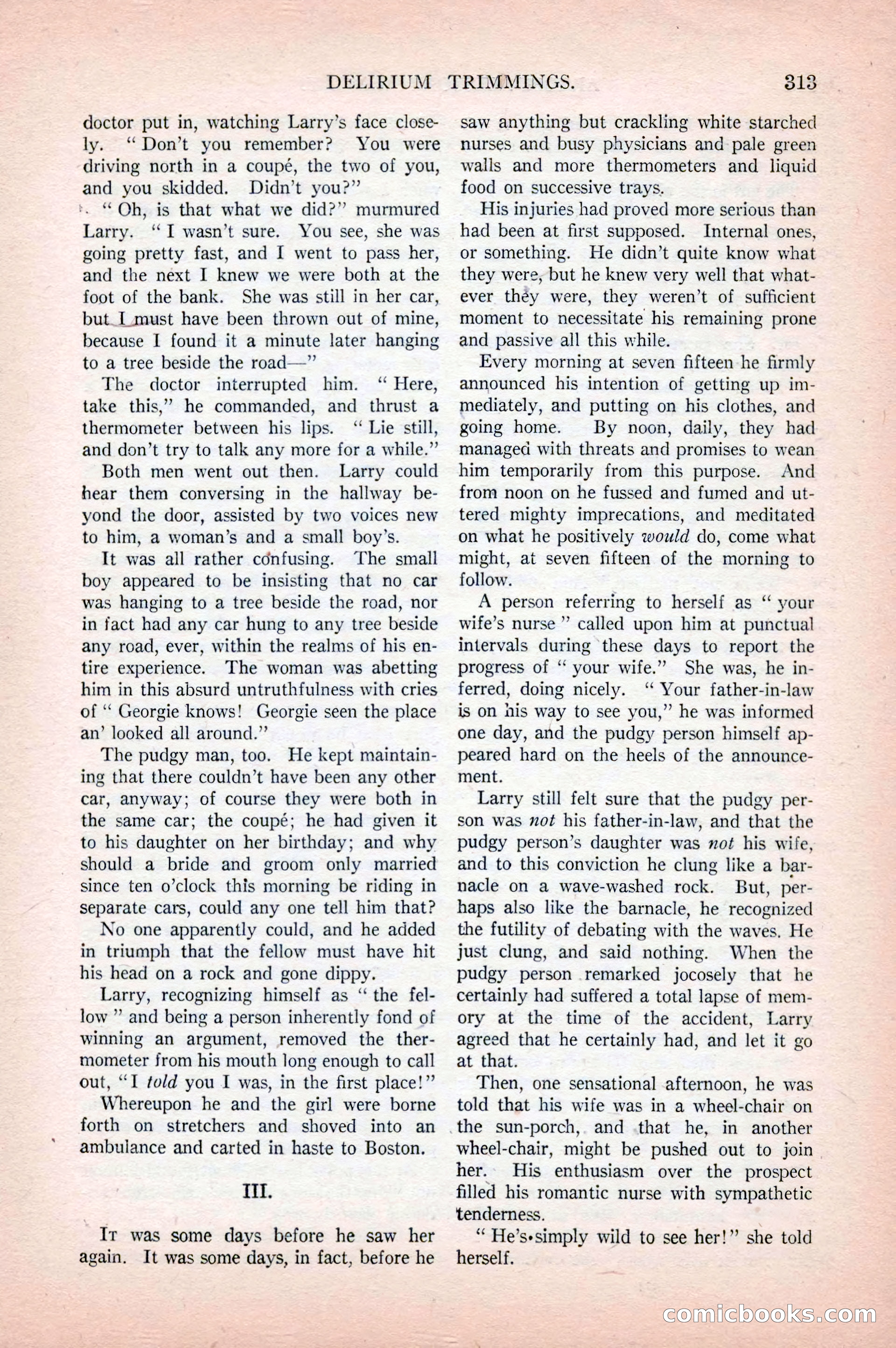
A restored page from Pulp Fiction, 1925. Page through the whole issue in the reader above.
📄 Transcribed text from this page (OCR, searchable)
Machine-transcribed from the original scan — historical spelling and the odd misread are preserved.
DELIRIUM TRIMMINGS. doctor put in, watching Larry’s face close- ly. ‘Don’t you remember? You were driving north in a coupé, the two of you, and you skidded. Didn’t you?” - “Qh, is that what we did?” murmured Larry. ‘‘ I wasn’t sure. You see, she was going pretty fast, and I went to pass her, and the next I knew we were both at the foot of the bank. She was still in her car, but_I_must have been thrown out of mine, because I found it a minute later hanging to a tree beside the road—”’ The doctor interrupted him. ‘“ Here, take this,” he commanded, and thrust a thermometer between his lips. ‘“‘ Lie still, and don’t try to talk any more for a while.” Both men went out then. Larry could hear them conversing in the hallway be- yond the door, assisted by two voices new to him, a woman’s and a small boy’s. It was all rather confusing. ‘The small boy appeared to be insisting that no car was hanging to a tree beside the road, nor in fact had any car hung to any tree beside any road, ever, within the realms of his en- tire experience. The woman was abetting him in this absurd untruthfulness with cries of ‘‘ Georgie knows! Georgie seen the place an’ looked all around.” The pudgy man, too. He kept maintain- ing that there couldn’t have been any other car, anyway; of course they were both in the same car; the coupé; he had given it to his daughter on her birthday; and why should a bride and groom only married since ten o’clock this morning be riding in separate cars, could any one tell him that? No one apparently could, and he added in triumph that the fellow must have hit his head on a rock and gone dippy. Larry, recognizing himself as “ the fel- low ” and being a person inherently fond of winning an argument, removed the ther- mometer from his mouth long enough to call out, “I told you I was, in the first place!” Whereupon he and the girl were borne forth on stretchers and shoved into an ambulance and carted in haste to Boston. Il. It was some days before he saw her again. It was some days, in fact, before he 313 saw anything but crackling white starched nurses and busy physicians and pale green walls and more thermometers and liquid food on successive trays. His injuries had proved more serious than had been at first supposed. Internal ones, or something. He didn’t quite know what they were, but he knew very well that what- ever théy were, they weren’t of sufficient moment to necessitate his remaining prone and passive all this while. Every morning at seven fifteen he firmly announced his intention of getting up im- mediately, and putting on his clothes, and going home. By noon, daily, they had managed with threats and promises to wean him temporarily from this purpose. And from noon on he fussed and fumed and ut- tered mighty imprecations, and meditated on what he positively would do, come what might, at seven fifteen of the morning to follow. A person referring to herself as ‘‘ your wife’s nurse” called upon him at punctual intervals during these days to report the progress of ‘‘ your wife.” She was, he in- ferred, doing nicely. ‘‘ Your father-in-law is On his way to see you,” he was informed one day, and the pudgy person himself ap- peared hard on the heels of the announce- ment. Larry still felt sure that the pudgy per- son was vot his father-in-law, and that the pudgy person’s daughter was not his wife, and to this conviction he clung like a bar- nacle on a wave-washed rock. But, per- haps also like the barnacle, he recognized the futility of debating with the waves. He just clung, and said nothing. When the pudgy person remarked jocosely that he certainly had suffered a total lapse of mem- ory at the time of the accident, Larry agreed that he certainly had, and let it go at that. Then, one sensational afternoon, he was told that his wife was in a wheel-chair on the sun-porch, and that he, in another wheel-chair, might be pushed out to join her. His enthusiasm over the prospect filled his romantic nurse with sympathetic tenderness. ‘ He’sesimply wild to see her!” she told herself. COMIC OOO KS (E@)