
Pulp Fiction, 1925 · page 44 of 172
Argosy All-Story Weekly, April 18, 1925 — page 44: what you’re looking at
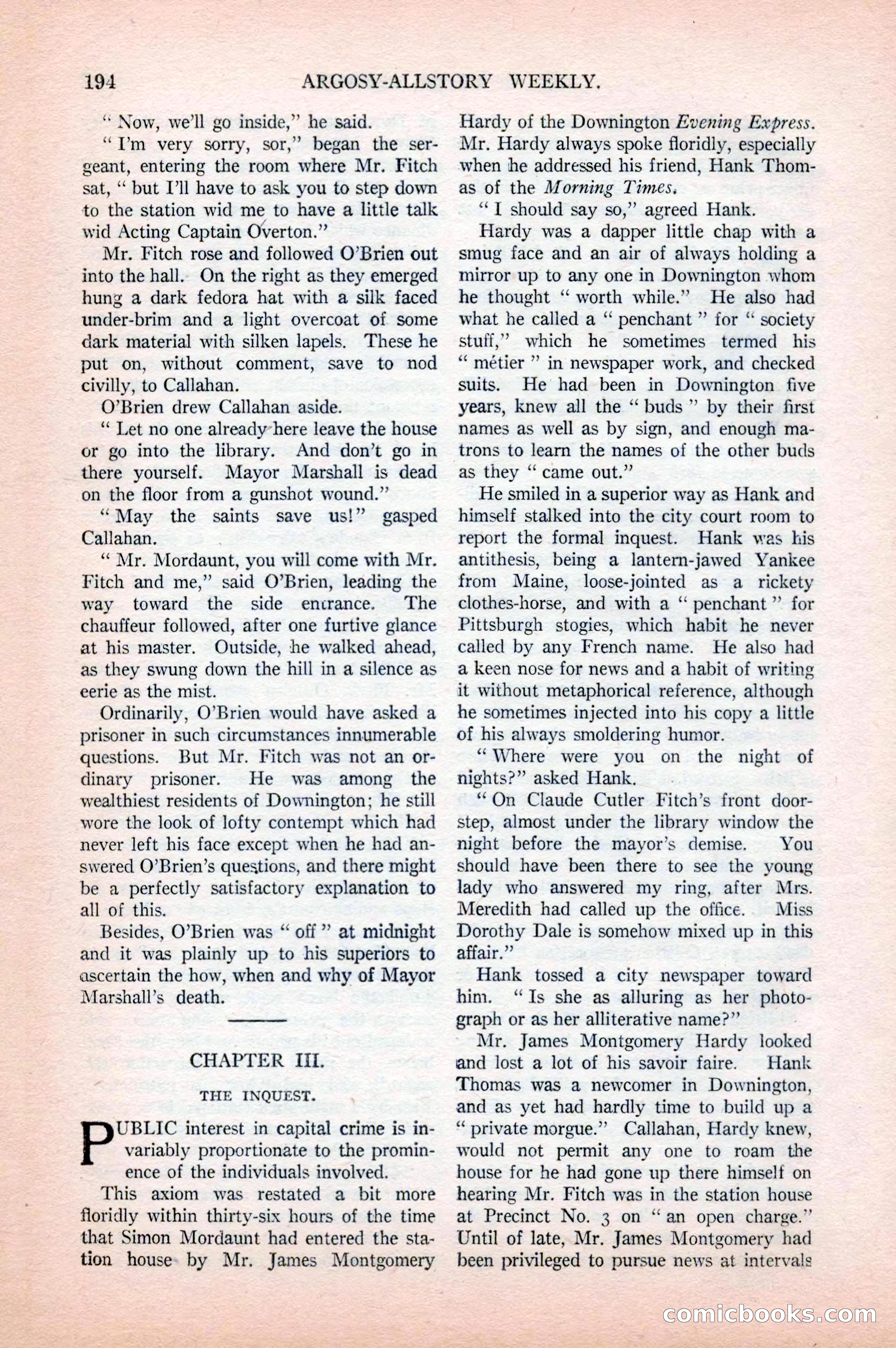
A restored page from Pulp Fiction, 1925. Page through the whole issue in the reader above.
📄 Transcribed text from this page (OCR, searchable)
Machine-transcribed from the original scan — historical spelling and the odd misread are preserved.
194 ‘ Now, we'll go inside,” he said. “T’m very sorry, sor,” began the ser- eeant, entering the room where Mr. Fitch sat, ‘‘ but Dll have to ask you to step down to the station wid me to have a little talk wid Acting Captain Overton.” Mr. Fitch rose and followed O’Brien out into the hall. On the right as they emerged hung a dark fedora hat with a silk faced under-brim and a light overcoat of some dark material with silken lapels. These he put on, without comment, save to nod civilly, to Callahan. O’Brien drew Callahan aside. “‘ Let no one already’here leave the house or go into the library. And don’t go in there yourself. Mayor Marshall is dead on the floor from a gunshot wound.” “May the saints save us!” gasped Callahan. “Mr. Mordaunt, you will come with Mr. Fitch and me,” said O’Brien, leading the way toward the side entrance. The chauffeur followed, after one furtive glance at his master. Outside, he walked ahead, as they swung down the hill in a silence as eerie as the mist. Ordinarily, O’Brien would have asked a prisoner in such circumstances innumerable questions. But Mr. Fitch was not an or- dinary prisoner. He was among the wealthiest residents of Downington; he still wore the look of lofty contempt which had never left his face except when he had an- swered O’Brien’s questions, and there might be a perfectly satisfactory explanation to all of this. Besides, O’Brien was “ off” at midnight and it was plainly up to his superiors to ascertain the how, when and why of Mayor Marshall’s death. CHAPTER Ii. THE INQUEST. UBLIC interest in capital crime is in- variably proportionate to the promin- ence of the individuals involved. This axiom was restated a bit more floridly within thirty-six hours of the time that Simon Mordaunt had entered the sta- tion house by Mr. James Montgomery ARGOSY-ALLSTORY WEEKLY. Hardy of the Downington Evening Express. Mr. Hardy always spoke floridly, especially when he addressed his friend, Hank Thom- as of the Morning Times, ‘1 should say so,” agreed Hank. Hardy was a dapper little chap with a smug face and an air of always holding a mirror up to any one in Downington whom he thought “ worth while.” He also had what he called a ‘“ penchant ” for “ society stuff,’ which he sometimes termed his “‘ métier ” in newspaper work, and checked suits. He had been in Downington five years, knew all the “ buds ” by their first names as well as by sign, and enough ma- trons to learn the names of the other buds as they “ came out.” He smiled in a superior way as Hank and himself stalked into the city court room to report the formal inquest. Hank was his antithesis, being a lantern-jawed Yankee from Maine, loose-jointed as a rickety clothes-horse, and with a “ penchant ”’ for Pittsburgh stogies, which habit he never called by any French name. He also had a keen nose for news and a habit of writing it without metaphorical reference, although he sometimes injected into his copy a little of his always smoldering humor. “Where were you on the night of nights?” asked Hank. “On Claude Cutler Fitch’s front door- step, almost under the library window the night before the mayor’s demise. You should have been there to see the young lady who answered my ring, after Mrs. Meredith had called up the office. Miss Dorothy Dale is somehow mixed up in this affair.” Hank tossed a city newspaper toward him. “Is she as alluring as her photo- graph or as her alliterative name?”’ Mr. James Montgomery Hardy looked and lost a lot of his savoir faire. Hank Thomas was a newcomer in Downington, and as yet had hardly time to build up a “ private morgue.” Callahan, Hardy knew, would not permit any one to roam the house for he had gone up there himself on hearing Mr. Fitch was in the station house at Precinct No. 3 on “an open charge.”’ Until of late, Mr. James Montgomery had been privileged to pursue news at intervals connicbool<s (E@)