
Pulp Fiction, 1925 · page 55 of 172
Argosy All-Story Weekly, April 18, 1925 — page 55: what you’re looking at
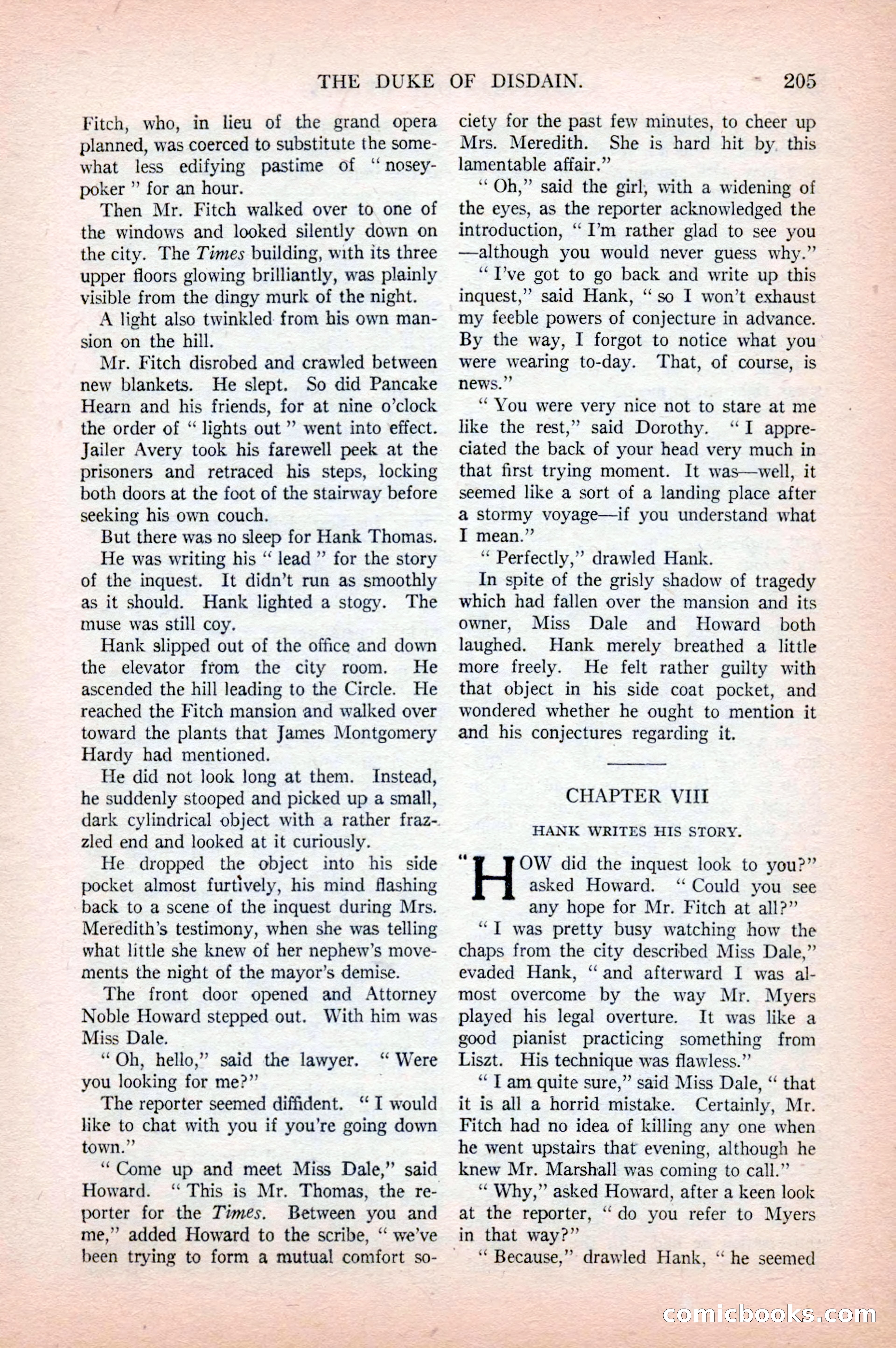
A restored page from Pulp Fiction, 1925. Page through the whole issue in the reader above.
📄 Transcribed text from this page (OCR, searchable)
Machine-transcribed from the original scan — historical spelling and the odd misread are preserved.
THE DUKE OF DISDAIN. Fitch, who, in lieu of the grand opera planned, was coerced to substitute the some- what less edifying pastime of “ nosey- poker ” for an hour. Then Mr. Fitch walked over to one of the windows and looked silently down on the city. The Times building, with its three upper floors glowing brilliantly, was plainly visible from the dingy murk of the night. A light also twinkled from his own man- sion on the hill. Mr. Fitch disrobed and crawled between new blankets. He slept. So did Pancake Hearn and his friends, for at nine o’clock the order of “ lights out” went into effect. Jailer Avery took his farewell peek at the prisoners and retraced his steps, locking both doors at the foot of the stairway before seeking his own couch. But there was no sleep for Hank Thomas. He was writing his “ lead ”’ for the story of the inquest. It didn’t run as smoothly as it should. Hank lighted a stogy. The muse was still coy. Hank slipped out of the office and down the elevator from the city room. He ascended the hill leading to the Circle. He reached the Fitch mansion and walked over toward the plants that James Montgomery Hardy had mentioned. He did not look long at them. Instead, he suddenly stooped and picked up a small, dark cylindrical object with a rather fraz-. zled end and looked at it curiously. He dropped the object into his side pocket almost furtively, his mind flashing back to a scene of the inquest during Mrs. Meredith’s testimony, when she was telling what little she knew of her nephew’s move- ments the night of the mayor’s demise. The front door opened and Attorney Noble Howard stepped out. With him was Miss Dale. “Oh, hello,” said the lawyer. “ Were you looking for me?” 3 The reporter seemed diffident. “ I would like to chat with you if you’re going down town.” ‘“Come up and meet Miss Dale,” said Howard. porter for the Times. Between you and me,” added Howard to the scribe, ‘‘ we’ve been trying to form a mutual comfort so- “This is Mr. Thomas, the re- 205 ciety for the past few minutes, to cheer up Mrs. Meredith. She is hard hit by. this lamentable affair.” “Oh,” said the girl, with a widening of the eyes, as the reporter acknowledged the introduction, “I’m rather glad to see you —although you would never guess why.” ‘““Tve got to go back and write up this inquest,” said Hank, ‘‘so I won’t exhaust my feeble powers of conjecture in advance. By the way, I forgot to notice what you were wearing to-day. ‘That, of course, is news.” “You were very nice not to stare at me like the rest,” said Dorothy. ‘I appre- ciated the back of your head very much in that first trying moment. It was—well, it seemed like a sort of a landing place after a stormy voyage—if you understand what I mean.” ‘* Perfectly,” drawled Hank. In spite of the grisly shadow of tragedy which had fallen over the mansion and its owner, Miss Dale and Howard both laughed. Hank merely breathed a little more freely. He felt rather guilty with that object in his side coat pocket, and wondered whether he ought to mention it and his conjectures regarding it. CHAPTER VIII HANK WRITES HIS STORY. OW did the inquest look to you?” asked Howard. ‘“ Could you see any hope for Mr. Fitch at all?” “I was pretty busy watching how the chaps from the city described Miss Dale,” evaded Hank, ‘‘ and afterward I was al- most overcome by the way Mr. Myers played his legal overture. It was like a good pianist practicing something from Liszt. His technique was flawless.” “I am quite sure,” said Miss Dale, “ that it is all a horrid mistake. Certainly, Mr. Fitch had no idea of killing any one when he went upstairs that evening, although he knew Mr. Marshall was coming to call.” “Why,” asked Howard, after a keen look at the reporter, “do you refer to Myers in that way?” ‘* Because,” drawled Hank, “ he seemed COPMIC OOO KS (E@)