
Pulp Fiction, 1925 · page 57 of 172
Argosy All-Story Weekly, April 18, 1925 — page 57: what you’re looking at
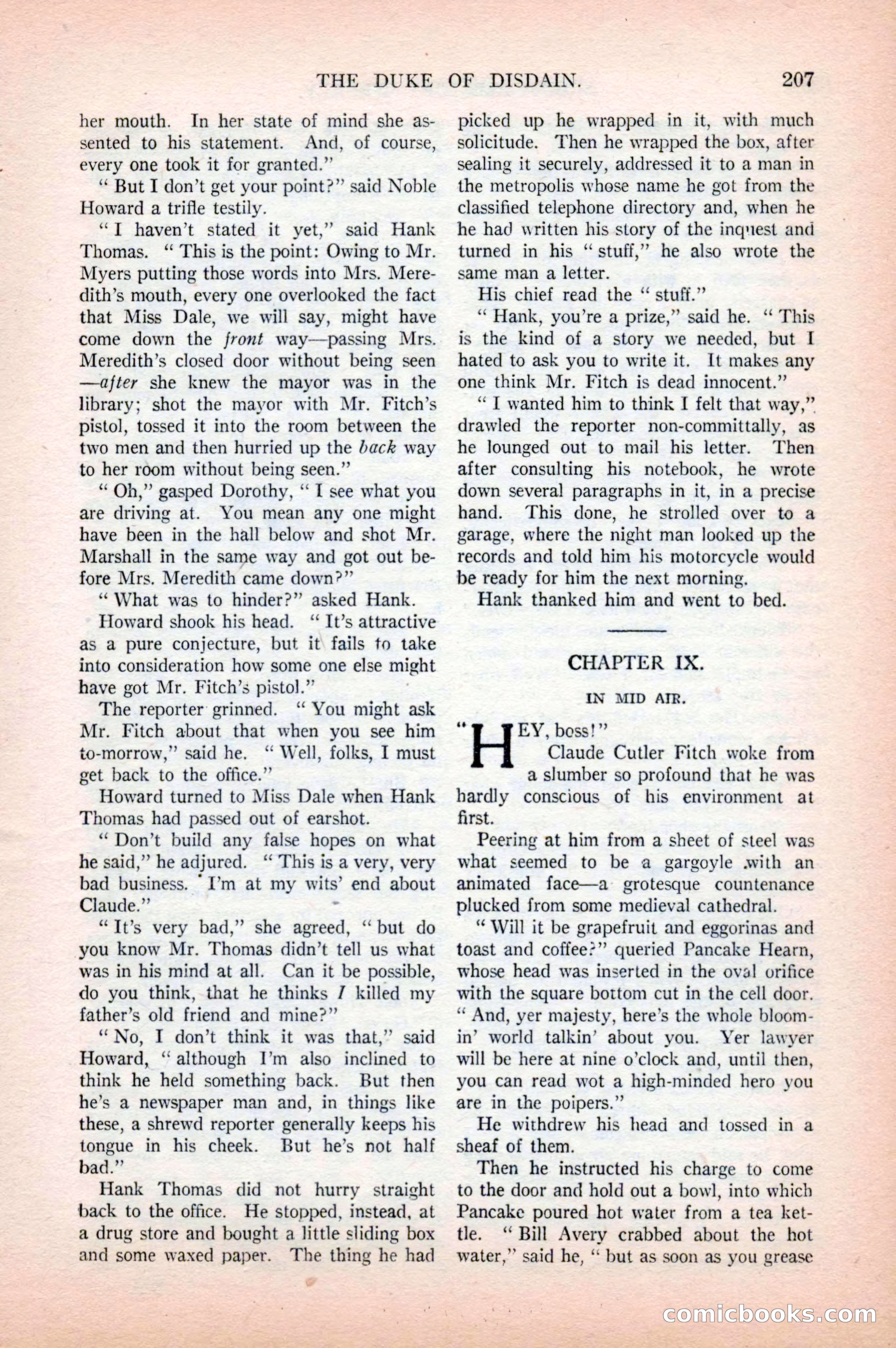
A restored page from Pulp Fiction, 1925. Page through the whole issue in the reader above.
📄 Transcribed text from this page (OCR, searchable)
Machine-transcribed from the original scan — historical spelling and the odd misread are preserved.
THE DUKE OF DISDAIN. her mouth. In her state of mind she as- sented to his statement. And, of course, every one took it for granted.”’ ‘“ But I don’t get your point?” said Noble Howard a trifle testily. “I haven’t stated it yet,” said Hank Thomas. ‘“ This is the point: Owing to Mr. Myers putting those words into Mrs. Mere- dith’s mouth, every one overlooked the fact that Miss Dale, we will say, might have come down the front way—passing Mrs. Meredith’s closed door without being seen —after she knew the mayor was in the library; shot the mayor with Mr. Fitch’s pistol, tossed it into the room between the two men and then hurried up the back way to her room without being seen.” “Oh,” gasped Dorothy, “‘ [ see what you are driving at. You mean any one might have been in the hall below and shot Mr. Marshall in the same way and got out be- fore Mrs. Meredith came down?” “What was to hinder?” asked Hank. Howard shook his head. “ It’s attractive as a pure conjecture, but it fails fo take into consideration how some one else might have got Mr. Fitch’s pistol.” The reporter grinned. ‘“ You might ask Mr. Fitch about that when you see him to-morrow,” said he. “ Well, folks, I must get back to the office.”’ Howard turned to Miss Dale when Hank Thomas had passed out of earshot. “Don’t build any false hopes on what he said,” he adjured. ‘ This is a very, very bad business. I’m at my wits’ end about Claude.” - “It’s very bad,” she agreed, “ but do you know Mr. Thomas didn’t tell us what was in his mind at all. Can it be possible, do you think, that he thinks / killed my father’s old friend and mine?” “No, I don’t think it was that,” said Howard, “although I’m also inclined to think he held something back. But then he’s a newspaper man and, in things like these, a shrewd reporter generally keeps his tongue in his cheek. But he’s not half bad.” Hank Thomas did not hurry straight back to the office. He stopped, instead, at a drug store and bought a little sliding box and some waxed paper. The thing he had ee 207 picked up he wrapped in it, with much solicitude. Then he wrapped the box, after sealing it securely, addressed it to a man in the metropolis whese name he got from the classified telephone directory and, when he he had written his story of the inquest and turned in his “stuff,” he also wrote the same man a letter. His chief read the “ stuff.” “Hank, you’re a prize,” said he. “ This is the kind of a story we needed, but I hated to ask you to write it. It makes any one think Mr. Fitch is dead innocent.” ‘“T wanted him to think I felt that way,” drawled the reporter non-committally, as he lounged out to mail his letter. Then after consulting his notebook, he wrote down several paragraphs in it, in a precise hand. ‘This done, he strolled over to a garage, where the night man looked up the records and told him his motorcycle would be ready for him the next morning, Hank thanked him and went to bed. CHAPTER IX. IN MID AIR. : EY, boss!” Claude Cutler Fitch woke from a slumber so profound that he was hardly conscious of his environment at first. Peering at him from a sheet of steel was what seemed to be a gargoyle with an animated face—a grotesque countenance plucked from some medieval cathedral. “ Will it be grapefruit and eggorinas and toast and coffee?” queried Pancake Hearn, whose head was inserted in the oval orifice with the square bottom cut in the cell door. “And, yer majesty, here’s the whole bloom- in’ world talkin’ about you. Yer lawyer will be here at nine o’clock and, until then, you can read wot a high-minded hero you are in the poipers.”’ He withdrew his head and tossed in a sheaf of them. Then he instructed his charge to come to the door and hold out a bowl, into which Pancake poured hot water from a tea ket- tle. ‘ Bill Avery crabbed about the hot water,” said he, ‘‘ but as soon as you grease EOPMMIC LOO KS (E@)