
Pulp Fiction, 1925 · page 73 of 172
Argosy All-Story Weekly, April 18, 1925 — page 73: what you’re looking at
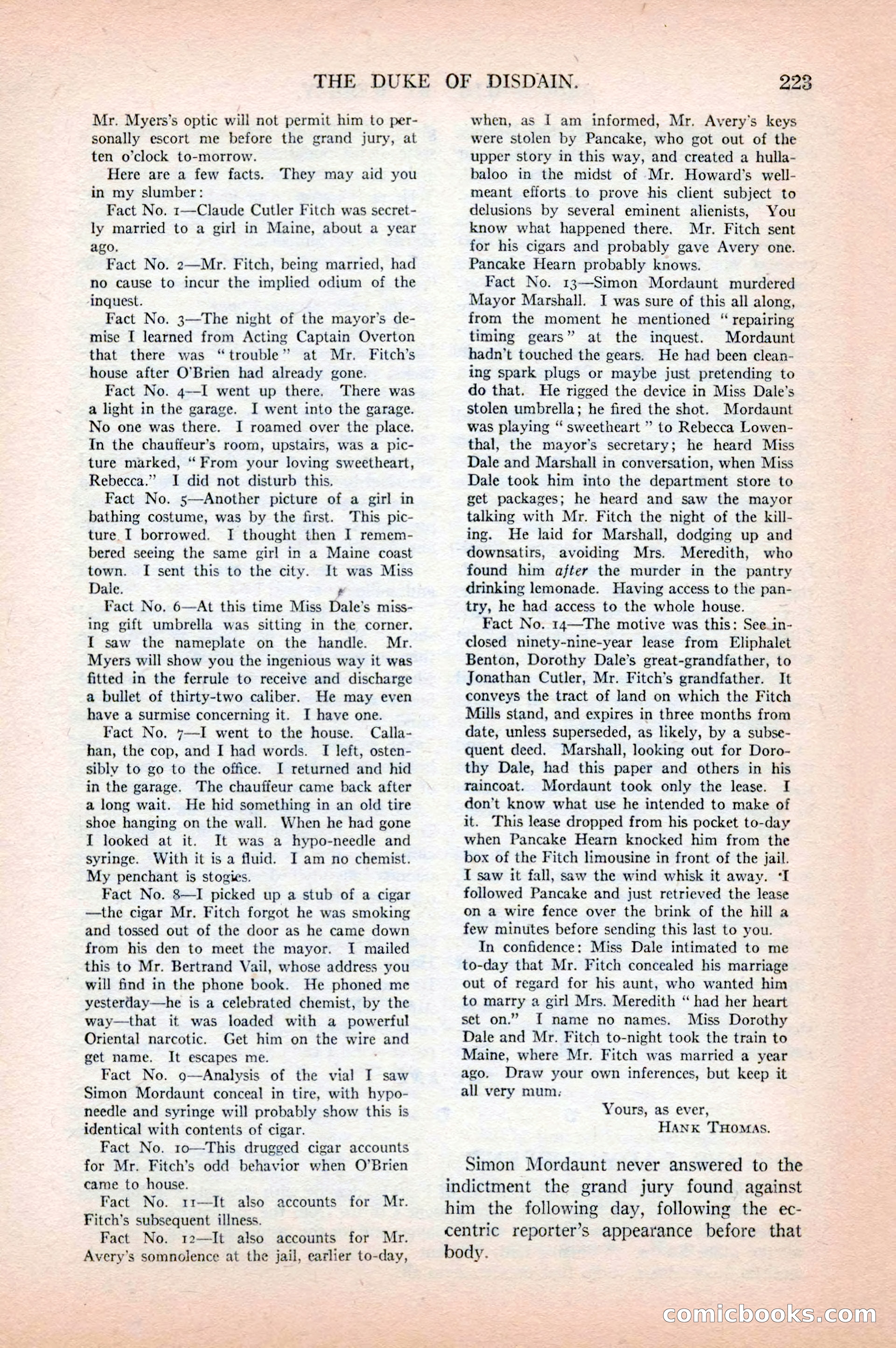
A restored page from Pulp Fiction, 1925. Page through the whole issue in the reader above.
📄 Transcribed text from this page (OCR, searchable)
Machine-transcribed from the original scan — historical spelling and the odd misread are preserved.
THE DUKE OF DISDAIN. 223 Mr. Myers’s optic will not permit him to per- sonally escort me before the grand jury, at ten o’clock to-morrow. Here are a few facts. They may aid you in my slumber: Fact No. 1—Claude Cutler Fitch was secret- ly married to a girl in Maine, about a year ago, Fact No. 2—Mr. Fitch, being married, had no cause to incur the implied odium of the inquest. Fact No. 3—The night of the mayor’s de- mise [ learned from Acting Captain Overton that there was “trouble” at Mr. Fitch’s house after O'Brien had already gone. Fact No. 4—I went up there, There was a light in the garage. I went into the garage. No one was there. I roamed over the place. In the chauffeur’s room, upstairs, was a pic- ture marked, “ From your loving sweetheart, Rebecca.” I did not disturb this. Fact No. 5—Another picture of a girl in bathing costume, was by the first. This pic- ture I borrowed. I thought then I remem- bered seeing the same girl in a Maine coast town. I sent this to the city. It was Miss Dale. s Fact No, 6—At this time Miss Dale’s miss- ing gift umbrella was sitting in the corner. I saw the nameplate on the handle. Mr. Myers will show you the ingenious way it was fitted in the ferrule to receive and discharge a bullet of thirty-two caliber. He may even have a surmise concerning it. I have one. Fact No. 7—I went to the house. Calla- han, the cop, and I had words. [I left, osten- sibly to go to the office. I returned and hid in the garage. The chauffeur came back after a long wait. He hid something in an old tire shoe hanging on the wall. When he had gone I looked at it. It was a hypo-needle and syringe. With it isa fluid. I am no chemist. My penchant is stogies. Fact No. 8—I picked up a stub of a cigar —the cigar Mr. Fitch forgot he was smoking and tossed out of the door as he came down from his den to meet the mayor. I mailed this to Mr. Bertrand Vail, whose address you will find in the phone book. He phoned me yesterday—he is a celebrated chemist, by the way—that it was loaded with a powerful Oriental narcotic. Get him on the wire and get name. It escapes me. , Fact No. 9—Analysis of the vial I saw Simon Mordaunt conceal in tire, with hypo- needle and syringe will probably show this is identical with contents of cigar. Fact No. 10o—This drugged cigar accounts for Mr. Fitch’s odd behavior when O’Brien came to house. Fact No. 11—It also accounts for Mr. Fitch’s subsequent illness. Fact No. 12—It also accounts for Mr. Avery’s somnolence at the jail, earlier to-day, when, as I am informed, Mr. Avery’s keys were stolen by Pancake, who got out of the upper story in this way, and created a hulla- baloo in the midst of Mr. Howard’s well- meant efforts to prove his client subject to delusions by several eminent alienists, You know what happened there. Mr. Fitch sent for his cigars and probably gave Avery one. Pancake Hearn probably knows. Fact No. 13—Simon Mordaunt murdered Mayor Marshall. I was sure of this all along, from the moment he mentioned “ repairing timing gears” at the inquest. Mordaunt hadn’t touched the gears. He had been clean- ing spark plugs or maybe just pretending to do that. He rigged the device in Miss Dale's stolen umbrella; he fired the shot. Mordaunt was playing ‘“ sweetheart ” to Rebecca Lowen- thal, the mayor’s secretary; he heard Miss Dale and Marshall in conversation, when Miss Dale took him into the department store to get packages; he heard and saw the mayor talking with Mr. Fitch the night of the kill- ing. He laid for Marshall, dodging up and downsatirs, avoiding Mrs. Meredith, who found him after the murder in the pantry drinking lemonade. Having access to the pan- try, he had access to the whole house. Fact No. 14—The motive was this: See in- closed ninety-nine-year lease from Eliphalet Benton, Dorothy Dale’s great-grandfather, to Jonathan Cutler, Mr. Fitch’s grandfather. It conveys the tract of land on which the Fitch Mills stand, and expires in three months from date, unless superseded, as likely, by a subse- quent deed. Marshall, looking out for Doro- thy Dale, had this paper and others in his raincoat. Mordaunt took only the lease. I don’t know what use he intended to make of it. This lease dropped from his pocket to-day when Pancake Hearn knocked him from the box of the Fitch limousine in front of the jail. T saw it fall, saw the wind whisk it away. ‘T followed Pancake and just retrieved the lease on a wire fence over the brink of the hill a few minutes before sending this last to you. In confidence: Miss Dale intimated to me to-day that Mr. Fitch concealed his marriage out of regard for his aunt, who wanted him to marry a girl Mrs. Meredith “ had her heart set on.” f[ name no names. Miss Dorothy Dale and Mr. Fitch to-night took the train to Maine, where Mr. Fitch was married a year ago. Draw your own inferences, but keep it all very mum; Yours, as ever, HANK THOMAS. Simon Mordaunt never answered to the indictment the grand jury found against him the following day, following the ec- centric reporter’s appearance before that body. EOPMIECLOOO (E@)