
Pulp Fiction, 1925 · page 91 of 172
Argosy All-Story Weekly, April 18, 1925 — page 91: what you’re looking at
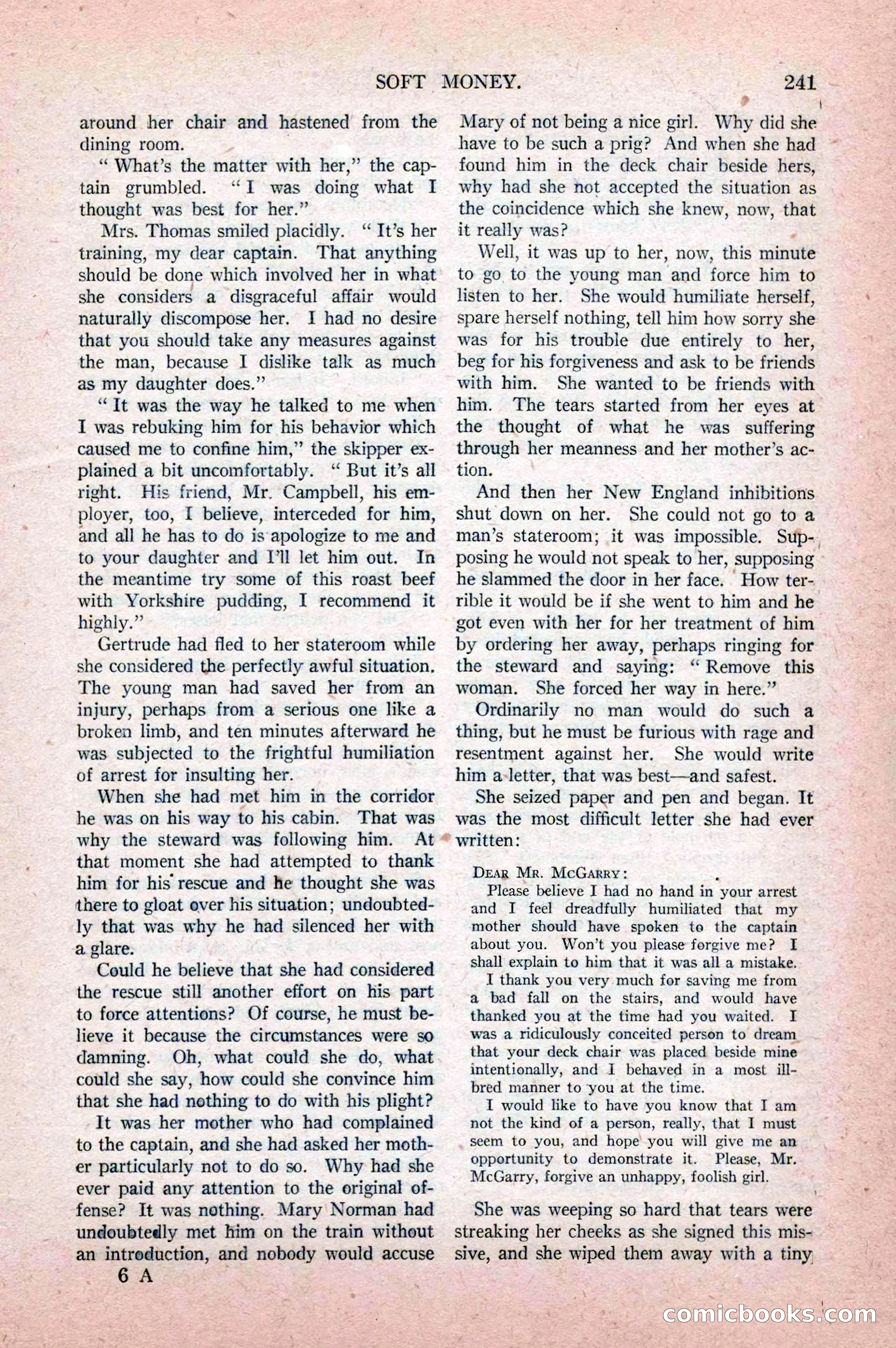
A restored page from Pulp Fiction, 1925. Page through the whole issue in the reader above.
📄 Transcribed text from this page (OCR, searchable)
Machine-transcribed from the original scan — historical spelling and the odd misread are preserved.
SOFT MONEY. around her chair and hastened from the dining room. 3 ‘““What’s the matter with her,” the cap- tain grumbled. ‘I was doing what I thought was best for her.” Mrs. Thomas smiled placidly. “ It’s her training, my dear captain. That anything should be done which involved her in what she considers a disgraceful affair would naturally discompose her. I had no desire that you should take any measures against the man, because I dislike talk as much as my daughter does.” “It was the way he talked to me when I was rebuking him for his behavior which caused me to confine him,” the skipper ex- plained a bit uncomfortably. “ But it’s all right. His friend, Mr. Campbell, his em- ployer, too, I believe, interceded for him, and all he has to do is apologize to me and to your daughter and IJ’ll let him out. In the meantime try some of this roast beef with Yorkshire pudding, I recommend it highly.” Gertrude had fled to her stateroom while she considered the perfectly awful situation, The young man had saved her from an injury, perhaps from a serious one like a broken limb, and ten minutes afterward he was subjected to the frightful humiliation of arrest for insulting her. When she had met him in the corridor he was on his way to his cabin. That was why the steward was following him. At that moment she had attempted to thank him for his rescue and he thought she was there to gloat over his situation; undoubted- ly that was why he had silenced her with a glare. Could he believe that she had considered the rescue still another effort on his part to force attentions? Of course, he must be- lieve it because the circumstances were so damning. Oh, what could she do, what could she say, how could she convince him that she had nothing to do with his plight? It was her mother who had complained to the captain, and she had asked her moth- er particularly not to do so. Why had she ever paid any attention to the original of- fense? It was nothing. Mary Norman had undoubtedly met him on the train without an intreduction, and nobody would accuse 6A > 241 > Mary of not being a nice girl. have to be such a prig? And when she had found him in the deck chair beside hers, why had she not accepted the situation as the coincidence which she knew, now, that it really was? Well, it was up to her, now, this minute to go to the young man and force him to listen to her. She would humiliate herself, spare herself nothing, tell him how sorry she was for his trouble due entirely to her, beg for his forgiveness and ask to be friends with him. She wanted to be friends with him. The tears started from her eyes at the thought of what he was suffering through her meanness and her mother’s ac- tion. And then her New England inhibitions shut down on her. She could not go to a man’s stateroom; posing he would not speak to her, supposing he slammed the door in her face. How ter- rible it would be if she went to him and he got even with her for her treatment of him by ordering her away, perhaps ringing for the steward and saying: “ Remove this woman. She forced her way in here.” Ordinarily no man would do such a thing, but he must be furious with rage and resentment against her. She would write him a-letter, that was best—and safest. She seized paper and pen and began. It was the most difficult letter she had ever ” written: Drag Mr. McGarry: Please believe I had no hand in "your arrest and I feel dreadfully humiliated that my mother should have spoken to the captain about you. Won’t you please forgive me? I shall explain to him that it was all a mistake. I thank you very much for saving me from a bad fall on the stairs, and would have thanked you at the time had you waited. I was a ridiculously conceited person to dream that your deck chair was placed beside mine intentionally, and I behaved in a most ill- bred manner to you at the time. I would like to have you know that I am not the kind of a person, really, that I must seem to you, and hope you will give me an opportunity to demonstrate it. Please, Mr. McGarry, forgive an unhappy, foolish girl. She was weeping so hard that tears were streaking her cheeks as she signed this mis- sive, and she wiped them away with a tiny .OOKS Why did she it was impossible. Sup-, EOmiG