
Pulp Fiction, 1925 · page 108 of 170
Argosy All-Story Weekly, June 13, 1925 — page 108: what you’re looking at
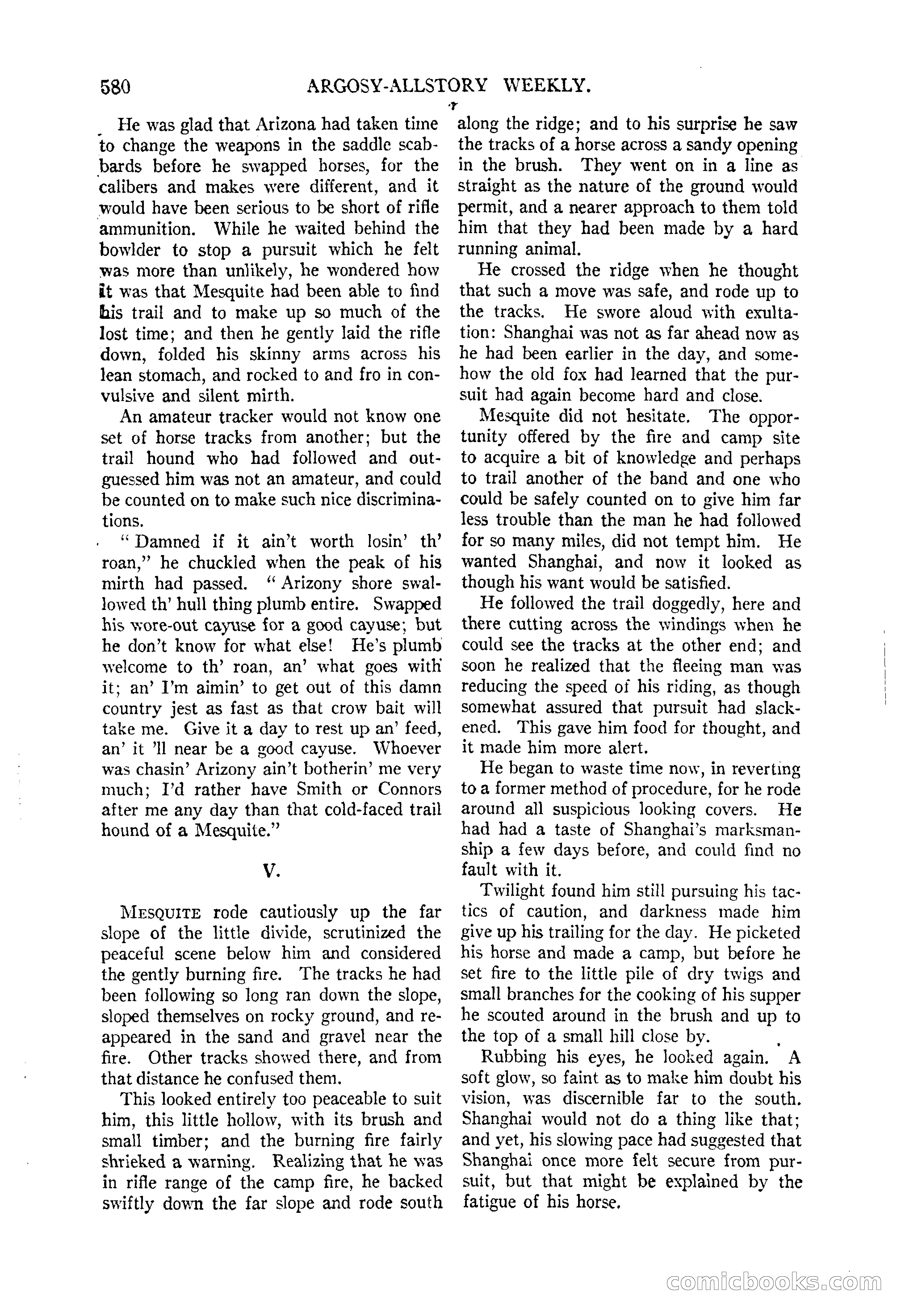
A restored page from Pulp Fiction, 1925. Page through the whole issue in the reader above.
📄 Transcribed text from this page (OCR, searchable)
Machine-transcribed from the original scan — historical spelling and the odd misread are preserved.
580 _ He was glad that Arizona had taken time to change the weapons in the saddle scab- bards before he swapped horses, for the calibers and makes were different, and it would have been serious to be short of rifle ammunition. While he waited behind the bowlder to stop a pursuit which he felt was more than unlikely, he wondered how it was that Mesquite had been able to find his trail and to make up so much of the lost time; and then he gently laid the rifle down, folded his skinny arms across his lean stomach, and rocked to and fro In con- vulsive and silent mirth. An amateur tracker would not know one set of horse tracks from another; but the trail hound who had followed and out- guessed him was not an amateur, and could be counted on to make such nice discrimina- tions. “Damned if it ain’t worth losin’ th’ roan,” he chuckled when the peak of his mirth had passed. ‘ Arizony shore swal- lowed th’ hull thing plumb entire. Swapped his wore-out cayuse for a good cayuse; but he don’t know for what else! He’s plumb welcome to th’ roan, an’ what goes with it; an’ I’m aimin’ to get out of this damn country jest as fast as that crow bait will take me. Give it a day to rest up an’ feed, an’ it ‘ll near be a good cayuse. Whoever was chasin’ Arizony ain’t botherin’ me very much; I’d rather have Smith or Connors after me any day than that cold-faced trail hound of a Mesquite.” V. MESQUITE rode cautiously up the far slope of the little divide, scrutinized the peaceful scene below him and considered the gently burning fire. The tracks he had been following so long ran down the slope, sloped themselves on rocky ground, and re- appeared in the sand and gravel near the fire. Other tracks showed there, and from that distance he confused them. This looked entirely too peaceable to suit him, this little hollow, with its brush and small timber; and the burning fire fairly shrieked a warning. Realizing that he was in rifle range of the camp fire, he backed swiftly down the far slope and rode south ARGOSY-ALLSTORY WEEKLY. v along the ridge; and to his surprise he saw the tracks of a horse across a sandy opening in the brush. They went on in a line as Straight as the nature of the ground would permit, and a nearer approach to them told him that they had been made by a hard running animal. He crossed the ridge when he thought that such a move was safe, and rode up to the tracks. He swore aloud with exulta- tion: Shanghai was not as far ahead now as he had been earlier in the day, and some- how the old fox had learned that the pur- suit had again become hard and close. Mesquite did not hesitate. The oppor- tunity offered by the fire and camp site to acquire a bit of knowledge and perhaps to trail another of the band and one who could be safely counted on to give him far less trouble than the man he had followed for so many miles, did not tempt him. He wanted Shanghai, and now it looked as though his want would be satisfied. He followed the trail doggedly, here and there cutting across the windings when he could see the tracks at the other end; and soon he realized that the fleeing man was reducing the speed of his riding, as though somewhat assured that pursuit had slack- ened. This gave him food for thought, and it made him more alert. He began to waste time now, in reverting to a former method of procedure, for he rode around all suspicious looking covers. He had had a taste of Shanghai’s marksman- ship a few days before, and could find no fault with it. Twilight found him still pursuing his tac- tics of caution, and darkness made him give up his trailing for the day. He picketed his horse and made a camp, but before he set fire to the little pile of dry twigs and small branches for the cooking of his supper he scouted around in the brush and up to the top of a small hill close by. Rubbing his eyes, he looked again. A soft glow, so faint as to make him doubt his vision, was discernible far to the south. Shanghai would not do a thing like that; and yet, his slowing pace had suggested that Shanghai once more felt secure from pur- suit, but that might be explained by the fatigue of his horse. CO lODOOLK CO