
Pulp Fiction, 1925 · page 13 of 170
Argosy All-Story Weekly, June 13, 1925 — page 13: what you’re looking at
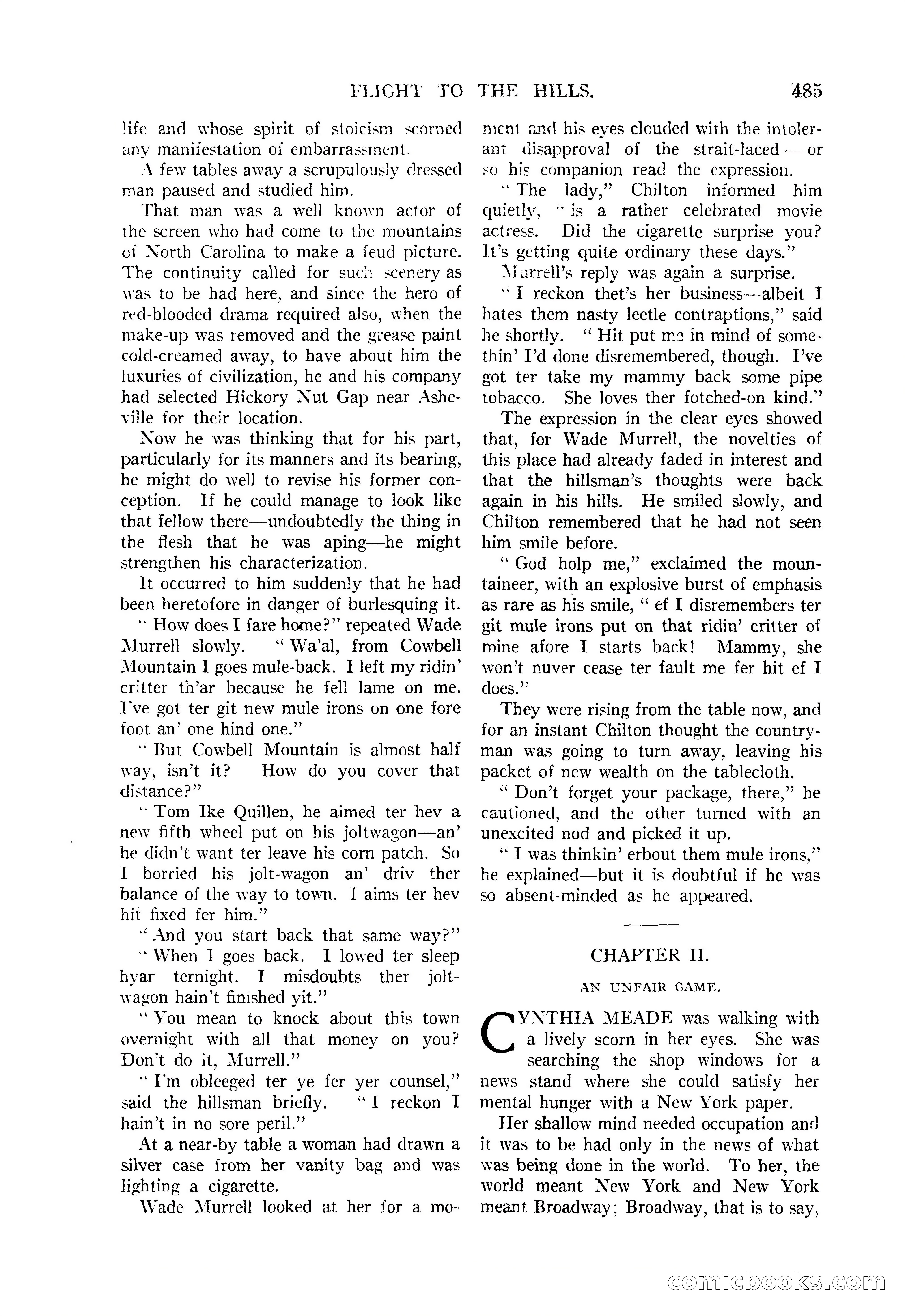
A restored page from Pulp Fiction, 1925. Page through the whole issue in the reader above.
📄 Transcribed text from this page (OCR, searchable)
Machine-transcribed from the original scan — historical spelling and the odd misread are preserved.
FLIGHT TO life and whose spirit of stoicism scorned any manifestation of embarrassment. A few tables away a scrupulously dressed man paused and studied him. That man was a well known actor of the screen who had come to the mountains of North Carolina to make a feud picture. The continuity called for such scenery as was to be had here, and since the hero of red-blooded drama required also, when the make-up was removed and the grease paint cold-creamed away, to have about him the luxuries of civilization, he and his company had selected Hickory Nut Gap near Ashe- ville for their location. Now he was thinking that for his part, particularly for its manners and its bearing, he might do well to revise his former con- ception. If he could manage to look hke that fellow there—undoubtedly the thing in the flesh that he was aping—he might strengthen his characterization. It occurred to him suddenly that he had been heretofore in danger of burlesquing it. ‘ How does I fare home?” repeated Wade Murrell slowly. ‘“ Wa’al, from Cowbell Mountain I goes mule-back. I left my ridin’ critter th’ar because he fell lame on me. I've got ter git new mule irons on one fore foot an’ one hind one.”’ ‘* But Cowbell Mountain is almost half way, isn’t it? How do you cover that distance?”’ * Tom Ike Quillen, he aimed ter hev a new fifth wheel put on his joltwagon—an’ he didn’t want ter leave his com patch. So Y borried his jolt-wagon an’ driv ther balance of the way to town. I aims ter hev hit fixed fer him.” “And you start back that same way?” ‘When I goes back. I lowed ter sleep hyar ternight. I misdoubts ther jolt- wagon hain’t finished yit.” ‘You mean to knock about this town overnight with all that money on you? Don’t do it, Murrell.” ‘I'm obleeged ter ye fer yer counsel,” said the hillsman briefly. ‘I reckon I hain’t in no sore peril.” At a near-by table a woman had drawn a silver case from her vanity bag and was lighting a cigarette. Wade Murrell looked at her for a mo- THE HILLS. A485 ment and his eyes clouded with the intoler- ant dsapproval of the strait-laced — or sa his companion read the expression. “The lady,” Chilton informed him quietly, “is a rather celebrated movie actress. Did the cigarette surprise you? It’s getting quite ordinary these days.” Niaurrell’s reply was again a surprise. ‘| reckon thet’s her business-—albeit I hates them nasty leetle contraptions,” said he shortly.‘ Hit put me in mind of some- thin’ I’d done disremembered, though. I’ve got ter take my mammy back some pipe tobacco. She loves ther fotched-on kind.” The expression in the clear eyes showed that, for Wade Murrell, the novelties of this place had already faded in interest and that the hillsman’s thoughts were back again in his hills. He smiled slowly, and Chilton remembered that he had not seen him smile before. “God holp me,” exclaimed the moun- taineer, with an explosive burst of emphasis as rare as his smile, “ ef I disremembers ter git mule irons put on that ridin’ critter of mine afore I starts back! Mammy, she won't nuver cease ter fault me fer hit ef I does.”’ They were rising from the table now, and for an instant Chilton thought the country- man was going to turn away, leaving his packet of new wealth on the tablecloth. “Don’t forget your package, there,” he cautioned, and the other turned with an unexcited nod and picked it up. ‘I was thinkin’ erbout them mule irons,” ke explained—but it is doubtful if he was so absent-minded as he appeared. —$ CHAPTER II. AN UNFAIR GAME. YNTHIA MEADE was walking with C a lively scorn in her eyes. She was searching the shop windows for a news stand where she could satisfy her mental hunger with a New York paper. Her shallow mind needed occupation and it was to be had only in the news of what was being done in the world. To her, the world meant New York and New York meant Broadway; Broadway, that is to say, comicoool.