
Pulp Fiction, 1925 · page 155 of 170
Argosy All-Story Weekly, June 13, 1925 — page 155: what you’re looking at
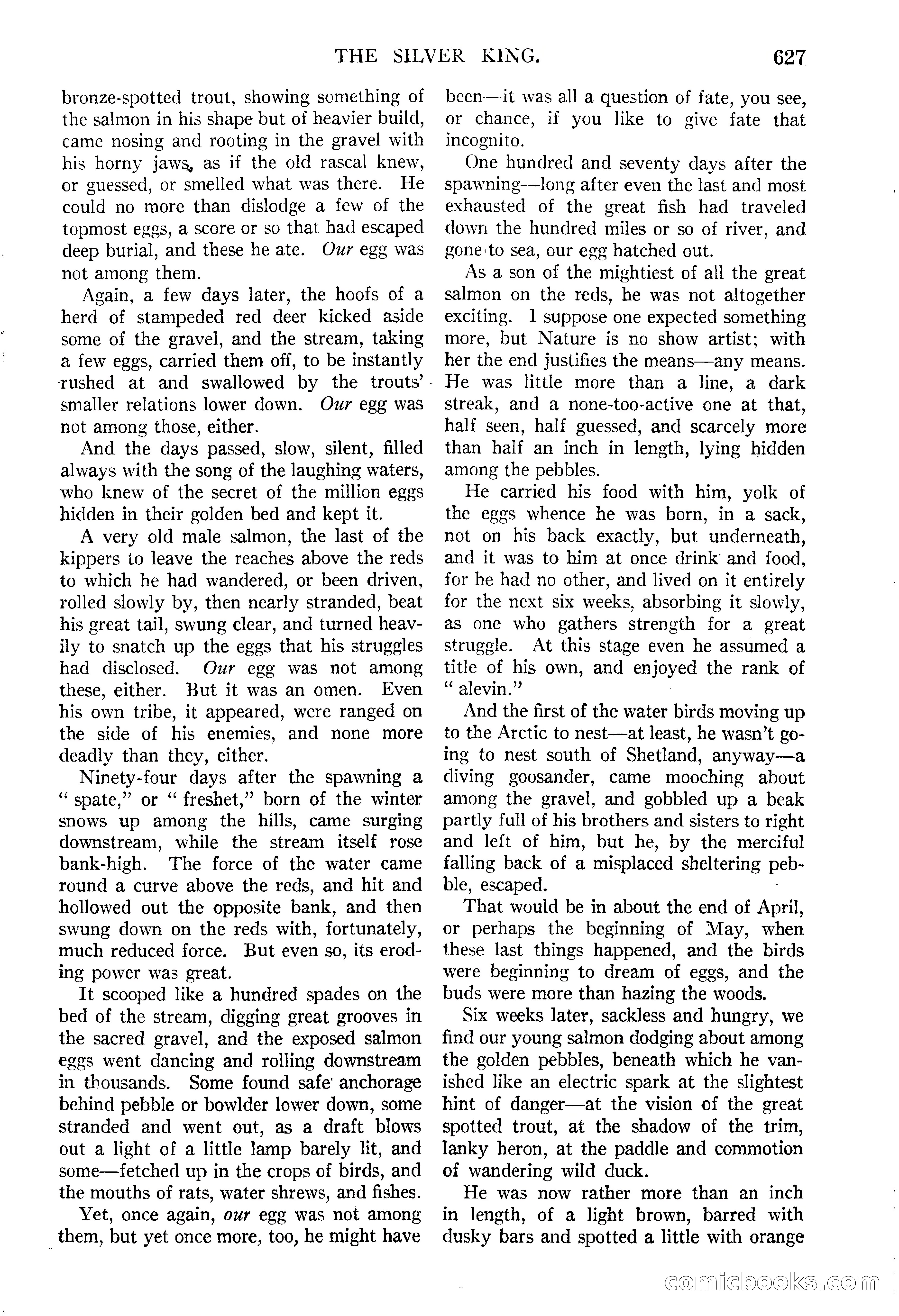
A restored page from Pulp Fiction, 1925. Page through the whole issue in the reader above.
📄 Transcribed text from this page (OCR, searchable)
Machine-transcribed from the original scan — historical spelling and the odd misread are preserved.
THE bronze-spotted trout, showing something of the salmon in his shape but of heavier build, came nosing and rooting in the gravel with his horny jaws, as if the old rascal knew, or guessed, or smelled what was there. He could no more than dislodge a few of the topmost eggs, a score or so that had escaped deep burial, and these he ate. Our egg was not among them. Again, a few days later, the hoofs of a herd of stampeded red deer kicked aside some of the gravel, and the stream, taking a few eggs, carried them off, to be instantly rushed at and swallowed by the trouts’- smaller relations lower down. Our egg was not among those, either. And the days passed, slow, silent, filled always with the song of the laughing waters, who knew of the secret of the million eggs hidden in their golden bed and kept it. A very old male salmon, the last of the kippers to leave the reaches above the reds to which he had wandered, or been driven, rolled slowly by, then nearly stranded, beat his great tail, swung clear, and turned heav- ily to snatch up the eggs that his struggles had disclosed. Our egg was not among these, either. But it was an omen. Even his own tribe, it appeared, were ranged on the side of his enemies, and none more deadly than they, either. Ninety-four days after the spawning a “ snate,” or ‘ freshet,” born of the winter snows up among the hills, came surging downstream, while the stream itself rose bank-high. The force of the water came round a curve above the reds, and hit and hollowed out the opposite bank, and then swung down on the reds with, fortunately, much reduced force. But even so, its erod- ing power was great. It scooped like a hundred spades on the bed of the stream, digging great grooves in the sacred gravel, and the exposed salmon eggs went dancing and rolling downstream in thousands. Some found safe’ anchorage behind pebble or bowlder lower down, some stranded and went out, as a draft blows out a light of a little lamp barely lit, and some—fetched up in the crops of birds, and the mouths of rats, water shrews, and fishes. Yet, once again, our egg was not among them, but yet once more, too, he might have SILVER KING. 627 been—it was all a question of fate, you see, or chance, if you like to give fate that incognito. One hundred and seventy days after the spawning-—long after even the last and most exhausted of the great fish had traveled down the hundred miles or so of river, and gone:to sea, our egg hatched out. As a son of the mightiest of all the great salmon on the reds, he was not altogether exciting. 1 suppose one expected something more, but Nature is no show artist; with her the end justifies the means—any means. He was little more than a line, a dark streak, and a none-too-active one at that, half seen, half guessed, and scarcely more than half an inch in length, lying hidden among the pebbles. He carried his food with him, yolk of the eggs whence he was born, in a sack, not on his back exactly, but underneath, and it was to him at once drink’ and food, for he had no other, and lived on it entirely for the next six weeks, absorbing it slowly, as one who gathers strength for a great struggle. At this stage even he assumed a title of his own, and enjoyed the rank of ‘ alevin.” And the first of the water birds moving up to the Arctic to nest—at least, he wasn’t go- ing to nest south of Shetland, anyway—a diving goosander, came mooching about among the gravel, and gobbled up a beak partly full of his brothers and sisters to right and left of him, but he, by the merciful falling back of a misplaced sheltering peb- ble, escaped. That would be in about the end of April, or perhaps the beginning of May, when these last things happened, and the birds were beginning to dream of eggs, and the buds were more than hazing the woods. Six weeks later, sackless and hungry, we find our young salmon dodging about among the golden pebbles, beneath which he van- ished like an electric spark at the slightest hint of danger—at the vision of the great spotted trout, at the shadow of the trim, lanky heron, at the paddle and commotion of wandering wild duck. He was now rather more than an inch in length, of a light brown, barred with dusky bars and spotted a little with orange COmiclboo SS CO