
Pulp Fiction, 1925 · page 157 of 170
Argosy All-Story Weekly, June 13, 1925 — page 157: what you’re looking at
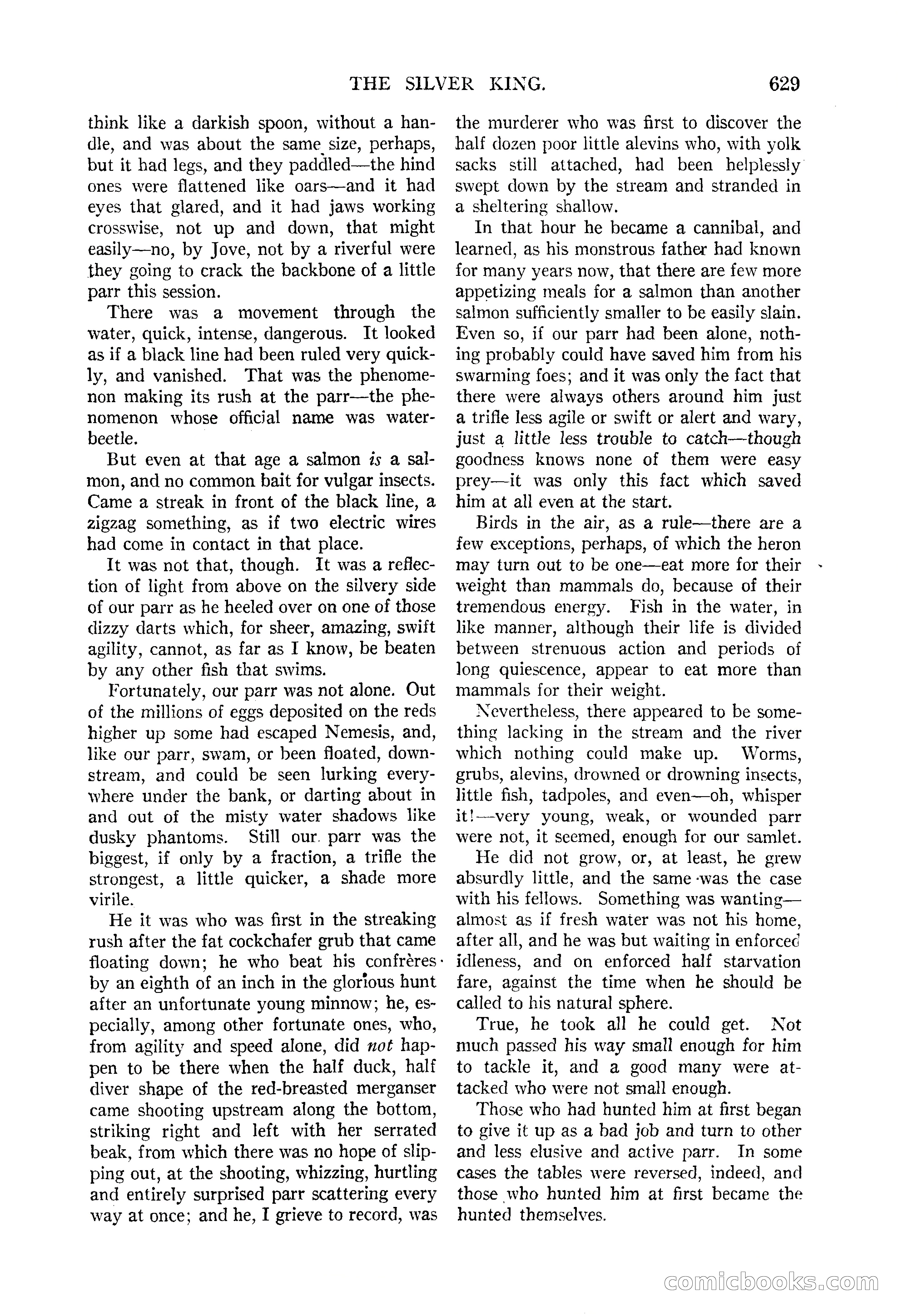
A restored page from Pulp Fiction, 1925. Page through the whole issue in the reader above.
📄 Transcribed text from this page (OCR, searchable)
Machine-transcribed from the original scan — historical spelling and the odd misread are preserved.
THE SILVER KING. think like a darkish spoon, without a han- die, and was about the same size, perhaps, but it had legs, and they paddled—the hind ones were flattened like oars—and it had eyes that glared, and it had jaws working crosswise, not up and down, that might easily—no, by Jove, not by a riverful were they going to crack the backbone of a little parr this session. There was a movement through the water, quick, intense, dangerous. It looked as if a black line had been ruled very quick- ly, and vanished. That was the phenome- non making its rush at the parr—the phe- nomenon whose official name was water- beetle. | | But even at that age a salmon 7s a sal- mon, and no common bait for vulgar insects. Came a streak in front of the black line, a zigzag something, as if two electric wires had come in contact in that place. It was not that, though. It was a reflec- tion of light from above on the silvery side of our parr as he heeled over on one of those dizzy darts which, for sheer, amazing, swift agility, cannot, as far as I know, be beaten by any other fish that swims. Fortunately, our parr was not alone. Out of the millions of eggs deposited on the reds higher up some had escaped Nemesis, and, like our parr, swam, or been floated, down- stream, and could be seen lurking every- where under the bank, or darting about in and out of the misty water shadows like dusky phantoms. Still our. parr was the biggest, if only by a fraction, a trifle the strongest, a little quicker, a shade more virile. He it was who was first in the streaking rush after the fat cockchafer grub that came floating down; he who beat his confreres- by an eighth of an inch in the glorious hunt after an unfortunate young minnow; he, es- pecially, among other fortunate ones, who, from agility and speed alone, did not hap- pen to be there when the half duck, halt diver shape of the red-breasted merganser came shooting upstream along the bottom, striking right and left with her serrated beak, from which there was no hope of slip- ping out, at the shooting, whizzing, hurtling and entirely surprised parr scattering every way at once; and he, I grieve to record, was 629 the murderer who was first to discover the half dozen poor little alevins who, with yolk sacks still attached, had been helplessly swept down by the stream and stranded in a sheltering shallow. In that hour he became a cannibal, and learned, as his monstrous father had known for many years now, that there are few more appetizing meals for a salmon than another salmon sufficiently smaller to be easily slain. Even so, if our parr had been alone, noth- ing probably could have saved him from his swarming foes; and it was only the fact that there were always others around him just a trifle less agile or swift or alert and wary, just a little less trouble to catch—-though goodness knows none of them were easy prey—it was only this fact which saved him at all even at the start. Birds in the air, as a rule—there are a few exceptions, perhaps, of which the heron may turn out to be one—eat more for their weight than mammals do, because of their tremendous energy. Fish in the water, in like manner, although their life is divided between strenuous action and periods of long quiescence, appear to eat more than mammals for their weight. Nevertheless, there appeared to be some- thing lacking in the stream and the river which nothing could make up. Worms, grubs, alevins, drowned or drowning insects, little fish, tadpoles, and even—oh, whisper it!—-very young, weak, or wounded parr were not, it seemed, enough for our samlet. He did not grow, or, at least, he grew absurdly little, and the same -was the case with his fellows. Something was wanting— almost as if fresh water was not his home, after all, and he was but waiting in enforcec idleness, and on enforced half starvation fare, against the time when he should be called to his natural sphere. True, he took all he could get. Not much passed his way small enough for him to tackle it, and a good many were at- tacked who were not small enough. Those who had hunted him at first began to give it up as a bad job and turn to other and less elusive and active parr. In some cases the tables were reversed, indeed, and those who hunted him at first became the hunted themselves. COMmiicloooe CO