
Pulp Fiction, 1925 · page 16 of 170
Argosy All-Story Weekly, June 13, 1925 — page 16: what you’re looking at
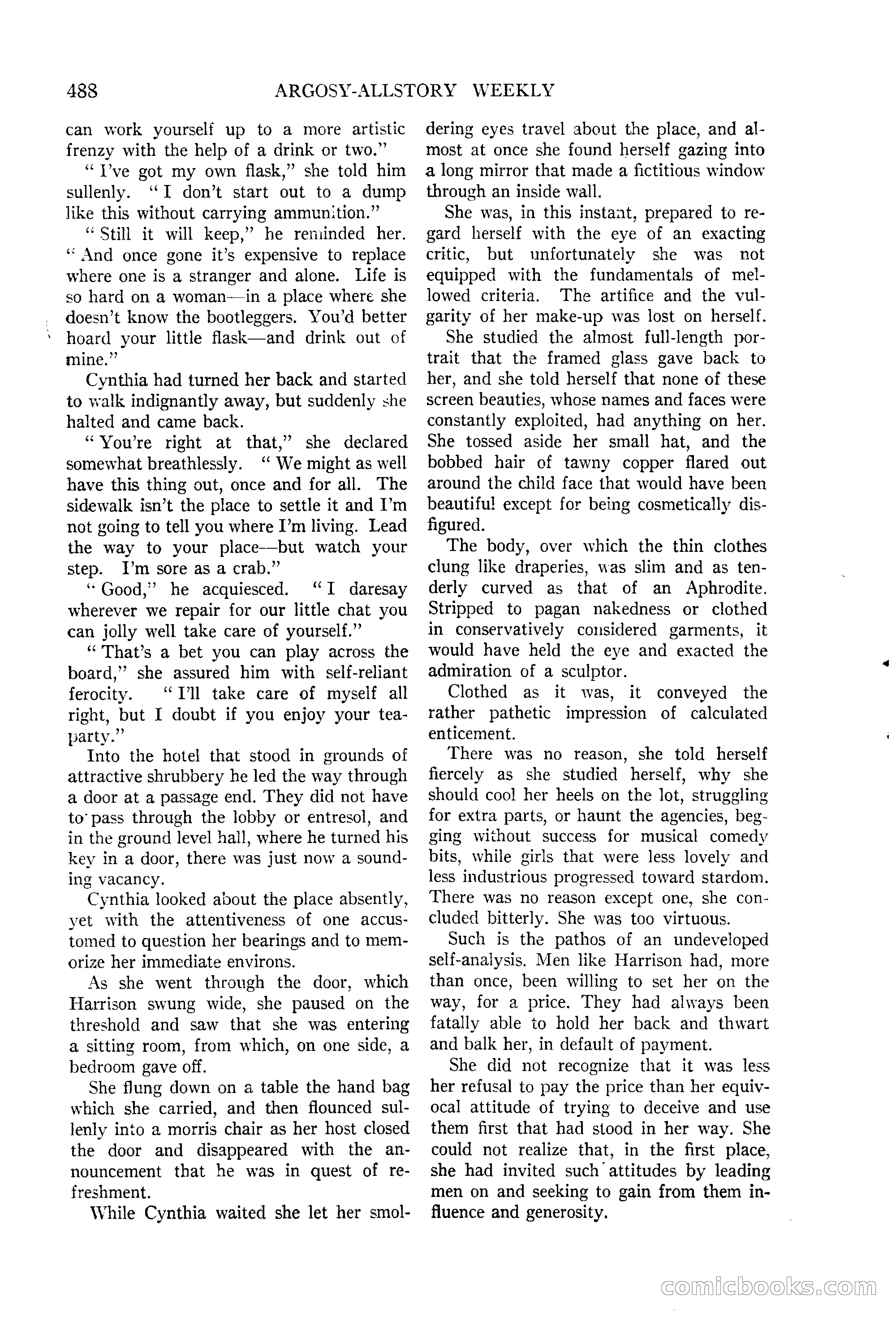
A restored page from Pulp Fiction, 1925. Page through the whole issue in the reader above.
📄 Transcribed text from this page (OCR, searchable)
Machine-transcribed from the original scan — historical spelling and the odd misread are preserved.
488 can work yourself up to a more artistic frenzy with the help of a drink or two.” “Vve got my own flask,” she told him sullenly. ‘“‘I don’t start out to a dump like this without carrying ammunition.” “ Still it will keep,” he reniinded her. ‘““ And once gone it’s expensive to replace where one is a stranger and alone. Life is so hard on a woman—in a place where she doesn’t know the bootleggers. You’d better hoard your little flask—and drink out of mine.” Cynthia had turned her back and started to walk indignantly away, but suddenly she halted and came back. “You're right at that,” she declared somewhat breathlessly. ‘“‘ We might as well have this thing out, once and for all. The sidewalk isn’t the place to settle it and I’m not going to tell you where I’m living. Lead the way to your place—but watch your step. I’m sore as a crab.” “ Good,” he acquiesced. wherever we repair for our little chat you can jolly well take care of yourself.” “That’s a bet you can play across the board,” she assured him with self-reliant ferocity. ‘Dll take care of myself all right, but I doubt if you enjoy your tea- party.” Into the hotel that stood in grounds of attractive shrubbery he led the way through a door at a passage end. They did not have to’ pass through the lobby or entresol, and in the ground level hall, where he turned his key in a door, there was just now a sound- ing vacancy. Cynthia looked about the place absently, yet with the attentiveness of one accus- tomed to question her bearings and to mem- orize her immediate environs. As she went through the door, which Harrison swung wide, she paused on the threshold and saw that she was entering a sitting room, from which, on one side, a bedroom gave off. She flung down on a table the hand bag which she carried, and then flounced sul- lenly into a morris chair as her host closed the door and disappeared with the an- nouncement that he was in quest of re- freshment. While Cynthia waited she let her smol- ARGOSY-ALLSTORY “TI daresay | WEEKLY dering eyes travel about the place, and al- most at once she found herself gazing into a long mirror that made a fictitious window through an inside wall. She was, in this instant, prepared to re- gard herself with the eye of an exacting critic, but unfortunately she was not equipped with the fundamentals of mel- lowed criteria. The artifice and the vul- garity of her make-up was lost on herself. She studied the almost full-length por- trait that the framed glass gave back to her, and she told herself that none of these screen beauties, whose names and faces were constantly exploited, had anything on her. She tossed aside her small hat, and the bobbed hair of tawny copper flared out around the child face that would have been beautiful except for being cosmetically dis- figured. The body, over which the thin clothes clung like draperies, was slim and as ten- derly curved as that of an Aphrodite. Stripped to pagan nakedness or clothed in conservatively considered garments, it would have held the eye and exacted the admiration of a sculptor. Clothed as it was, it conveyed the rather pathetic impression of calculated enticement. There was no reason, she told herself fiercely as she studied herself, why she should cool her heels on the lot, struggling for extra parts, or haunt the agencies, beg- ging without success for musical comedy bits, while girls that were less lovely and less industrious progressed toward stardom. There was no reason except one, she con- cluded bitterly. She was too virtuous. Such is the pathos of an undeveloped self-analysis. Men like Harrison had, more than once, been willing to set her on the way, for a price. They had always been fatally able to hold her back and thwart and balk her, in default of payment. She did not recognize that it was less her refusal to pay the price than her equiv- ocal attitude of trying to deceive and use them first that had stood in her way. She could not realize that, in the first place, she had invited such attitudes by leading men on and seeking to gain from them in- fluence and generosity. CO comicaooks