
Pulp Fiction, 1925 · page 19 of 170
Argosy All-Story Weekly, June 13, 1925 — page 19: what you’re looking at
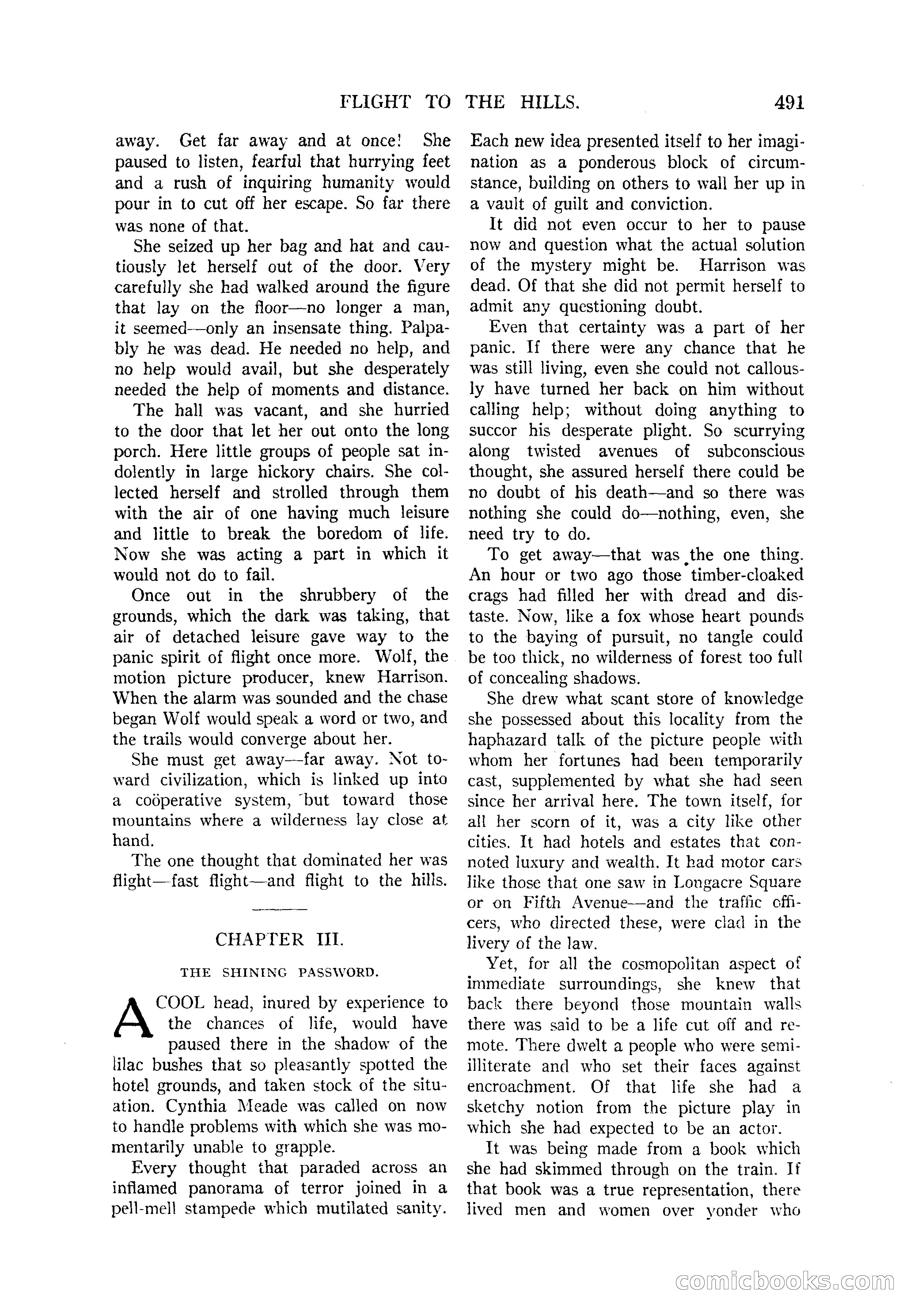
A restored page from Pulp Fiction, 1925. Page through the whole issue in the reader above.
📄 Transcribed text from this page (OCR, searchable)
Machine-transcribed from the original scan — historical spelling and the odd misread are preserved.
FLIGHT TO away. Get far away and at once! She paused to listen, fearful that hurrying feet and a rush of inquiring humanity would pour in to cut off her escape. So far there was none of that. She seized up her bag and hat and cau- tiously let herself out of the door. Very carefully she had walked around the figure that lay on the floor—no longer a man, it seemed—only an insensate thing. Palpa- bly he was dead. He needed no help, and no help would avail, but she desperately needed the help of moments and distance. The hall was vacant, and she hurried to the door that let her out onto the long porch. Here little groups of people sat in- dolently in large hickory chairs. She col- lected herself and strolled through them with the air of one having much leisure and little to break the boredom of life. Now she was acting a part in which it would not do to fail. Once out in the shrubbery of the grounds, which the dark was taking, that air of detached leisure gave way to the panic spirit of flight once more. Wolf, the. motion picture producer, knew Harrison. When the alarm was sounded and the chase began Wolf would speak a word or two, and the trails would converge about her. She must get away--far away. Not to- ward civilization, which is linked up into a cooperative system, ‘but toward those mountains where a wilderness lay close at hand. The one thought that dominated her was flight—fast flight—and flight to the hills. CHAPTER III. THE SHINING PASSWORD. COOL head, inured by experience to the chances of life, would have paused there in the shadow of the lilac bushes that so pleasantly spotted the hotel grounds, and taken stock of the situ- ation. Cynthia Meade was called on now to handle problems with which she was mo- mentarily unable to grapple. Every thought that paraded across an inflamed panorama of terror joined in a pell-mell stampede which mutilated sanity. THE HILOS. A491 Each new idea presented itself to her imagi- nation as a ponderous block of circum- stance, building on others to wall her up in a vault of guilt and conviction. It did not even occur to her to pause now and question what the actual solution of the mystery might be. Harrison was dead. Of that she did not permit herself to admit any questioning doubt. Even that certainty was a part of her panic. If there were any chance that he was still living, even she could not callous- ly have turned her back on him without calling help; without doing anything to succor his desperate plight. So scurrying along twisted avenues of subconscious thought, she assured herself there could be no doubt of his death—and so there was nothing she could do—nothing, even, she need try to do. To get away—that was the one thing. An hour or two ago those timber-cloaked crags had filled her with dread and dis- taste. Now, like a fox whose heart pounds to the baying of pursuit, no tangle could be too thick, no wilderness of forest too full of concealing shadows. She drew what scant store of knowledge she possessed about this locality from the haphazard talk of the picture people with whom her fortunes had been temporarily cast, supplemented by what she had seen since her arrival here. The town itself, for all her scorn of it, was a city like other cities. It had hotels and estates that con- noted luxury and wealth. It had motor cars like those that one saw in Longacre Square or on Fifth Avenue—and the traffic cffi- cers, who directed these, were clad in the livery of the law. Yet, for all the cosmopolitan aspect of immediate surroundings, she knew that back there beyond those mountain walls there was said to be a life cut off and re- mote. There dwelt a people who were semi- illiterate and who set their faces against encroachment. Of that life she had a sketchy notion from the picture play in which she had expected to be an actor. {It was being made from a book which she had skimmed through on the train. If that book was a true representation, there lived men and women over yonder who An (A) (© ElOOOlK