
Pulp Fiction, 1925 · page 45 of 170
Argosy All-Story Weekly, June 13, 1925 — page 45: what you’re looking at
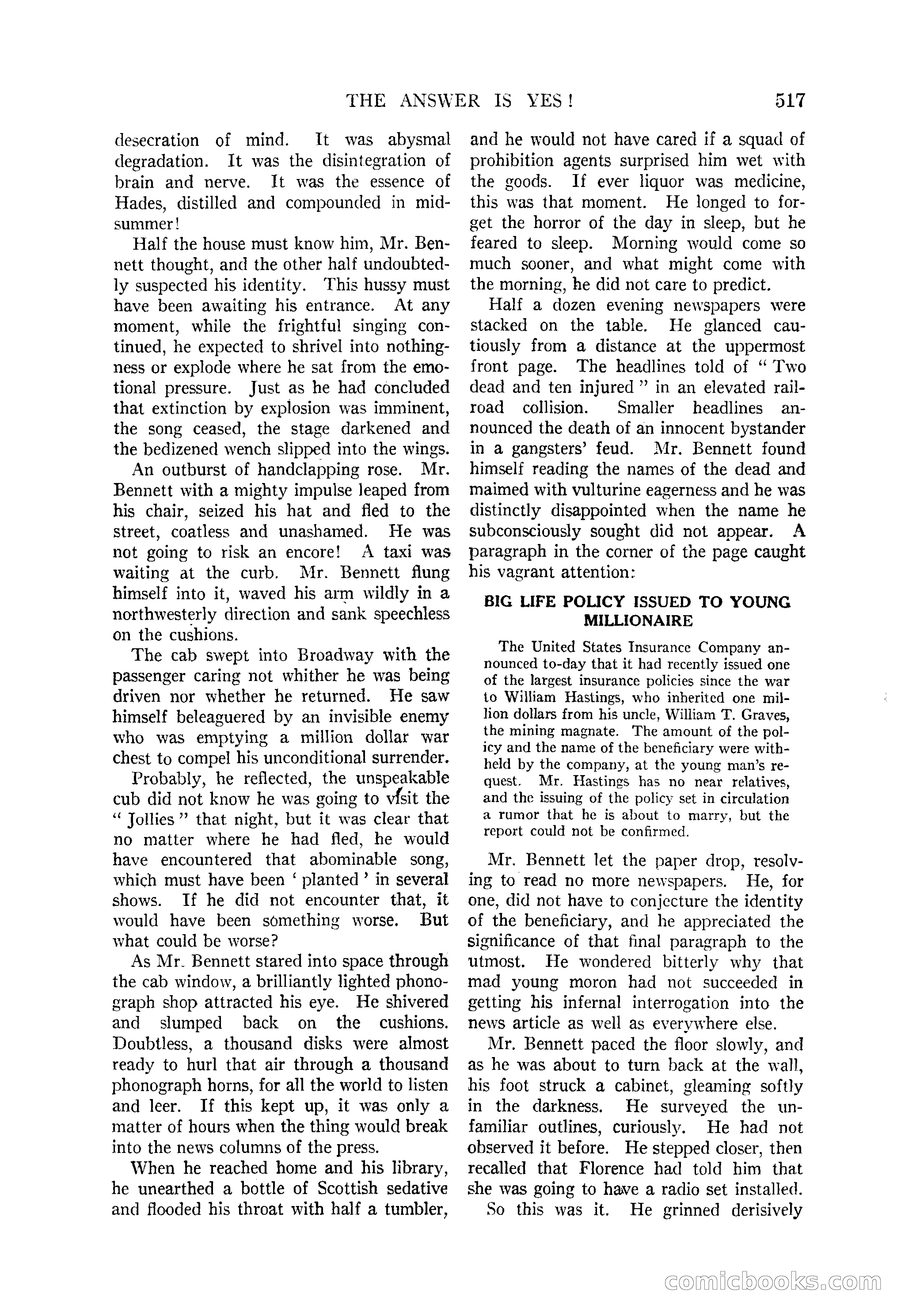
A restored page from Pulp Fiction, 1925. Page through the whole issue in the reader above.
📄 Transcribed text from this page (OCR, searchable)
Machine-transcribed from the original scan — historical spelling and the odd misread are preserved.
THE desecration of mind. It was abysmal degradation. It was the disintegration of brain and nerve. It was the essence of Hades, distilled and compounded in mid- summer! Half the house must know him, Mr. Ben- nett thought, and the other half undoubted- ly suspected his identity. This hussy must have been awaiting his entrance. At any moment, while the frightful singing con- tinued, he expected to shrivel into nothing- ness or explode where he sat from the emo- tional pressure. Just as he had concluded that extinction by explosion was imminent, the song ceased, the stage darkened and the bedizened wench slipped into the wings. An outburst of handclapping rose. Mr. Bennett with a mighty impulse leaped from his chair, seized his hat and fled to the Street, coatless and unashamed. He was not going to risk an encore! A taxi was waiting at the curb. Mr. Bennett flung himself into it, waved his arm wildly in a northwesterly direction and sank speechless on the cushions. The cab swept into Broadway with the passenger caring not whither he was being driven nor whether he returned. He saw himself beleaguered by an invisible enemy who was emptying a million dollar war chest to compel his unconditional surrender. Probably, he reflected, the unspeakable cub did not know he was going to visit the “ Jollies ” that night, but it was clear that no matter where he had fled, he would have encountered that abominable song, which must have been ‘ planted’ in several shows. If he did not encounter that, it would have been something worse. But what could be worse? As Mr. Bennett stared into space through the cab window, a brilliantly lighted phono- eraph shop attracted his eye. He shivered and slumped back on the cushions. Doubtless, a thousand disks were almost ready to hurl that air through a thousand phonograph horns, for all the world to listen and leer. If this kept up, it was only a matter of hours when the thing would break into the news columns of the press. When he reached home and his library, he unearthed a bottle of Scottish sedative and flooded his throat with half a tumbler, ANSWER IS YES! OL7 and he would not have cared if a squad of prohibition agents surprised him wet with the goods. If ever liquor was medicine, this was that moment. He longed to for- get the horror of the day in sleep, but he feared to sleep. Morning would come so much sooner, and what might come with the morning, he did not care to predict. Half a dozen evening newspapers were stacked on the table. He glanced cau- tiously from a distance at the uppermost front page. The headlines told of “ Two dead and ten injured ” in an elevated rail- road collision. Smaller headlines an- nounced the death of an innocent bystander in a gangsters’ feud. Mr. Bennett found himself reading the names of the dead and maimed with vulturine eagerness and he was distinctly disappointed when the name he subconsciously sought did not appear. A paragraph in the corner of the page caught his vagrant attention: BIG LIFE POLICY ISSUED TO YOUNG MILLIONAIRE The United States Insurance Company an- nounced to-day that it had recently issued one of the largest insurance policies since the war to William Hastings, who inherited one mil- hon dollars from his uncle, William T. Graves, the mining magnate. The amount of the pol- icy and the name of the beneficiary were with- held by the company, at the young man’s re- quest. Mr. Hastings has no near relatives, and the issuing of the policy set in circulation a rumor that he is about to marry, but the report could not be confirmed. Mr. Bennett let the paper drop, resolv- ing to read no more newspapers. He, for one, did not have to conjecture the identity of the beneficiary, and he appreciated the significance of that final paragraph to the utmost. He wondered bitterly why that mad young moron had not succeeded in getting his infernal interrogation into the news article as well as everywhere else. Mr. Bennett paced the floor slowly, and as he was about to turn back at the wall, his foot struck a cabinet, gleaming softly in the darkness. He surveyed the un- familiar outlines, curiously. He had not observed it before. He stepped closer, then recalled that Florence had told him that she was going to have a radio set installed. So this was it. He grinned derisively A (CCO)INN OO) S (C(O)