
Pulp Fiction, 1925 · page 86 of 170
Argosy All-Story Weekly, June 13, 1925 — page 86: what you’re looking at
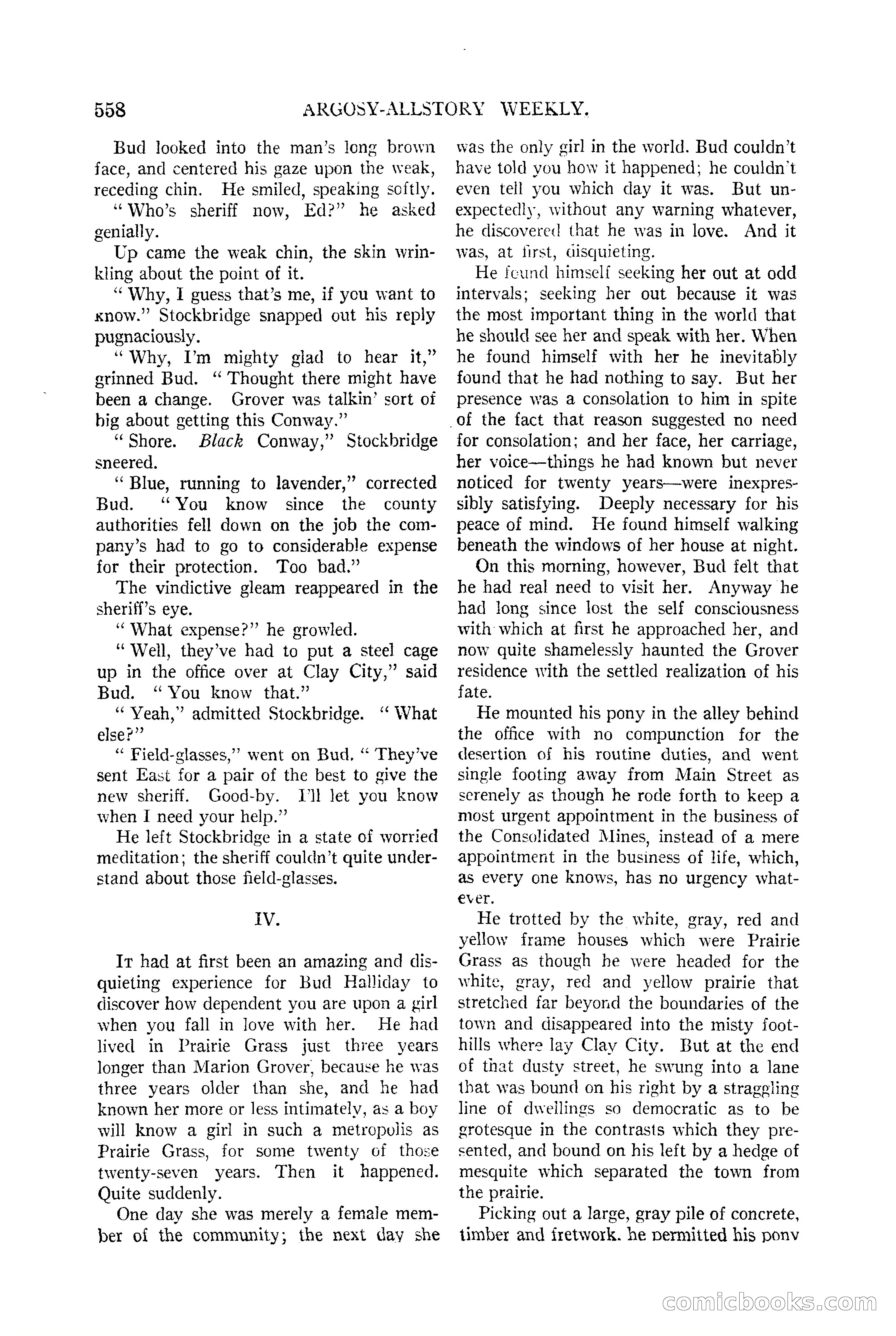
A restored page from Pulp Fiction, 1925. Page through the whole issue in the reader above.
📄 Transcribed text from this page (OCR, searchable)
Machine-transcribed from the original scan — historical spelling and the odd misread are preserved.
d08 Bud looked into the man’s long brown face, and centered his gaze upon the weak, receding chin. He smiled, speaking scftly. ‘“Who’s sheriff now, Ed?” he asked genially. Up came the weak chin, the skin wrin- kling about the point of it. “Why, I guess that’s me, if you want to xnow.” Stockbridge snapped out his reply pugnaciously. “Why, I’m mighty glad to hear it,” erinned Bud. “ Thought there might have been a change. Grover was talkin’ sort of big about getting this Conway.” “Shore. Black Conway,” Stockbridge sneered. ‘Blue, running to lavender,” corrected Bud. ‘“ You know since the county authorities fell down on the job the com- pany’s had to go to considerable expense for their protection. Too bad.” The vindictive gleam reappeared in the sheriff’s eye. ‘“ What expense?” he growled. ‘Well, they’ve had to put a steel cage up in the office over at Clay City,” said Bud. “ You know that.” ‘* Yeah,” admitted Stockbridge. ‘‘ What else?”’ “ Field-glasses,”” went on Bud. “ They’ve sent East for a pair of the best to give the new sheriff. Good-by. I'll let you know when I need your help.” He left Stockbridge in a state of worried meditation; the sheriff couldn’t quite under- stand about those field-glasses. IV. It had at first been an amazing and dis- quieting experience for Bud Halliday to discover how dependent you are upon a girl when you fall in love with her. He had lived in Prairie Grass just three years longer than Marion Grover, because he was three years older than she, and he had known her more or less intimately, as a boy will know a girl in such a metropolis as Prairie Grass, for some twenty of those twenty-seven years. Then it happened. Quite suddenly. One day she was merely a female mem- ber of the community; the next day she ARGOSY-ALLSTORY WEEKLY. was the only girl in the world. Bud couldn’t have told you how it happened; he couldn’t even tell you which day it was. But un- expectedly, without any warning whatever, he discovered that he was in love. And it was, at first, aisquieting. He fcund himself seeking her out at odd intervals; seeking her out because it was the most important thing in the world that he should see her and speak with her. When he found himself with her he inevitably found that he had nothing to say. But her presence was a consolation to him in spite of the fact that reason suggested no need for consolation; and her face, her carriage, her voice—things he had known but never noticed for twenty years—were inexpres- sibly satisfying. Deeply necessary for his peace of mind. He found himself walking beneath the windows of her house at night. On this morning, however, Bud felt that he had real need to visit her. Anyway he had long since lost the self consciousness with which at first he approached her, and now quite shamelessly haunted the Grover residence with the settled realization of his fate. He mounted his pony in the alley behind the office with no compunction for the desertion of his routine duties, and went single footing away from Main Street as serenely as though he rode forth to keep a most urgent appointment in the business of the Consolidated Mines, instead of a mere appointment in the business of life, which, as every one knows, has no urgency what- ever. He trotted by the white, gray, red and yellow frame houses which were Prairie Grass as though he were headed for the white, gray, red and yellow prairie that stretched far beyond the boundaries of the town and disappeared into the misty foot- hills where lay Clay City. But at the end of that dusty street, he swung into a lane that was bound on his right by a strageling line of dweilings so democratic as to be grotesque in the contrasts which they pre- sented, and bound on his left by a hedge of mesquite which separated the town from the prairie. Picking out a large, gray pile of concrete, timber and fretwork. he permitted his ponv C@ Cc DOOKS C@