
Pulp Fiction, 1925 · page 99 of 170
Argosy All-Story Weekly, June 13, 1925 — page 99: what you’re looking at
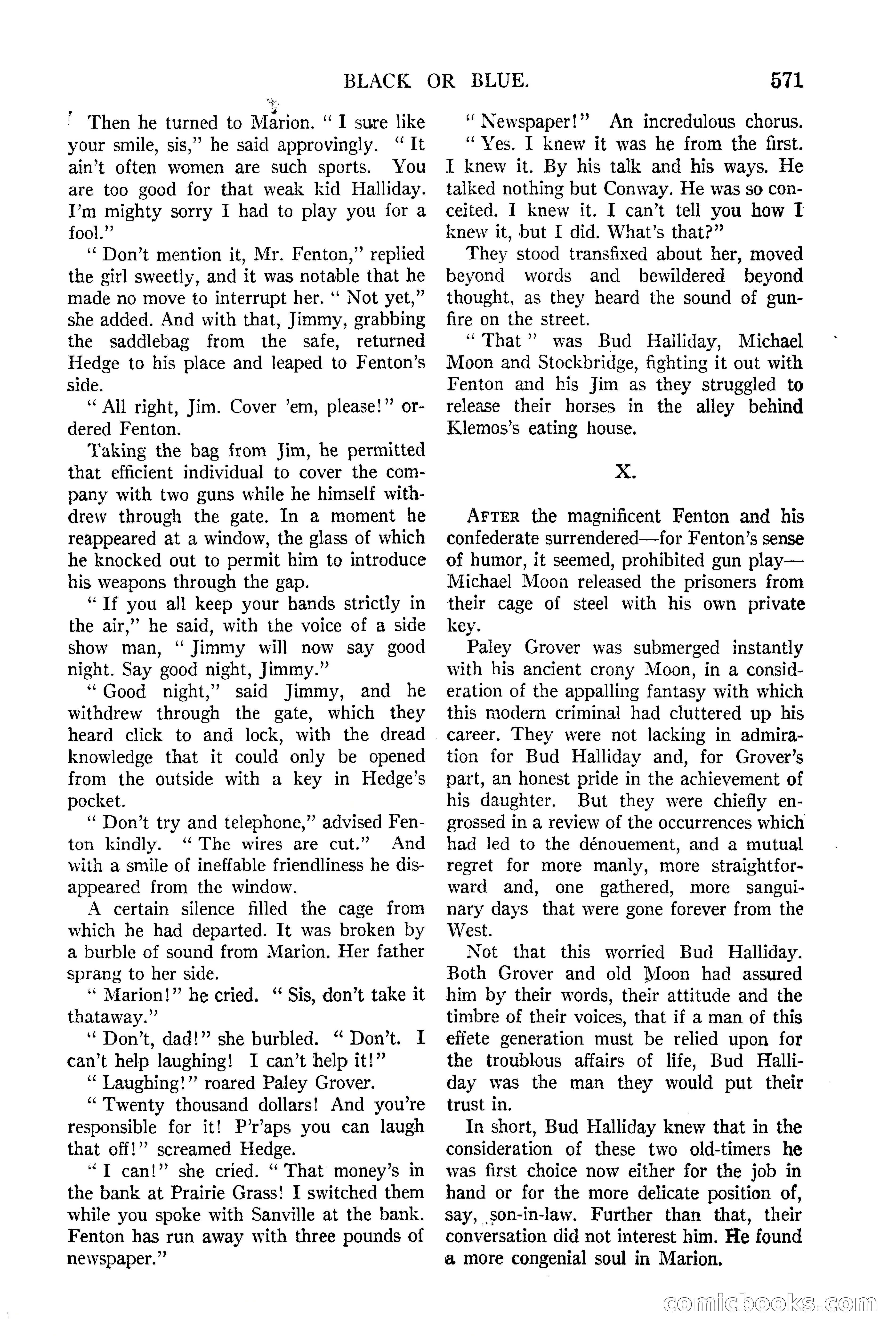
A restored page from Pulp Fiction, 1925. Page through the whole issue in the reader above.
📄 Transcribed text from this page (OCR, searchable)
Machine-transcribed from the original scan — historical spelling and the odd misread are preserved.
BLACK OR BLUE. " Then he turned to Marion. “I sure like your smile, sis,”’ he said approvingly. “ It ain’t often women are such sports. You are too good for that weak kid Halliday. I’m mighty sorry I had to play you for a fool.” ‘Don’t mention it, Mr. Fenton,” replied the girl sweetly, and it was notable that he made no move to interrupt her. ‘“‘ Not yet,” she added. And with that, Jimmy, grabbing the saddlebag from the safe, returned Hedge to his place and leaped to Fenton’s side. “All right, Jim. Cover ’em, please!”’ or- dered Fenton. Taking the bag from Jim, he permitted that efficient individual to cover the com- pany with two guns while he himself with- drew through the gate. In a moment he reappeared at a window, the glass of which he knocked out to permit him to introduce his weapons through the gap. “Tf you all keep your hands strictly in the air,” he said, with the voice of a side show man, “ Jimmy will now say good night. Say good night, Jimmy.” “Good night,’ said Jimmy, and he withdrew through the gate, which they heard click to and lock, with the dread . knowledge that it could only be opened from the outside with a key in Hedge’s pocket. ‘Don’t try and telephone,” advised Fen- ton kindly. ‘“ The wires are cut.” And with a smile of ineffable friendliness he dis- appeared from the window. A certain silence filled the cage from which he had departed. It was broken by a burble of sound from Marion. Her father sprang to her side. “Marion!” he cried. ‘ Sis, don’t take it thataway.” ‘Don’t, dad!” she burbled. “ Don’t. I can’t help laughing! I can’t help it!” ‘“ Laughing!” roared Paley Grover. “Twenty thousand dollars! And you’re responsible for it! P’r’aps you can laugh that off!’ screamed Hedge. “T can!” she cried. “ That money’s in the bank at Prairie Grass! I switched them while you spoke with Sanville at the bank. Fenton has run away with three pounds of newspaper.”’ oll “Newspaper!” An incredulous chorus. “ Ves. I knew it was he from the first. I knew it. By his talk and his ways. He talked nothing but Conway. He was so con- ceited. I knew it. I can’t tell you how f knew it, but I did. What’s that?” They stood transfixed about her, moved beyond words and bewildered beyond thought, as they heard the sound of gun- fire on the street. “That” was Bud Halliday, Michael Moon and Stockbridge, fighting it out with Fenton and his Jim as they struggled to release their horses in the alley behind Klemos’s eating house. X. AFTER the magnificent Fenton and his confederate surrendered—for Fenton’s sense of humor, it seemed, prohibited gun play— Michael Moon released the prisoners from their cage of steel with his own private key. Paley Grover was submerged instantly with his ancient crony Moon, in a consid- eration of the appalling fantasy with which this modern criminal had cluttered up his career. They were not lacking in admira- tion for Bud Halliday and, for Grover’s part, an honest pride in the achievement of his daughter. But they were chiefly en- grossed in a review of the occurrences which had led to the dénouement, and a mutual regret for more manly, more straightfor- ward and, one gathered, more sangui- nary days that were gone forever from the West. Not that this worried Bud Halliday. Both Grover and old Moon had assured him by their words, their attitude and the timbre of their voices, that if a man of this effete generation must be relied upon for the troublous affairs of life, Bud Halli- day was the man they would put their trust in. | In short, Bud Halliday knew that in the consideration of these two old-timers he was first choice now either for the job in hand or for the more delicate position of, say, son-in-law. Further than that, their conversation did not interest him. He found a more congenial soul in Marion. CORmiclboo S CO