
Pulp Fiction, 1925 · page 11 of 168
Argosy All-Story Weekly, June 27, 1925 — page 11: what you’re looking at
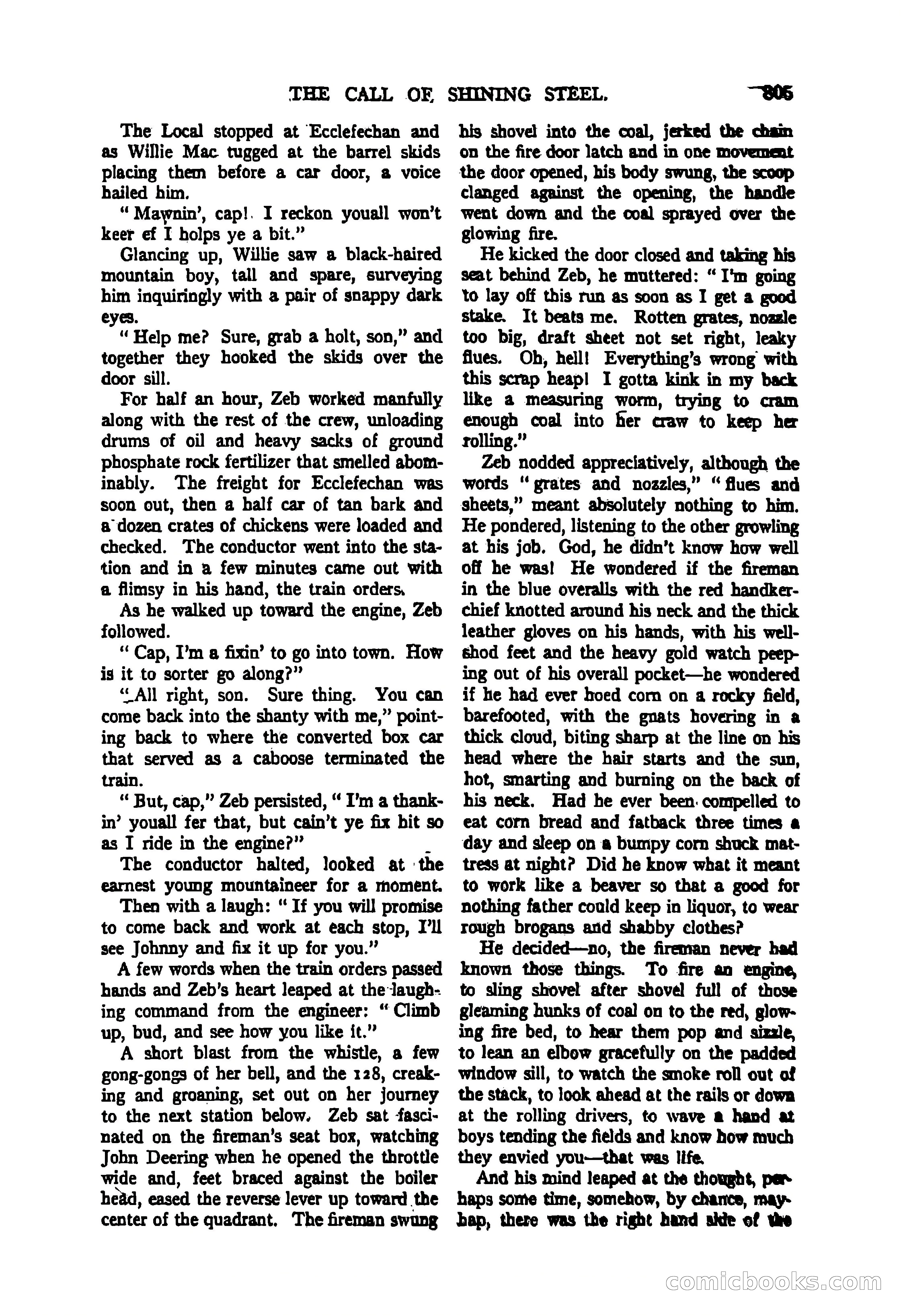
A restored page from Pulp Fiction, 1925. Page through the whole issue in the reader above.
📄 Transcribed text from this page (OCR, searchable)
Machine-transcribed from the original scan — historical spelling and the odd misread are preserved.
THE CALL OF SHINING STEEL. The Local stopped at Ecclefechan and as Willie Mac tugged at the barrel skids placing them before a car door, a voice hailed him. “ Mawnin’, cap!. I reckon youall won’t keer ef I holps ye a bit.” Glancing up, Willie saw a black-haired mountain boy, tall and spare, surveying him inquiringly with a pair of snappy dark eyes. e Help me? Sure, grab a holt, son,” and together they hooked the skids over the door sill. For half an hour, Zeb worked manfully along with the rest of the crew, unloading drums of oil and heavy sacks of ground phosphate rock fertilizer that smelled abom- inably. The freight for Ecclefechan was soon out, then a half car of tan bark and a dozen crates of chickens were loaded and checked. The conductor went into the sta- tion and in a few minutes came out with a flimsy in his hand, the train orders, As he walked up toward the engine, Zeb followed. “ Cap, I’m a fixin’ to go into town. How is it to sorter go along?” “‘All right, son. Sure thing. You can come back into the shanty with me,” point- ing back to where the converted box car that served as a caboose terminated the train. “ But, cap,” Zeb persisted, “ I'm a thank- in’? youall fer that, but cain’t ye fix bit so as I ride in the engine?” ; The conductor halted, looked at the earnest young mountaineer for a moment. Then with a laugh: “ If you will promise to come back and work at each stop, I'll see Johnny and fix it up for you.” A few words when the train orders passed hands and Zeb’s heart leaped at the Jaugh- ing command from the engineer: “ Climb up, bud, and see how you like it.” A short blast from the whistle, a few gong-gongs of her bell, and the 128, creak- ing and groaning, set out on her journey to the next station below. Zeb sat fasci- nated on the fireman’s seat box, watching John Deering when he opened the throttle wide and, feet braced against the boiler head, eased the reverse lever up toward the center of the quadrant. The fireman swung “B05 his shovel into the coal, jerked the cham on the fire door latch and in one movement the door opened, his body swung, the scoop clanged against the opening, the handle went down and the coal sprayed over the glowing fire. He kicked the door closed and taking his seat behind Zeb, he muttered: “ I'm going to lay off this run as soon as I get a good stake. It beats me. Rotten grates, nozzle too big, draft sheet not set right, leaky flues. Oh, hell! Everything’s wrong with this scrap heap! I gotta kink in my back like a measuring worm, trying to cram enough coal into her craw to keep her rolling.” Zeb nodded appreciatively, although the words “grates and nozzles,” “flues and sheets,” meant absolutely nothing to him. He pondered, listening to the other growling at his job. God, he didn’t know how well off he was! He wondered if the fireman in the blue overalls with the red handker- chief knotted around his neck and the thick leather gloves on his hands, with his well- shod feet and the heavy gold watch peep- ing out of his overall pocket—he wondered if he had ever hoed com on a rocky field, barefooted, with the gnats hovering in a thick cloud, biting sharp at the line on his head where the hair starts and the sun, hot, smarting and burning on the back of his neck. Had he ever been. compelled to eat corn bread and fatback three times a day and sleep on a bumpy corn shuck mat- tress at night? Did he know what it meant to work like a beaver so that a good for nothing father could keep in liquor, to wear rough brogans ard shabby clothes? He decided—no, the fireman never had known those things. To fire an engine, to sling shovel after shovel full of those gleaming hunks of coal on to the red, glow- ing fire bed, to hear them pop and sizzle, to lean an elbow gracefully on the padded window sill, to watch the smoke roll out af the stack, to look ahead at the rails or down at the rolling drivers, to wave a hand at boys tending the fields and know how much they envied you—that was life. And his mind leaped at the thought, per haps some time, somehow, by chance, may- bap, there was the right hand ake of the COnniEaoo () SS Co