
Pulp Fiction, 1925 · page 119 of 168
Argosy All-Story Weekly, June 27, 1925 — page 119: what you’re looking at
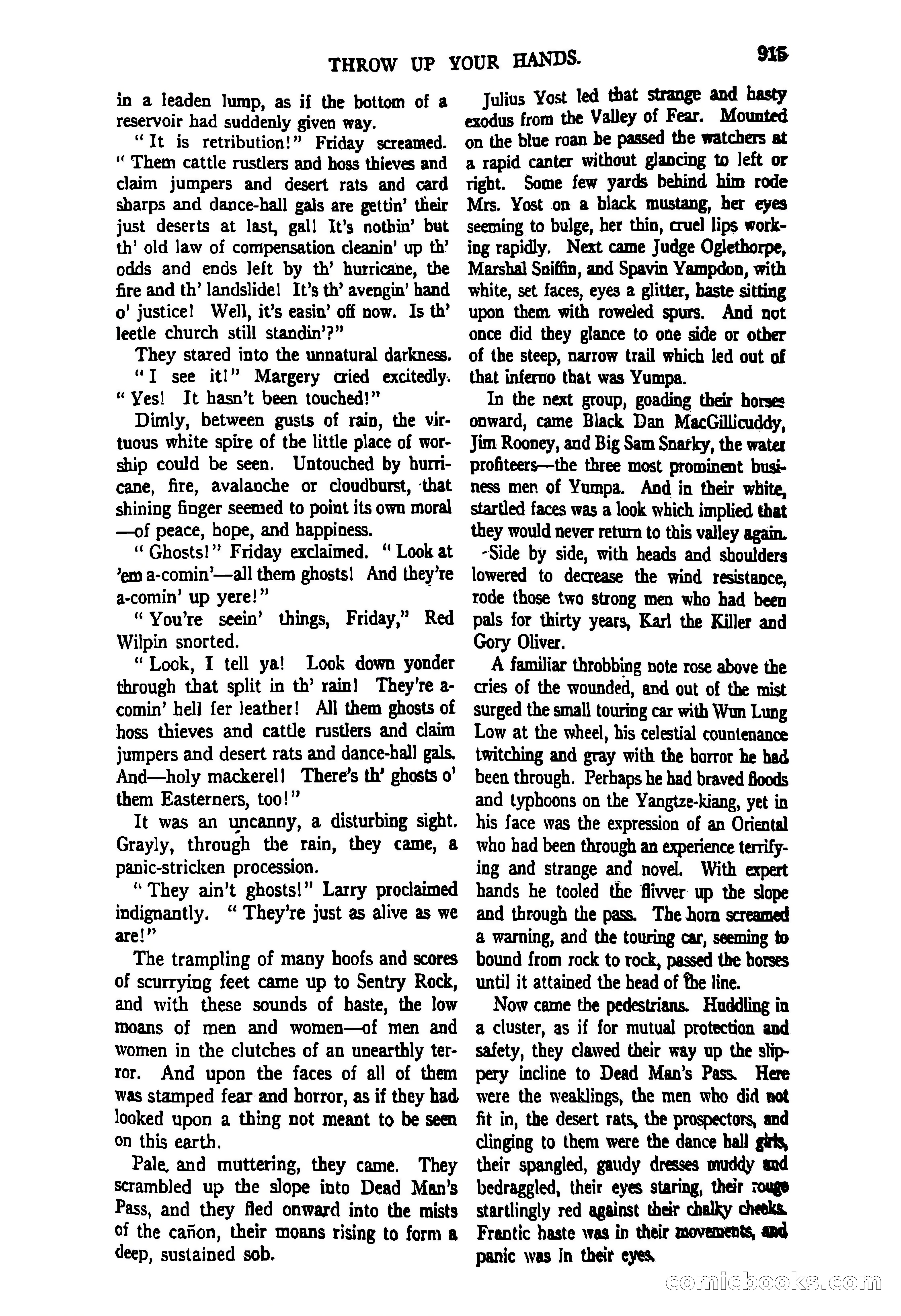
A restored page from Pulp Fiction, 1925. Page through the whole issue in the reader above.
📄 Transcribed text from this page (OCR, searchable)
Machine-transcribed from the original scan — historical spelling and the odd misread are preserved.
THROW UP YOUR HANDS. in a leaden lump, as if the bottom of a reservoir had suddenly given way. ‘It is retribution!” Friday screamed. ‘Them cattle rustlers and hoss thieves and claim jumpers and desert rats and card sharps and dance-hall gals are gettin’ their just deserts at last, gal! It’s nothin’ but th’ old law of compensation cleanin’ up th’ odds and ends left by th’ hurricane, the fire and th’ landslide! It’s th’ avengin’ hand o' justice! Well, it’s easin’ off now. Is th’ leetle church still standin’?” They stared into the unnatural darkness. “T see itl” Margery cried excitedly. “Yes! It hasn’t been touched!” Dimly, between gusts of rain, the vir- tuous white spire of the little place of wor- ship could be seen. Untouched by hum- cane, fire, avalanche or cloudburst, ‘that shining finger seemed to point its own moral —of peace, hope, and happiness. “Ghosts!” Friday exclaimed. ‘“ Look at ’em a-comin’—all them ghosts! And they’re a-comin’ up yere!” “You're seein’ things, Friday,” Red Wilpin snorted. “Look, I tell ya! Look down yonder through that split in th’ rain! They’re a- comin’ hell fer leather! All them ghosts of hoss thieves and cattle rustlers and claim jumpers and desert rats and dance-hall gals. And—holy mackerel! There’s th’ ghosts o! them Easterners, too!” It was an uncanny, a disturbing sight. Grayly, through the rain, they came, a panic-stricken procession. “They ain’t ghosts!” Larry proclaimed indignantly. ‘‘ They’re just as alive as we are!” The trampling of many hoofs and scores of scurrying feet came up to Sentry Rock, and with these sounds of haste, the low moans of men and women—of men and women in the clutches of an unearthly ter- ror. And upon the faces of all of then was stamped fear and horror, as if they had looked upon a thing not meant to be seen on this earth. Pale, and muttering, they came. They Scrambled up the slope into Dead Man’s Pass, and they fled onward into the mists of the cafion, their moans rising to form a deep, sustained sob. 916 Julius Yost led that strange and hasty exodus from the Valley of Fear. Mounted on the blue roan be passed the watchers at right. Some few yards behind him rode Mrs. Yost on a black mustang, her eyes seeming to bulge, her thin, cruel lips work- ing rapidly. Next came Judge Oglethorpe, Marshal Sniffin, and Spavin Yampdon, with white, set faces, eyes 2 glitter, haste sitting upon them with roweled spurs. And not once did they glance to one side or other of the steep, narrow trail which led out of that inferno that was Yumpa. In the next group, goading their horses onward, came Black Dan MacGillicuddy, Jim Rooney, and Big Sam Snarky, the water profiteers—the three most prominent busi- ness men of Yumpa. And in their white, startled faces was a look which implied that they would never return to this valley again. “Side by side, with heads and shoulders lowered to decrease the wind resistance, rode those two strong men who had been pals for thirty years, Karl the Killer and Gory Oliver. A familiar throbbing note rose above the cries of the wounded, and out of the mist surged the small touring car with Wun Lung Low at the wheel, his celestial countenance twitching and gray with the horror he had been through. Perhaps he had braved floods and typhoons on the Yangtze-kiang, yet in his face was the expression of an Oriental who had been through an experience terrify- ing and strange and novel. With expert hands he tooled the flivver up the slope and through the pass. The horn screamed a warning, and the touring car, seeming to bound from rock to rock, passed the horses until it attained the head of the line. Now came the pedestrians. Huddling in a cluster, as if for mutual protection and safety, they clawed their way up the slip- pery incline to Dead Man’s Pass. Here were the weaklings, the men who did rot fit in, the desert rats, the prospectors, and clinging to them were the dance hall girls, their spangled, gaudy dresses muddy and bedrageled, their eyes staring, their rouge startlingly red against their chalky cheeks. Frantic haste was in their movements, and panic was In their eyes. COnniEaoo () SS Co