
Pulp Fiction, 1925 · page 147 of 168
Argosy All-Story Weekly, June 27, 1925 — page 147: what you’re looking at
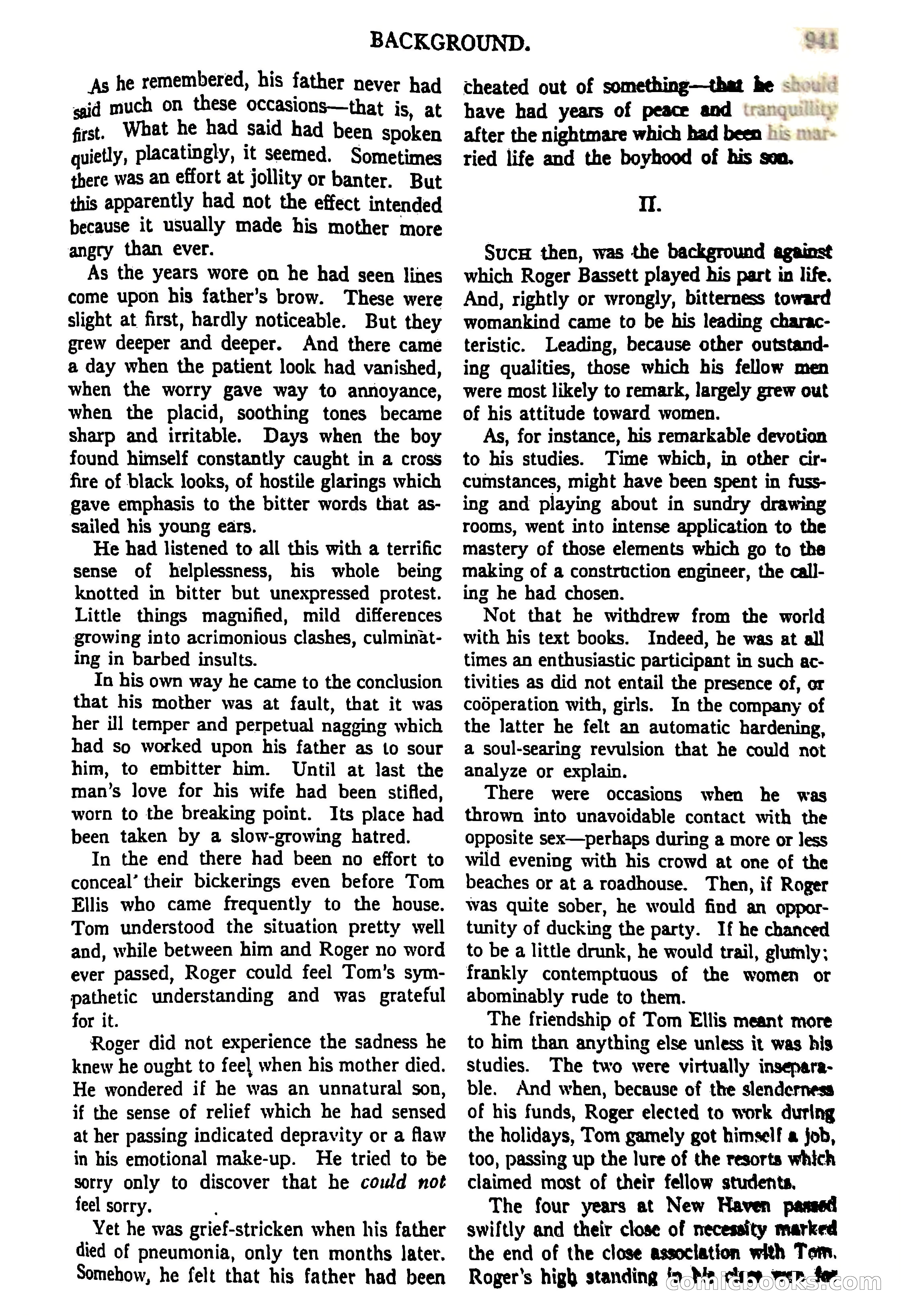
A restored page from Pulp Fiction, 1925. Page through the whole issue in the reader above.
📄 Transcribed text from this page (OCR, searchable)
Machine-transcribed from the original scan — historical spelling and the odd misread are preserved.
As he remembered, his father never had said much on these occasions—that is, at first. What he had said had been spoken quietly, placatingly, it seemed. Sometimes there was an effort at jollity or banter. But this apparently had not the effect intended because it usually made his mother more angry than ever. As the years wore on he had seen lines come upon his father’s brow. These were slight at first, hardly noticeable. But they grew deeper and deeper. And there came a day when the patient look had vanished, when the worry gave way to annoyance, when the placid, soothing tones became sharp and irritable. Days when the boy found himself constantly caught in a cross fire of black looks, of hostile glarings which gave emphasis to the bitter words that as- sailed his young ears. He had listened to all this with a terrific sense of helplessness, his whole being knotted in bitter but unexpressed protest. Little things magnified, mild differences growing into acrimonious clashes, culminat- ing in barbed insults. In his own way he came to the conclusion that his mother was at fault, that it was her ill temper and perpetual nagging which had so worked upon his father as to sour him, to embitter him. Until at last the man’s love for his wife had been stifled, worn to the breaking point. Its place had been taken by a slow-growing hatred. In the end there had been no effort to conceal’ their bickerings even before Tom Ellis who came frequently to the house. Tom understood the situation pretty well and, while between him and Roger no word ever passed, Roger could feel Tom’s sym- pathetic understanding and was grateful for it. Roger did not experience the sadness he knew he ought to feel when his mother died. He wondered if he was an unnatural son, if the sense of relief which he had sensed at her passing indicated depravity or a flaw in his emotional make-up. He tried to be sorry only to discover that he could not feel sorry. , Yet he was grief-stricken when his father died of pneumonia, only ten months later. Somehow, he felt that his father had been 7. G4 } o BACKGROUND. O4 cheated out of something—that he =» uld have had years of peace and trangu |) after the nightmare which had been bis mar- ried life and the boyhood of his son. II. Sucu then, was the background against which Roger Bassett played his part in life. And, rightly or wrongly, bitterness toward womankind came to be his leading charac- teristic. Leading, because other outstand- ing qualities, those which his fellow men were most likely to remark, largely grew out of his attitude toward women. As, for instance, his remarkable devotion to his studies. Time which, in other cir- cumstances, might have been spent in fuss- ing and playing about in sundry drawing rooms, went into intense application to the mastery of those elements which go to the making of a construction engineer, the call- ing he had chosen. Not that he withdrew from the world with his text books. Indeed, he was at all times an enthusiastic participant in such ac- tivities as did not entail the presence of, or codperation with, girls. In the company of the latter he felt an automatic hardening, a soul-searing revulsion that he could not analyze or explain. There were occasions when he was thrown into unavoidable contact with the opposite sex—perhaps during a more or Jess wild evening with his crowd at one of the beaches or at a roadhouse. Then, if Roger was quite sober, he would find an oppor- tunity of ducking the party. If he chanced to be a little drunk, he would trail, glumly; frankly contemptuous of the women or abominably rude to them. The friendship of Tom Ellis meant more to him than anything else unless it was his Studies. The two were virtually insepara- ble. And when, because of the slenderness of his funds, Roger elected to work during the holidays, Tom gamely got himself a job, too, passing up the lure of the resorts which claimed most of their fellow students, The four years at New Haven passed swiftly and their close of necessity marked the end of the close association with Tom. Roger's high standing 9. ve chs. ern te.