
Pulp Fiction, 1925 · page 152 of 168
Argosy All-Story Weekly, June 27, 1925 — page 152: what you’re looking at
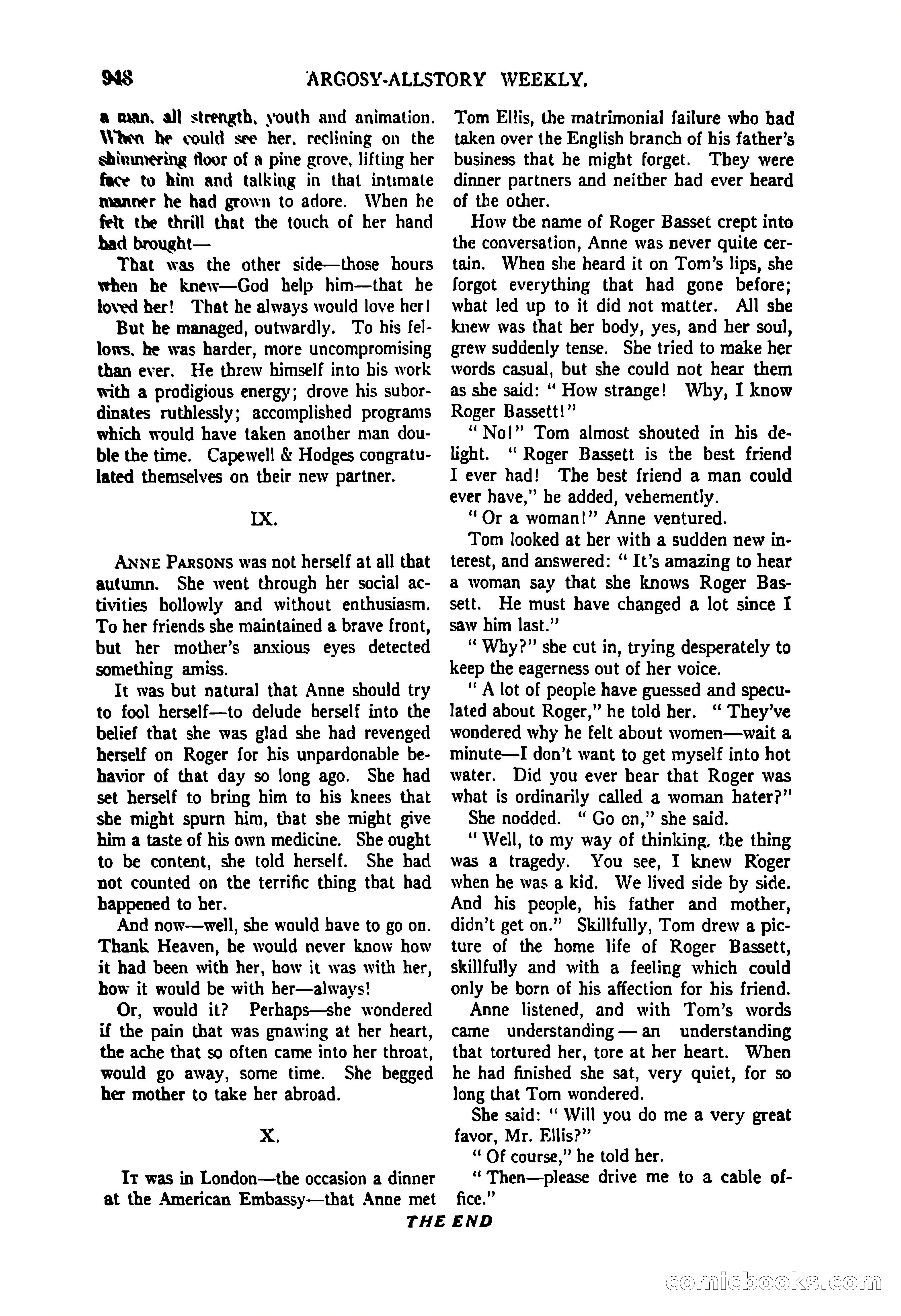
A restored page from Pulp Fiction, 1925. Page through the whole issue in the reader above.
📄 Transcribed text from this page (OCR, searchable)
Machine-transcribed from the original scan — historical spelling and the odd misread are preserved.
NS a man, all strength, youth and animation. When he could see her. reclining on the shivaunrering floor of a pine grove, lifting her face to him and talking in that intimate manner he had grown to adore. When he felt the thrill that the touch of her hand had brought— That was the other side—those hours wthen he knew—God help him—that he loved her! That he always would love her! But he managed, outwardly. To his fel- lows. he was harder, more uncompromising than ever. He threw himself into his work with a prodigious energy; drove his subor- dinates ruthlessly; accomplished programs which would have taken another man dou- ble the time. Capewell & Hodges congratu- lated themselves on their new partner. IX. ANNE Parsons was not herself at all that autumn. She went through her social ac- tivities hollowly and without enthusiasm. To her friends she maintained a brave front, but her mother’s anxious eyes detected something amiss. It was but natural that Anne should try to fool herself—to delude herself into the belief that she was glad she had revenged herself on Roger for his unpardonable be- havior of that day so long ago. She had set herself to bring him to his knees that she might spurn him, that she might give him a taste of his own medicine. She ought to be content, she told herself. She had not counted on the terrific thing that had happened to her. And now—well, she would have to go on. Thank Heaven, he would never know how it had been with her, how it was with her, how it would be with her—always! Or, would it? Perhaps—she wondered if the pain that was gnawing at her heart, the ache that so often came into her throat, would go away, some time. She begged her mother to take her abroad. Xx, It was in London—the occasion a dinner at the American Embassy—that Anne met ARGOSY-ALLSTORY WEEKLY. Tom Ellis, the matrimonial failure who had taken over the English branch of his father’s business that he might forget. They were dinner partners and neither had ever heard of the other. How the name of Roger Basset crept into the conversation, Anne was never quite cer- tain. When she heard it on Tom’s lips, she forgot everything that had gone before; what led up to it did not matter. All she knew was that her body, yes, and her soul, grew suddenly tense. She tried to make her words casual, but she could not hear them as she said: “‘ How strange! Why, I know Roger Bassett!” ‘“No!” Tom almost shouted in his de- light. “ Roger Bassett is the best friend I ever had! The best friend a man could ever have,” he added, vehemently. ‘Or a woman!” Anne ventured. Tom looked at her with a sudden new in- terest, and answered: “ It’s amazing to hear a woman say that she knows Roger Bas- sett. He must have changed a lot since I saw him last.” “Why?” she cut in, trying desperately to keep the eagerness out of her voice. ‘‘ A lot of people have guessed and specu- lated about Roger,” he told her. ‘‘ They’ve wondered why he felt about women—wait a minute—I don’t want to get myself into hot water. Did you ever hear that Roger was what is ordinarily called a woman hater?” She nodded. “ Go on,” she said. Well, to my way of thinking, the thing was a tragedy. You see, I knew Roger when he was a kid. We lived side by side. And his people, his father and mother, didn’t get on.” Skillfully, Tom drew a pic- ture of the home life of Roger Bassett, skillfully and with a feeling which could only be born of his affection for his friend. Anne listened, and with Tom’s words came understanding — an _ understanding that tortured her, tore at her heart. When he had finished she sat, very quiet, for so long that Tom wondered. She said: ‘‘ Will you do me a very great favor, Mr. Ellis?” “ Of course,” he told her. ‘‘ Then—please drive me to a cable of- fice.” THE END EO 1A@OO SS Co