
Pulp Fiction, 1925 · page 25 of 168
Argosy All-Story Weekly, June 27, 1925 — page 25: what you’re looking at
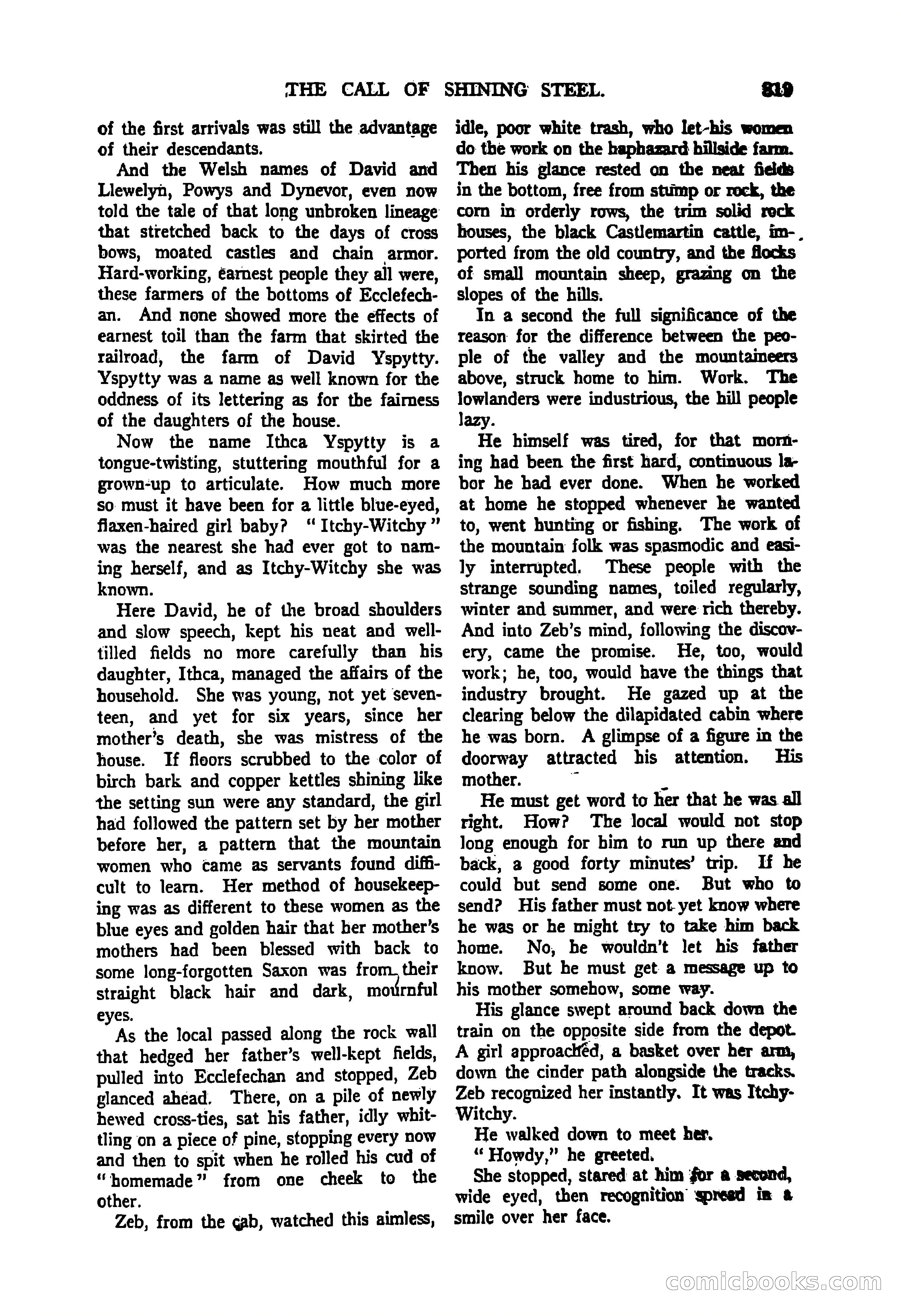
A restored page from Pulp Fiction, 1925. Page through the whole issue in the reader above.
📄 Transcribed text from this page (OCR, searchable)
Machine-transcribed from the original scan — historical spelling and the odd misread are preserved.
THE CALL OF SHINING STEEL. of the first arrivals was still the advantage of their descendants. And the Welsh names of David and Llewelyn, Powys and Dynevor, even now told the tale of that long unbroken lineage that stretched back to the days of cross bows, moated castles and chain armor. Hard-working, éarnest people they all were, these farmers of the bottoms of Ecclefech- an. And none showed more the effects of earnest toil than the farm that skirted the railroad, the farm of David Yspytty. Yspytty was a name as well known for the oddness of its lettering as for the fairness of the daughters of the house. Now the name Ithca Yspytty is a tongue-twisting, stuttering mouthful for a grown-up to articulate. How much more so must it have been for a little blue-eyed, flaxen-haired girl baby? ‘“ Itchy-Witchy ” was the nearest she had ever got to nam- ing herself, and as Itchy-Witchy she was known. Here David, he of the broad shoulders and slow speech, kept his neat and well- tilled fields no more carefully than his daughter, Ithca, managed the affairs of the household. She was young, not yet seven- teen, and yet for six years, since her mother’s death, she was mistress of the house. If fleors scrubbed to the color of birch bark and copper kettles shining like the setting sun were any standard, the girl had followed the pattern set by her mother before her, a pattern that the mountain women who came as servants found difh- cult to learn. Her method of housekeep- ing was as different to these women as the blue eyes and golden hair that her mother’s mothers had been blessed with back to some long-forgotten Saxon was from oe straight black hair and dark, mournful eyes. "AS the local passed along the rock wall that hedged her father’s well-kept fields, pulled into Ecclefechan and stopped, Zeb glanced ahead. There, on a pile of newly hewed cross-ties, sat his father, idly whit- tling on a piece of pine, stopping every now and then to spit when he rolled his cud of “homemade” from one cheek to the other. Zeb, from the gab, watched this aimless, idle, poor white trash, who let-his women do the work on the haphazard hillside farm. Then his glance rested on the neat fields in the bottom, free from stump or rock, the corn in orderly rows, the trim solid reck houses, the black Castlemartin cattle, im-. ported from the old country, and the flocks of small mountain sheep, grazing on the slopes of the hills. In a second the full significance of the reason for the difference between the peo- ple of the valley and the mountaineers above, struck home to him. Work. The lowlanders were industrious, the hill people lazy. He himself was tired, for that morn- ing had been the first hard, continuous la- bor he had ever done. When he worked at home he stopped whenever he wanted to, went hunting or fishing. The work of the mountain folk was spasmodic and easi- ly interrupted. These people with the strange sounding names, toiled regularly, winter and summer, and were rich thereby. And into Zeb’s mind, following the discov- ery, came the promise. He, too, would work; he, too, would have the things that industry brought. He gazed up at the clearing below the dilapidated cabin where he was born. A glimpse of a figure in the doorway attracted his attention. His mother. ~ . He must get word to her that he was all right. How? The local would not stop long enough for bim to run up there and back, a good forty minutes’ trip. If he could but send some one. But who to send? His father must not. yet know where he was or he might try to take him back home. No, be wouldn’t let bis father know. But he must get a message up to his mother somehow, some way. His glance swept around back down the train on the opposite side from the depot. A girl approached, a basket over her arn, down the cinder path alongside the tracks. Zeb recognized her instantly, It was Itchy- Witchy. He walked down to meet her. “Howdy,” he greeted. She stopped, stared at him for a second, wide eyed, then recognition spresd im & smile over her face. COnniEaoo () SS Co