
Pulp Fiction, 1925 · page 33 of 168
Argosy All-Story Weekly, June 27, 1925 — page 33: what you’re looking at
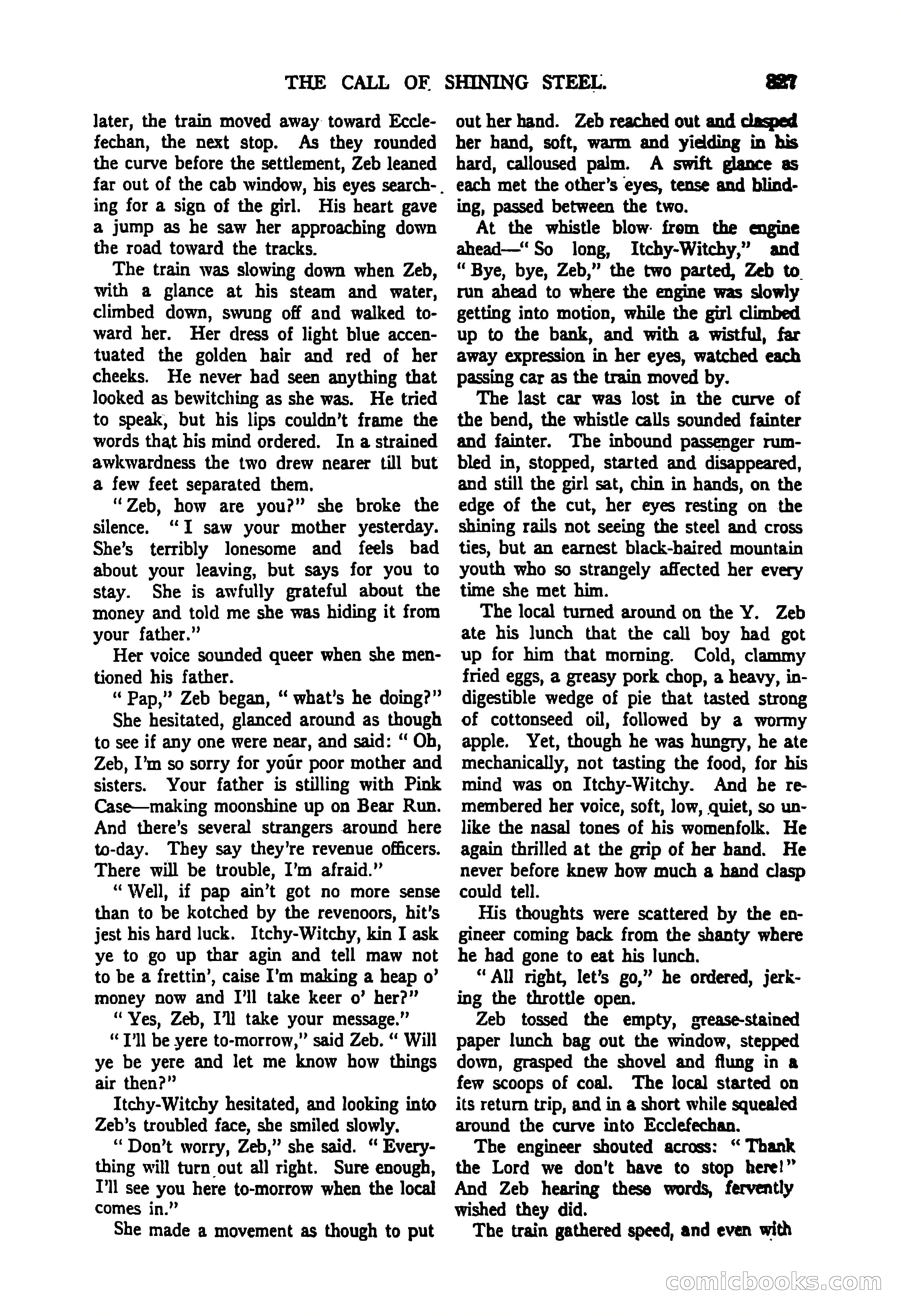
A restored page from Pulp Fiction, 1925. Page through the whole issue in the reader above.
📄 Transcribed text from this page (OCR, searchable)
Machine-transcribed from the original scan — historical spelling and the odd misread are preserved.
THE CALL OF SHINING STEEL. later, the train moved away toward Eccle- fechan, the next stop. As they rounded the curve before the settlement, Zeb leaned far out of the cab window, his eyes search-. ing for a sign of the girl. His heart gave a jump as he saw her approaching down the road toward the tracks. The train was slowing down when Zeb, with a glance at his steam and water, climbed down, swung off and walked to- ward her. Her dress of light blue accen- tuated the golden hair and red of her cheeks. He never had seen anything that looked as bewitching as she was. He tried to speak, but his lips couldn’t frame the words that his mind ordered. In a strained awkwardness the two drew nearer till but a few feet separated them. ‘Zeb, how are your” she broke the Silence. ‘I saw your mother yesterday. She’s terribly lonesome and feels bad about your leaving, but says for you to stay. She is awfully grateful about the money and told me she was hiding it from your father.” Her voice sounded queer when she men- tioned his father. “Pap,” Zeb began, “ what’s he doing?” She hesitated, glanced around as though to see if any one were near, and said: “ Ob, Zeb, I’m so sorry for your poor mother and sisters. Your father is stilling with Pink Case—making moonshine up on Bear Run. And there’s several strangers around here to-day. They say they’re revenue officers. There will be trouble, I’m afraid.” “Well, if pap ain’t got no more sense than to be kotched by the revenoors, hit’s jest his hard luck. Itchy-Witchy, kin I ask ye to go up thar agin and tell maw not to be a frettin’, caise I’m making a heap o’ money now and I'll take keer o’ her?” “Ves, Zeb, I'll take your message.” “ T'll be yere to-morrow,” said Zeb. “ Will ye be yere and let me know how things air then?” Itchy-Witchy hesitated, and looking into Zeb’s troubled face, she smiled slowly. “Don’t worry, Zeb,” she said. “ Every- thing will turn out all right. Sure enough, I'll see you here to-morrow when the local comes in.” She made a movement as though to put out her hand. Zeb reached out and clasped her hand, soft, warm and yielding in his hard, calloused palm. A swift glance as each met the other’s eyes, tense and blind- ing, passed between the two. At the whistle blow. from the engine ahead— So long, Itchy-Witchy,” and “Bye, bye, Zeb,” the two parted, Zeb to. run ahead to where the engine was slowly getting into motion, while the girl climbed up to the bank, and with a wistful, far away expression in her eyes, watched each passing car as the train moved by. The last car was lost in the curve of the bend, the whistle calls sounded fainter and fainter. The inbound passenger rum- bled in, stopped, started and disappeared, and still the girl sat, chin in hands, on the edge of the cut, her eyes resting on the shining rails not seeing the steel and cross ties, but an earnest black-haired mountain youth who so strangely affected her every time she met him. The local turned around on the Y. Zeb ate his lunch that the call boy had got up for him that morming. Cold, clammy fried eggs, a greasy pork chop, a heavy, in- digestible wedge of pie that tasted strong of cottonseed oil, followed by a wormy apple. Yet, though he was hungry, he ate mechanically, not tasting the food, for his mind was on Itchy-Witchy. And he re- membered her voice, soft, low, quiet, so un- like the nasal tones of his womenfolk. He again thrilled at the grip of her hand. He never before knew how much a hand clasp could tell. His thoughts were scattered by the en- gineer coming back from the shanty where he had gone to eat his lunch. “All right, let’s go,” he ordered, jerk- ing the throttle open. Zeb tossed the empty, grease-stained paper lunch bag out the window, stepped down, grasped the shovel and flung in a few scoops of coal. The local started on its return trip, and in a short while squealed around the curve into Ecclefechan. The engineer shouted across: ‘“ Thank the Lord we don’t have to stop here!” And Zeb hearing these words, fervently wished they did. The train gathered speed, and even with COnniEaoo () SS Co