
Pulp Fiction, 1925 · page 36 of 168
Argosy All-Story Weekly, June 27, 1925 — page 36: what you’re looking at
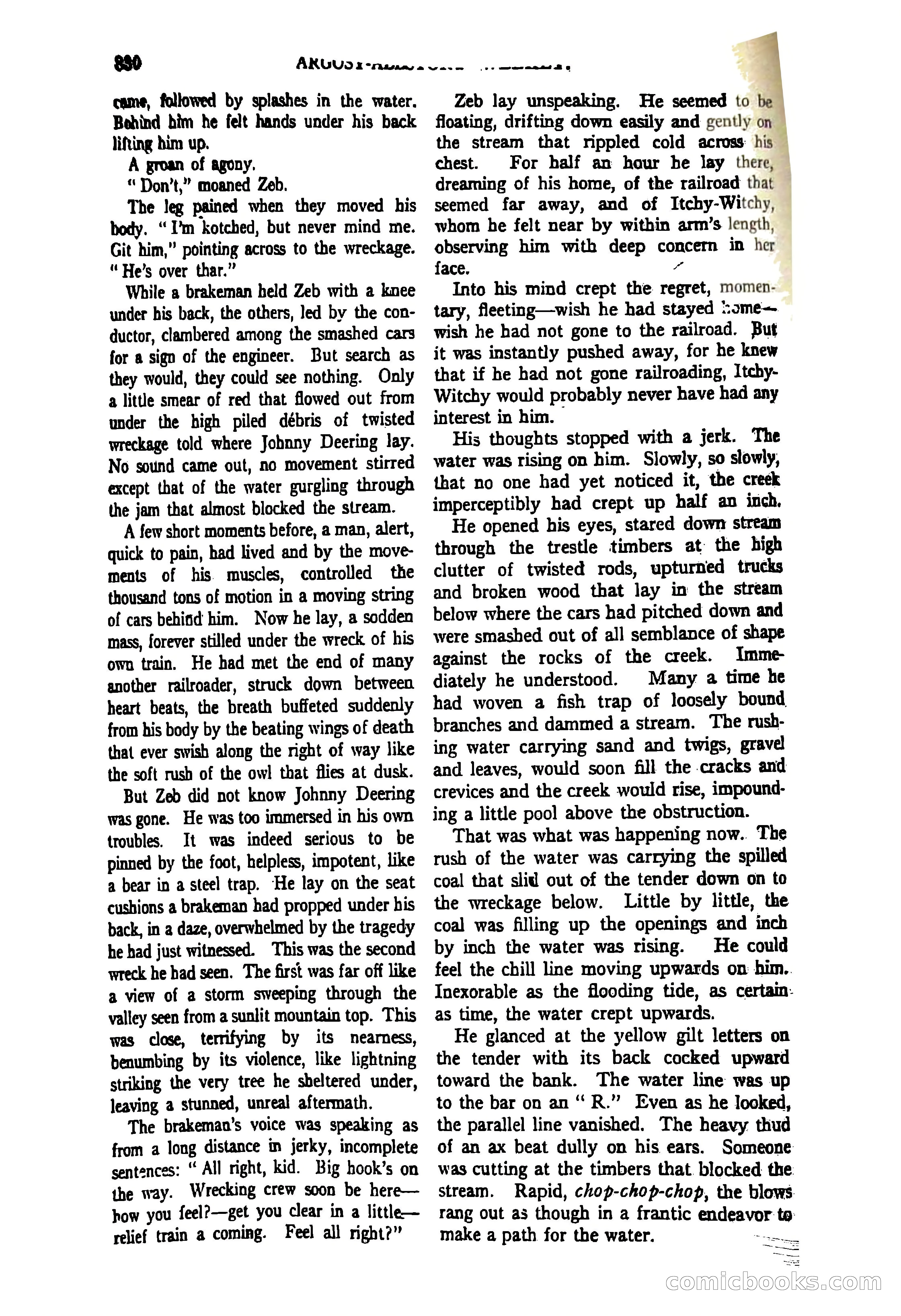
A restored page from Pulp Fiction, 1925. Page through the whole issue in the reader above.
📄 Transcribed text from this page (OCR, searchable)
Machine-transcribed from the original scan — historical spelling and the odd misread are preserved.
came, followed by splashes in the water. Behind him he felt hands under his back lifting him up. A groan of agony. “Ton’t,” moaned Zeb. The leg pained when they moved his body. “I’m kotched, but never mind me. Git him,” pointing across to the wreckage. “ He’s over thar.” While a brakeman held Zeb with a knee under his back, the others, led by the con- ductor, clambered among the smashed cars for a sign of the engineer. But search as they would, they could see nothing. Only a little smear of red that flowed out from under the high piled débris of twisted wreckage told where Johnny Deering lay. No sound came out, no movement stirred except that of the water gurgling through the jam that almost blocked the stream. A few short moments before, a man, alert, quick to pain, had lived and by the move- ments of his. muscles, controlled the thousand tons of motion in a moving string of cars behind him. Now he lay, a sodden mass, forever stilled under the wreck of his own train. He had met the end of many another railroader, struck down between heart beats, the breath buffeted suddenly from his body by the beating wings of death that ever swish along the right of way like the soft rush of the owl that flies at dusk. But Zeb did not know Johnny Deenng was gone. He was too immersed in his own troubles. It was indeed serious to be pinned by the foot, helpless, impotent, like a bear in a steel trap. He lay on the seat cushions a brakeman had propped under his back, in a daze, overwhelmed by the tragedy he had just witnessed. This was the second wreck he had seen. The first was far off like a view of a storm sweeping through the valley seen from a sunlit mountain top. This was close, terrifying by its nearness, benumbing by its violence, like lightning striking the very tree he sbeltered under, leaving a stunned, unreal aftermath. The brakeman’s voice was speaking as from a long distance in jerky, incomplete sentences: “ All right, kid. Big hook’s on the way. Wrecking crew soon be here— how you feelr—get you clear in a little— relief train a coming. Feel all right?” ,of aw aint A @ Zeb lay unspeaking. He seemed to | floating, drifting down easily and gently on — the stream that rippled cold across: his chest. For half an hour he lay there, dreaming of his home, of the railroad that seemed far away, and of Itchy-Witchy, whom he felt near by within arm’s length, observing him with deep concern in her face. c Into his mind crept the regret, momen- tary, fleeting—wish he had stayed ome wish he had not gone to the railroad. But it was instantly pushed away, for he knew that if he had not gone railroading, Itchy- Witchy would probably never have had any interest in him. — His thoughts stopped with a jerk. The water was rising on him. Slowly, so slowly, that no one had yet noticed it, the creek imperceptibly had crept up half an inch. He opened his eyes, stared down stream through the trestle timbers at the high clutter of twisted rods, upturned trucks and broken wood that lay in the stream below where the cars had pitched down and were smashed out of all semblance of shape against the rocks of the creek. Imme- diately he understood. Many a time he had woven a fish trap of loosely bound branches and dammed a stream. The rush- ing water carrying sand and twigs, gravel and leaves, would soon fill the cracks and crevices and the creek would rise, impound- ing a little pool above the obstruction. That was what was happening now.. The rush of the water was carrying the spilled coal that slid out of the tender down on to the wreckage below. Little by little, the coal was filling up the openings and inch by inch the water was rising. He could feel the chill line moving upwards on him.. Inexorable as the flooding tide, as certain: as time, the water crept upwards. He glanced at the yellow gilt letters on the tender with its back cocked upward toward the bank. The water line was up to the bar on an “R.” Even as he looked, the parallel line vanished. The heavy thud of an ax beat dully on his ears. Someone was cutting at the timbers that. blocked the stream. Rapid, chop-chop-chop, the blows. rang out as though in a frantic endeavor to: make a path for the water. — —= _~ —— — = CON () bool (GO)