
Pulp Fiction, 1925 · page 44 of 168
Argosy All-Story Weekly, June 27, 1925 — page 44: what you’re looking at
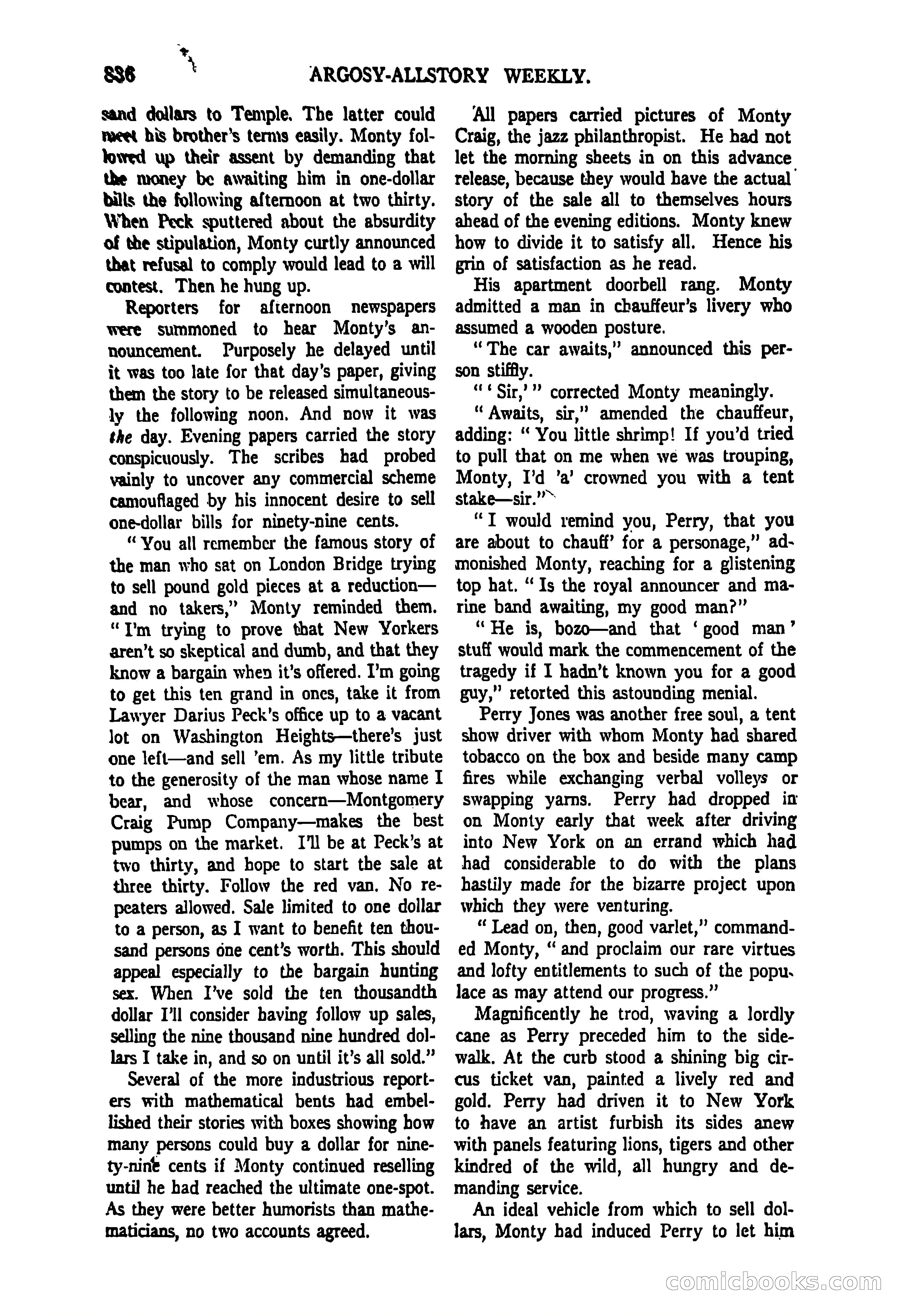
A restored page from Pulp Fiction, 1925. Page through the whole issue in the reader above.
📄 Transcribed text from this page (OCR, searchable)
Machine-transcribed from the original scan — historical spelling and the odd misread are preserved.
+ ese sand dollars to Temple. The latter could racet his brother’s terms easily. Monty fol- lowed up their assent by demanding that the money be awaiting him in one-dollar bills the following afternoon at two thirty. When Peck sputtered about the absurdity of the stipulation, Monty curtly announced that refusal to comply would lead to a will contest. Then he hung up. Reporters for afternoon newspapers were summoned to hear Monty’s an- nouncement. Purposely he delayed until it was too late for that day’s paper, giving them the story to be released simultaneous- ly the following noon. And now it was the day. Evening papers carried the story conspicuously. The scribes had probed vainly to uncover any commercial scheme camouflaged by his innocent desire to sell one-dollar bills for ninety-nine cents. “You all remember the famous story of the man who sat on London Bridge trying to sell pound gold pieces at a reduction— and no takers,’ Monty reminded them. “I'm trying to prove that New Yorkers aren’t so skeptical and dumb, and that they know a bargain when it’s offered. I’m going to get this ten grand in ones, take it from Lawyer Darius Peck’s office up to a vacant lot on Washington Heights—there’s just one left—and sell ’em. As my little tribute to the generosity of the man whose name I bear, and whose concern—Montgomery Craig Pump Company—makes the best pumps on the market. I'll be at Peck’s at two thirty, and hope to start the sale at three thirty. Follow the red van. No re- peaters allowed. Sale limited to one dollar to a person, as I want to benefit ten thou- sand persons one cent’s worth. This should appeal especially to the bargain hunting sex. When I’ve sold the ten thousandth dollar I'll consider having follow up sales, selling the nine thousand nine hundred dol- lars I take in, and so on until it’s all sold.” Several of the more industrious report- ers with mathematical bents had embel- lished their stories with boxes showing how many persons could buy a dollar for nine- ty-nine cents if Monty continued reselling until he had reached the ultimate one-spot. As they were better humorists than mathe- maticians, no two accounts agreed. ARGOSY-ALLSTORY WEEKLY. All papers carried pictures of Monty Craig, the jazz philanthropist. He had not let the morning sheets in on this advance release, because they would have the actual story of the sale all to themselves hours ahead of the evening editions. Monty knew how to divide it to satisfy all. Hence his grin of satisfaction as he read. His apartment doorbell rang. Monty admitted a man in chauffeur’s livery who assumed a wooden posture. “The car awaits,” announced this per- son stiffly. “6 Sir,’”’ corrected Monty meaningly. “ Awaits, sir,’ amended the chauffeur, adding: “ You little shrimp! If you’d tried to pull that on me when we was trouping, Monty, I’d ’a’ crowned you with a tent stake—sir.””~ “I would remind you, Perry, that you are about to chauff’ for a personage,” ad- monished Monty, reaching for a glistening top hat. “Is the royal announcer and ma- rine band awaiting, my good manr” “He is, bozo—and that ‘good man’ stuff would mark the commencement of the tragedy if I hadn’t known you for a good guy,” retorted this astounding menial. Perry Jones was another free soul, a tent show driver with whom Monty had shared tobacco on the box and beside many camp fires while exchanging verbal volleys or swapping yarns. Perry had dropped in on Monty early that week after driving into New York on an errand which had had considerable to do with the plans hastily made for the bizarre project upon which they were venturing. “ Lead on, then, good varlet,’’ command- ed Monty, “ and proclaim our rare virtues and lofty entitlements to such of the popu. lace as may attend our progress.”’ Magnificently he trod, waving a lordly cane as Perry preceded him to the side- walk. At the curb stood a shining big cir- cus ticket van, painted a lively red and gold. Perry had driven it to New York to have an artist furbish its sides anew with panels featuring lions, tigers and other kindred of the wild, all hungry and de- manding service. An ideal vehicle from which to sell dol- lars, Monty had induced Perry to let him COnniEaoo () SS Co