
Pulp Fiction, 1907 · page 118 of 228
The Argosy, March 1907 — page 118: what you’re looking at
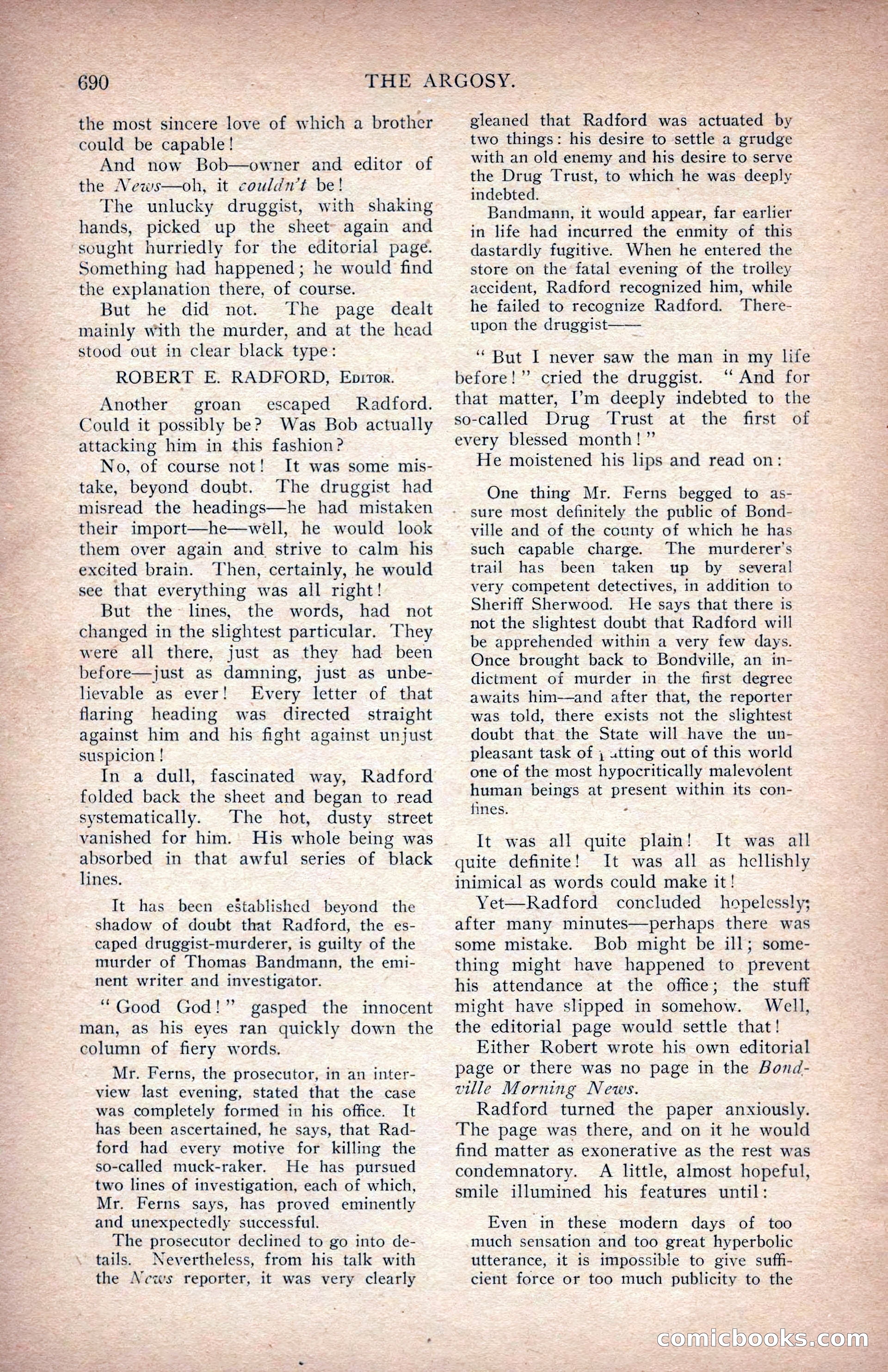
A restored page from Pulp Fiction, 1907. Page through the whole issue in the reader above.
📄 Transcribed text from this page (OCR, searchable)
Machine-transcribed from the original scan — historical spelling and the odd misread are preserved.
690 the most sincere love of which a brother could be capable! And now Bob—owner and editor of the News—oh, it couldn't be! The unlucky druggist, with shaking hands, picked up the sheet again and ‘sought hurriedly for the editorial page. Something had happened; he would find the explanation there, of course. But he did not. The page dealt mainly with the murder, and at the head stood out in clear black type: ROBERT E. RADFORD, Ebrror. Another groan escaped Radford. Could it possibly be? Was Bob actually attacking him in this fashion? | No, of course not! It was some mis- take, beyond doubt. The druggist had misread the headings—he had mistaken their import—he—well, he would look them over again and strive to calm his excited brain. ‘Then, certainly, he would see that everything was all right! But the lines, the words, had not changed in the slightest particular. They were all there, just as they had been before—just as damning, just as unbe- lievable as ever! Every letter of that flaring heading was directed straight against him and his fight against unjust suspicion ! 7 In a dull, fascinated way, Radford folded back the sheet and began to read systematically. The hot, dusty street vanished for him. His whole being was absorbed in that awful series of black lines. It has been eStablished beyond the -shadow of doubt that Radford, the es- caped druggist-murderer, is guilty of the murder of Thomas Bandmann, the emi- nent writer and investigator. “Good God!” gasped the innocent man, as his eyes ran quickly down the column of fiery words. Mr. Ferns, the prosecutor, in an inter- view last evening, stated that the case was completely formed in his office. It has been ascertained, he says, that Rad- ford had every motive for killing the so-called muck-raker. He has pursued two lines of investigation, each of which, Mr. Ferns says, has proved eminently and unexpectedly successful. The prosecutor declined to go into de- tails. Nevertheless, from his talk with the News reporter, it was very clearly THE ARGOSY. gleaned that Radford was actuated by two things: his desire to settle a grudge with an old enemy and his desire to serve the Drug Trust, to which he was deeply indebted. Bandmann, it would appear, far earlier in life had incurred the enmity of this dastardly fugitive. When he entered the store on the fatal evening of the trolley accident, Radford recognized him, while he failed to recognize Radford. There- upon the druggist ‘But I never saw the man in my life before!” cried the druggist. “ And for that matter, I’m deeply indebted to the so-called Drug ‘Trust at the first of every blessed month!” He moistened his lips and read on: One thing Mr. Ferns begged to as- sure most definitely the public of Bond- ville and of the county of which he has such capable charge. The murderer's trail has been taken up by _ several very competent detectives, in addition to Sheriff Sherwood. He says that there is not the slightest doubt that Radford will be apprehended within a very few days. Once brought back to Bondville, an in- dictment of murder in the first degree awaits him-—and after that, the reporter was told, there exists not the slightest doubt that the State will have the un- pleasant task of ; utting out of this world one of the most hypocritically malevolent human beings at present within its con- fines. . It was all quite plain! It was all quite definite! It was all as hellishly inimical as words could make it! Yet—Radford concluded hopelessly; after many minutes—perhaps there was some mistake. Bob might be ill; some- thing might have happened to prevent his attendance at the office; the stuff might have slipped in somehow. Well, the editorial page would settle that! Either Robert wrote his own editorial page or there was no page in the Bond- ville Morning News. Radford turned the paper anxiously. The page was there, and on it he would find matter as exonerative as the rest was condemnatory. A little, almost hopeful, smile illumined his features until: Even in these modern days of too much sensation and too great hyperbolic utterance, it is impossible to give suff- cient force or too much publicity to the Eomichboo im Be <SGO mM