
Pulp Fiction, 1907 · page 123 of 228
The Argosy, March 1907 — page 123: what you’re looking at
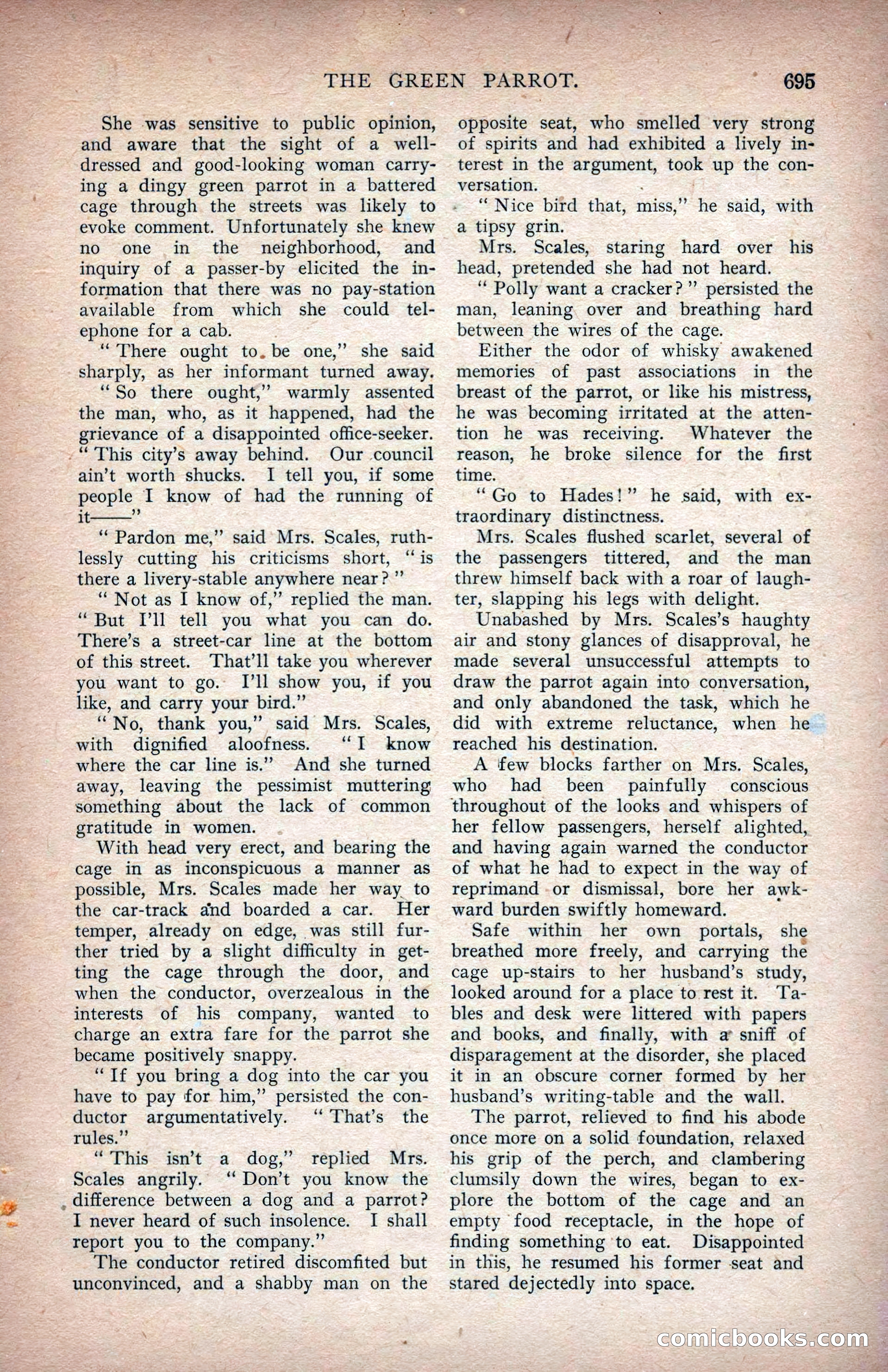
A restored page from Pulp Fiction, 1907. Page through the whole issue in the reader above.
📄 Transcribed text from this page (OCR, searchable)
Machine-transcribed from the original scan — historical spelling and the odd misread are preserved.
Ree THE GREEN PARROT. She was sensitive to public opinion, and aware that the sight of a well- dressed and good-looking woman carry- ing a dingy green parrot in a battered cage through the streets was likely to evoke comment. Unfortunately she knew no one in the neighborhood, and inquiry of a passer-by elicited the in- formation that there was no pay-station available from which she could tel- ephone for a cab. “There ought to. be one,” she said sharply, as her informant turned away. “So there ought,” warmly assented the man, who, as it happened, had the grievance of a disappointed office-seeker. -“ This city’s away behind. Our council ain’t worth shucks. I tell you, if some people I know of had the running of it * Pardon me,” said Mrs. Scales, ruth- lessly cutting his criticisms short, “is there a livery-stable anywhere near?” ‘““ Not as I know of,” replied the man. “But Pll tell you what you can do. There’s a street-car line at the bottom of this street. ‘That'll take you wherever you want to go. I'll show you, if you like, and carry your bird.” “No, thank you,” said Mrs. Scales, with dignified aloofness. “I know where the car line is.’”’ And she turned away, leaving the pessimist muttering something about the lack of common gratitude in women. With head very erect, and bearing the cage in as inconspicuous a manner as possible, Mrs. Scales made her way to the car-track dnd boarded a car. Her temper, already on edge, was still fur- ther tried by a slight difficulty in get- ting the cage through the door, and when the conductor, overzealous in the interests of his company, wanted to charge an extra fare for the parrot she became positively snappy. ‘Tf you bring a dog into the car you have to pay for him,” persisted the con- ductor argumentatively. ‘“ That’s the rules.”’ “This isn’t a dog,’ replied Mrs. Scales angrily. “ Don’t you know the difference between a dog and a parrot? I never heard of such insolence. I shall report you to the company.” The conductor retired discomfited but unconvinced, and a shabby man on the 695 opposite seat, who smelled very strong of spirits and had exhibited a lively in- terest in the seus = up the con- versation. “Nice bird that, miss,” he said, with a tipsy grin. Mrs. Scales, staring hard over his head, pretended she had not heard. ‘Polly want a cracker?” persisted the man, leaning over and breathing hard between the wires of the cage. Either the odor of whisky awakened memories of past associations in the breast of the parrot, or like his mistress, he was becoming irritated at the atten- tion he was receiving. Whatever the reason, he broke silence for the first time. “Go to Hades!” he said, with ex- traordinary distinctness. Mrs. Scales flushed scarlet, several of the passengers tittered, and the man threw himself back with a roar of laugh- ter, slapping his legs with delight. Unabashed by Mrs. Scales’s haughty air and stony glances of disapproval, he made several unsuccessful attempts to draw the parrot again into conversation, and only abandoned the task, which he did with extreme reluctance, when he reached his destination. A few blocks farther on Mrs. Scales, who had _ been painfully | conscious throughout of the looks and whispers of her fellow passengers, herself alighted, and having again warned the conductor of what he had to expect in the way of reprimand -or dismissal, bore her awk- ward burden swiftly homeward. Safe within her own portals, she breathed more freely, and carrying the cage up-stairs to her husband’s study, looked around for a place to rest it. Ta- bles and desk were littered with papers and books, and finally, with a sniff of disparagement at the disorder, she placed it in an obscure corner formed by her husband’s writing-table and the wall. The parrot, relieved to find his abode once more on a solid foundation, relaxed his grip of the perch, and clambering clumsily down the wires, began to ex- plore the bottom of the cage and an empty food receptacle, in the hope of finding something to eat. Disappointed in this, he resumed his former seat and stared dejectedly into space. GEomichbooks.¢o mM ~— is *) te