
Pulp Fiction, 1907 · page 15 of 228
The Argosy, March 1907 — page 15: what you’re looking at
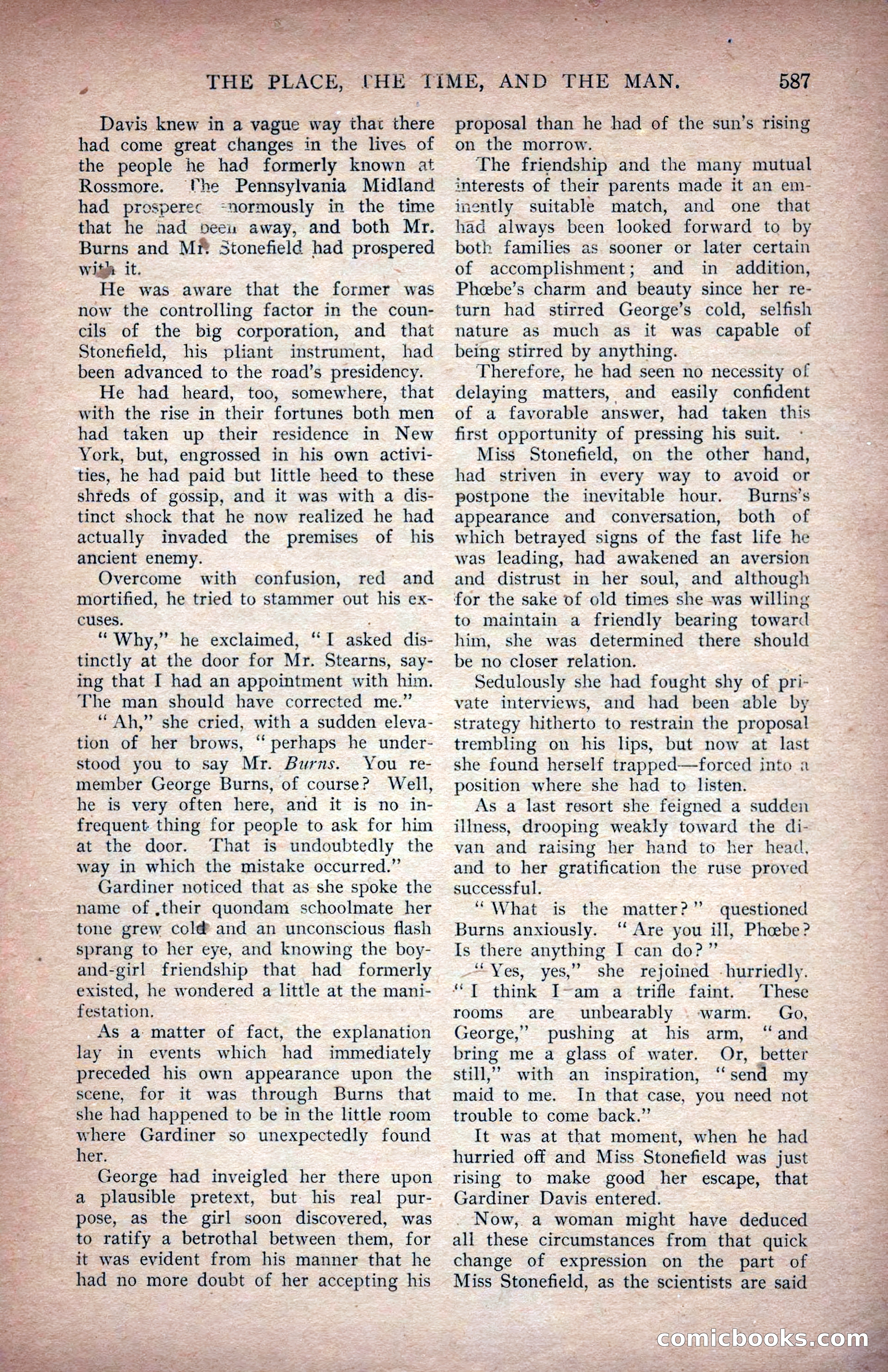
A restored page from Pulp Fiction, 1907. Page through the whole issue in the reader above.
📄 Transcribed text from this page (OCR, searchable)
Machine-transcribed from the original scan — historical spelling and the odd misread are preserved.
‘ LS x? ‘! i Si a) So a) te? . ; wa sy 7 THE PLACE, Davis knew in a vague way that there had come great changes in the lives of the people he had formerly known at Rossmore. he Pennsylvania Midland had prosperec <normously in the time that he nad been away, and both Mr. Burns and Mf 3Stonefield had oe tise With it. He was aware that the former was now the controlling factor in the coun- cils of the big corporation, and that Stonefield, his pliant instrument, had been advanced to the road’s presidency. He had heard, too, somewhere, that with the rise in their fortunes both men had taken up their residence in New York, but, engrossed in his own activi- ties, he had paid but little heed to these shreds of gossip, and it was with a dis- tinct shock that he now realized he had actually invaded the premises of his ancient enemy. Overcome with confusion, red and mortified, he tried to stammer out his ex- cuses. “Why,” he exclaimed, “I asked dis- tinctly at the door for Mr. Stearns, say- ing that I had an appointment with him. The man should have corrected me.” “Ah,” she cried, with a sudden eleva- tion of her brows, “ perhaps he under- stood you to say Mr. Burns. You re- member George Burns, of course? Well, he is very often here, and it is no in- frequent thing for people to ask for him at the door. That is undoubtedly the way in which the mistake occurred.” Gardiner noticed that as she spoke the name of ,their quondam schoolmate her tone grew col@ and an unconscious flash sprang to her eye, and knowing the boy- and-girl friendship that had formerly existed, he wondered a little at the mani- festation. As a matter of fact, the explanation lay in events which had immediately preceded his own appearance upon the scene, for it was through Burns that she had happened to be in the little room where Gardiner so unexpectedly found her. George had inveigled her there upon a plausible pretext, but his real pur- pose, as the girl soon discovered, was to ratify a betrothal between them, for it was evident from his manner that he had no more doubt of her accepting his ““T think I~am a trifle faint. proposal than he had of the sun’s rising on the morrow. The friendship and the many mutual interests of their parents made it an em- inently suitable match, and one that had always been looked forward to by beth families as sooner or later certain of accomplishment; and in addition, Phoebe’s charm and beauty since her re- turn had stirred George’s cold, selfish nature as much as it was capable of being stirred by anything. Therefore, he had seen no necessity of delaying matters, and easily confident of a favorable answer, had taken this first opportunity of pressing his suit. Miss Stonefield, on the other hand, had striven in every way to avoid or postpone the inevitable hour. Burns’s appearance and conversation, both of which betrayed signs of the fast life he was leading, had awakened an aversion and distrust in her soul, and although for the sake of old times she -was willing to maintain a friendly bearing toward him, she was determined there should be no closer relation. Sedulously she had fought shy of pri- vate interviews, and had been able by strategy hitherto to restrain the proposal trembling on his lips, but now at last she found herself trapped—forced into a position where she had to listen. As a last resort she feigned a sudden illness, drooping weakly toward the di- van and raising her hand to her head, and to her gratification the ruse proy ed successful. “What is the matter?” questioned Burns anxiously. “ Are you ill, Phoebe? Is there anything I can do?” “Yes, yes,” she rejoined -hurriedly. These rooms are unbearably . warm. Go, George,’ pushing at his arm, “and bring me a glass of water. Or, better still,” with an inspiration, ‘‘send my maid to me. In that case, you need not trouble to come back.” It was at that moment, when he had hurried off and Miss Stonefield was just rising to make good her escape, that Gardiner Davis entered. Now, a woman might have deduced all these circumstances from that quick change of expression on the part of Miss Stonefield, as the scientists are said ty . Ades i bs a rea Pat neg OF Syea RON [Ob we ‘) # ASD § wl “Pe es ds in