
Pulp Fiction, 1907 · page 156 of 228
The Argosy, March 1907 — page 156: what you’re looking at
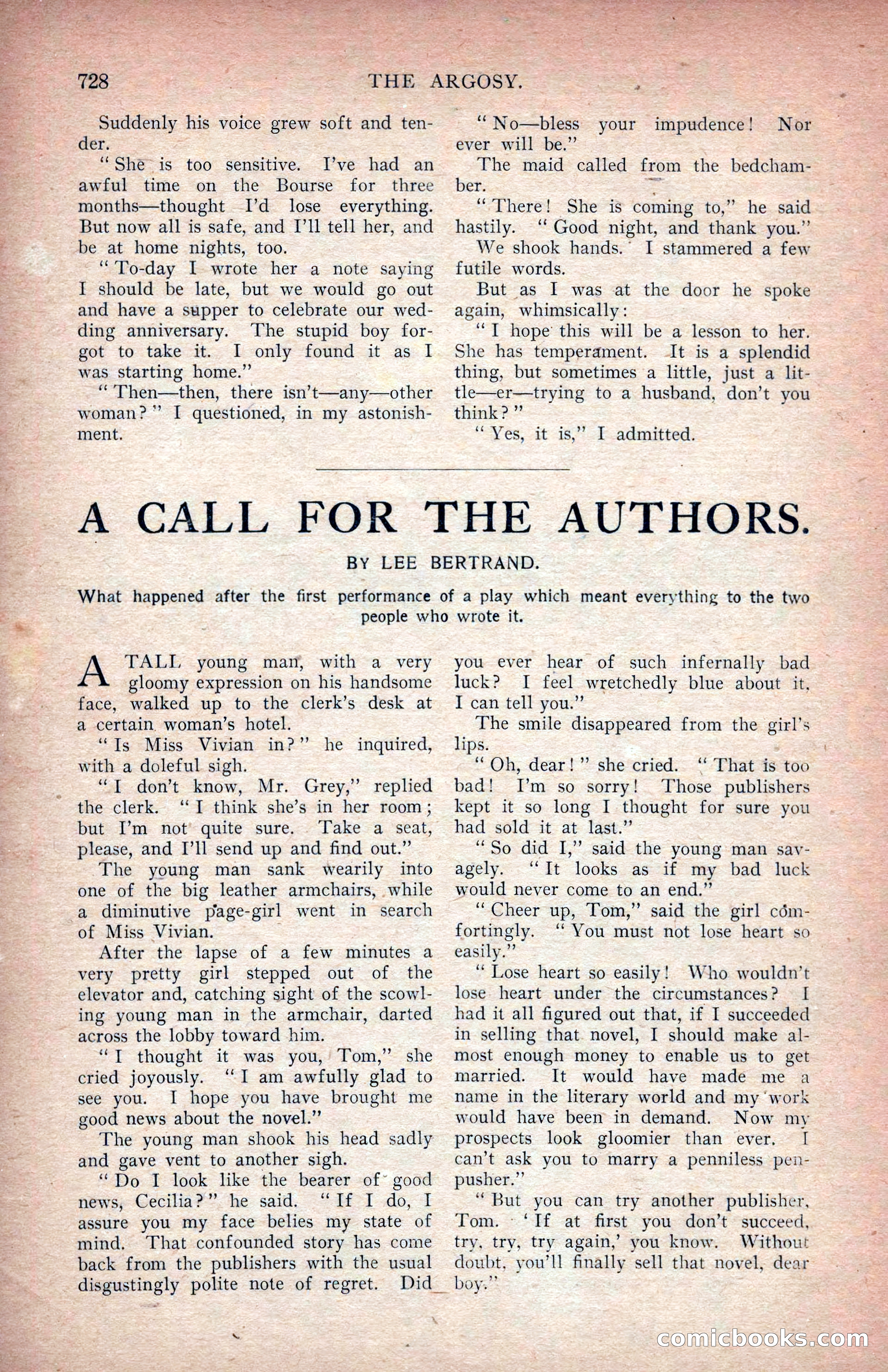
A restored page from Pulp Fiction, 1907. Page through the whole issue in the reader above.
📄 Transcribed text from this page (OCR, searchable)
Machine-transcribed from the original scan — historical spelling and the odd misread are preserved.
\ 728 :, Ge ere ate See Fete wes ae eS Se oe a — “ r Sma, Pentel ee ln a Ae ty Sp rs a8 iy Suddenly his voice grew soft and ten- der. 7 “She is too sensitive. I’ve had an awful time on the Bourse for three months—thought I’d lose everything. But now all is safe, and I’ll tell her, and be at home nights, too. “ To-day I wrote her a note saying I should be late, but we would go out and have a supper to celebrate our wed- ding anniversary. he stupid boy for- got to take it. I only found it as I was starting home.” ‘“Then—then, there isn’t—any—other woman?’ [I questioned, in my astonish- ment. THE ARGOSY. : a 0 ee a eS a a ee ae ae . oe _ ee ale ant oe nent ‘““No—bless your impudence! Nor ever will be.” The maid called from the bedcham- ber. = “There! She is coming to,” he said hastily. ‘‘ Good night, and thank you.” We shook hands. I stammered a few futile words. But as I was at the door he spoke again, whimsically: ‘IT hope this will be a lesson to her. She has temperament. -It is a splendid thing, but sometimes a little, just a lit- tle—er—trying to a husband, don’t you think?” ‘Yes, it is,’’ I admitted. A CALL FOR THE AUTHORS. BY LEE BERTRAND. What happened after the first performance of a play which meant everything to the two people who wrote it. A TALL young man, with a very gloomy expression on his handsome face, walked up to the clerk’s desk at a certain woman’s hotel. “Ts Miss Vivian in?” he inquired, with a doleful sigh. “IT don’t know, Mr. Grey,” replied the clerk. ‘“ I think she’s in her room; but I’m not quite sure. Take a seat, please, and I’ll send up and find out.” The young man sank wearily into one of the big leather armchairs, while a diminutive page-girl went in search of Miss Vivian. After the lapse of a few minutes a very pretty girl stepped out of the elevator and, catching sight of the scowl- ing young man in the armchair, darted across the lobby toward him. “T thought it was you, Tom,” she cried joyously. ‘I am awfully glad to see you. I hope you have brought me good news about the novel.” The young man shook his head sadly and gave vent to another sigh. “Do I look like the bearer of* good news; Gecilia?”’. he said. -“If>I .do, J assure you my face belies my state of mind. ‘That confounded story has come back from the publishers with the usual disgustingly polite note of regret. Did_ \ you ever hear of such infernally bad luck? I feel wretchedly blue about it, I can tell you.” The smile disappeared from the girl’s lips. ‘“Qh, dear!” she cried. ‘‘ That is too bad! I’m so sorry! Those publishers kept it so long I thought for sure you had sold it at last.” “So did I,” said the young man sav- agely. “It looks as if my bad luck would never come to an end.” ‘Cheer up, Tom,” said the girl cém- fortingly. ‘‘ You must not lose heart so easily.” “ Lose heart so easily! Who wouldn’t lose heart under the circumstances? I had it all figured out that, if I succeeded in selling that. novel, I should make al- most enough money to enable us to get married. It would have made me a name in the literary world and my ‘work would have been in demand. Now my prospects look gloomier than ever, I can’t ask you to marry a penniless pen- pusher.” “But you can try another publisher, Tom. ‘If at first you don’t succeed, try, try, try again,’ you know. Without doubt, you'll finally sell that novel, dear boy.” (E©) eXoXe) SEO) aa