
Pulp Fiction, 1907 · page 173 of 228
The Argosy, March 1907 — page 173: what you’re looking at
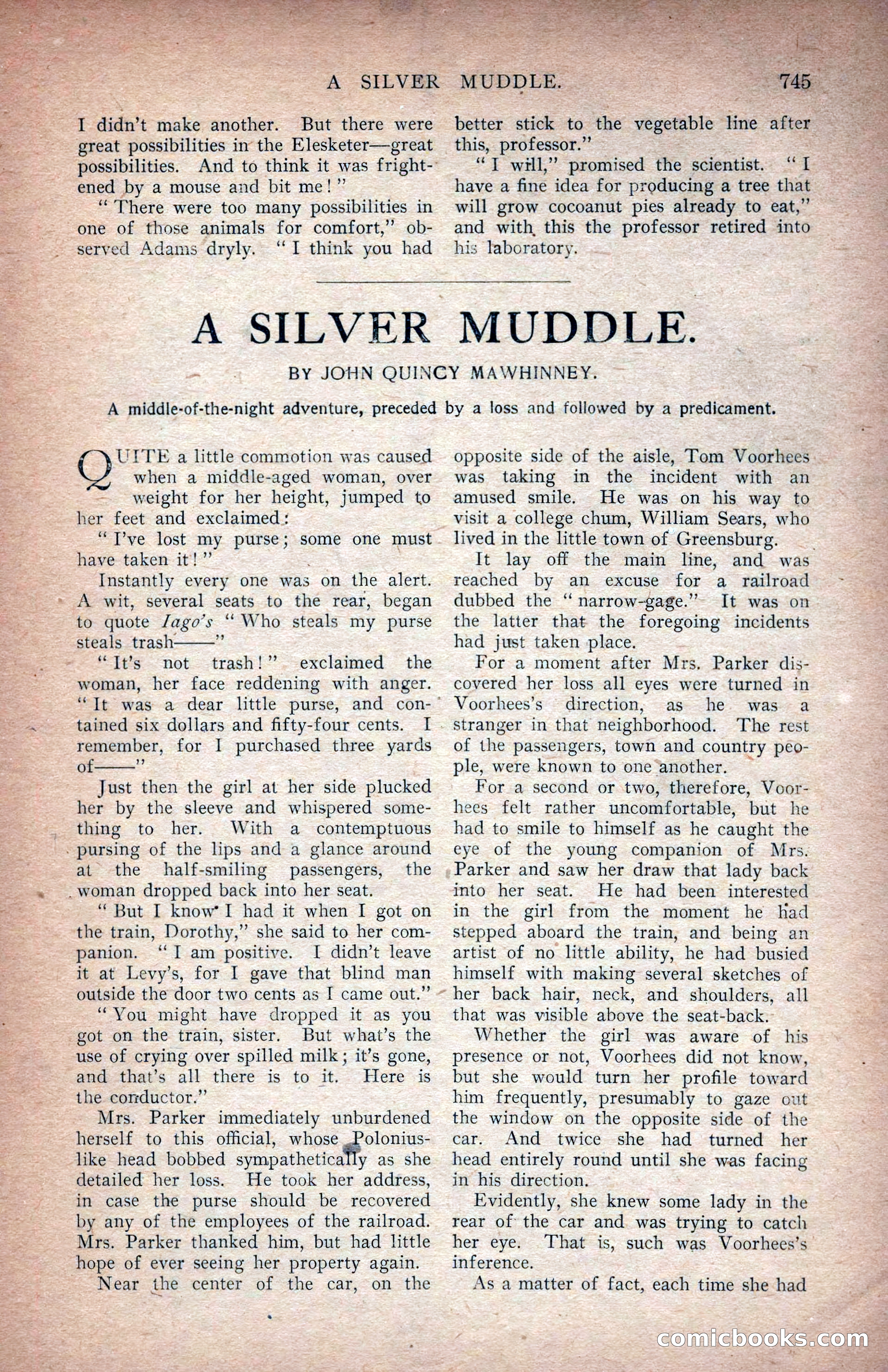
A restored page from Pulp Fiction, 1907. Page through the whole issue in the reader above.
📄 Transcribed text from this page (OCR, searchable)
Machine-transcribed from the original scan — historical spelling and the odd misread are preserved.
% I didn’t make another. - great possibilities in the Elesketer—great And to think it was fright- ened by a mouse and bit me!” the train, Dorothy, ae -got on the train, sister. use of crying over spilled milk; it’s gone, -and that’s all there is to it. =< SILVER ‘MUDDLE. But there were possibilities. “There were too many possibilities in one of those animals for comfort,” ob- served Adams dryly. “I think you had A SILVER pee BY JOHN QUINCY MAWHINNEY, = stick to the vegetable 1 tine after” this, professor.” ‘“T will,” promised the scientist. will grow cocoanut pies already to eat,” and with, this the professor retired into his laboratory. MUDDLE. A middle-of-the-night adventure, preceded by a loss and followed by a predicament. UTTE a little commotion was caused when a middle-aged woman, over — weight for her height, jumped to her feet and exclaimed: “T’ve lost my purse; some one must have taken it!”’ Instantly every one was on the alert. A wit, several seats to the rear, began to quote lago’s “ Who steals my purse steals trash——”’ “It’s not trash!” exclaimed the woman, her face reddening with anger. “Tt was a dear little purse, and con-~ tained six dollars and fifty-four cents. I | remember, for I purchased three yards ie” Just then the girl at her side plucked her by the sleeve and whispered some- thing to her. With a contemptuous _ pursing of the lips and a glance around at the half-smiling passengers, the -woman dropped back into her seat. ‘ But I know’ I had it when I got on ” she said to her com- panion. “I am positive. I didn’t leave it at Levy’s, for I gave that blind man outside the door two cents as I came out.” “You might have dropped it as you But what’s the Here is the conductor.” Mrs. Parker immediately unburdened herself to this official, whose " eee like head bobbed sympathetically as she detailed her loss. He took her address, in case the purse should be recovered by any of the employees of the railroad. Mrs. Parker thanked him, but had little hope of ever seeing her property again. Near the center of the car, on the opposite side of the aisle, Tom Voorhees . was taking in the incident with an amused smile. He was on his way to visit a college chum, William Sears, who lived in the little town of Greensburg. It lay off the main line, and was. reached by an excuse for a railroad dubbed the “ narrow-gage.” It was on the latter that the foregoing incidents had just taken place. For a moment after Mrs, Parker dis- covered her loss all eyes were turned in Voorhees’s direction, as he was a stranger in that neighborhood. ‘The rest of the passengers, town and country peo- ple, were known to one ‘another. For a second or two, therefore, Voor- hees felt rather uncomfortable, but he had to smile to himself as he caught the eye of the young companion of Mrs. Parker and saw her draw that lady back mto her seat. He had been interested in the girl from the moment he had stepped aboard the train, and being an artist of no little ability, he had busied himself with making several sketches of her back hair, neck, and shoulders, all that was visible above the seat-back. Whether the girl was aware of his presence or not, Voorhees did not know, but she would turn her profile toward him frequently, presumably to gaze out the window on the opposite side of the car. And twice she had turned her head entirely round until she was facing in his direction. Evidently, she knew some lady in the rear of the car and was trying to catch her eye. That is, such was Voorhees’s inference. As a matter of fact, each time she had ¢é L have a fine idea for producing a tree that na a. 1 ye . | wh Fo ri aso eh 2 y AP h % Sse eas. 1 Le a * a Sa 4 2y? ye. ~ < : s = : GOMmIG .OOK