
Pulp Fiction, 1907 · page 185 of 228
The Argosy, March 1907 — page 185: what you’re looking at
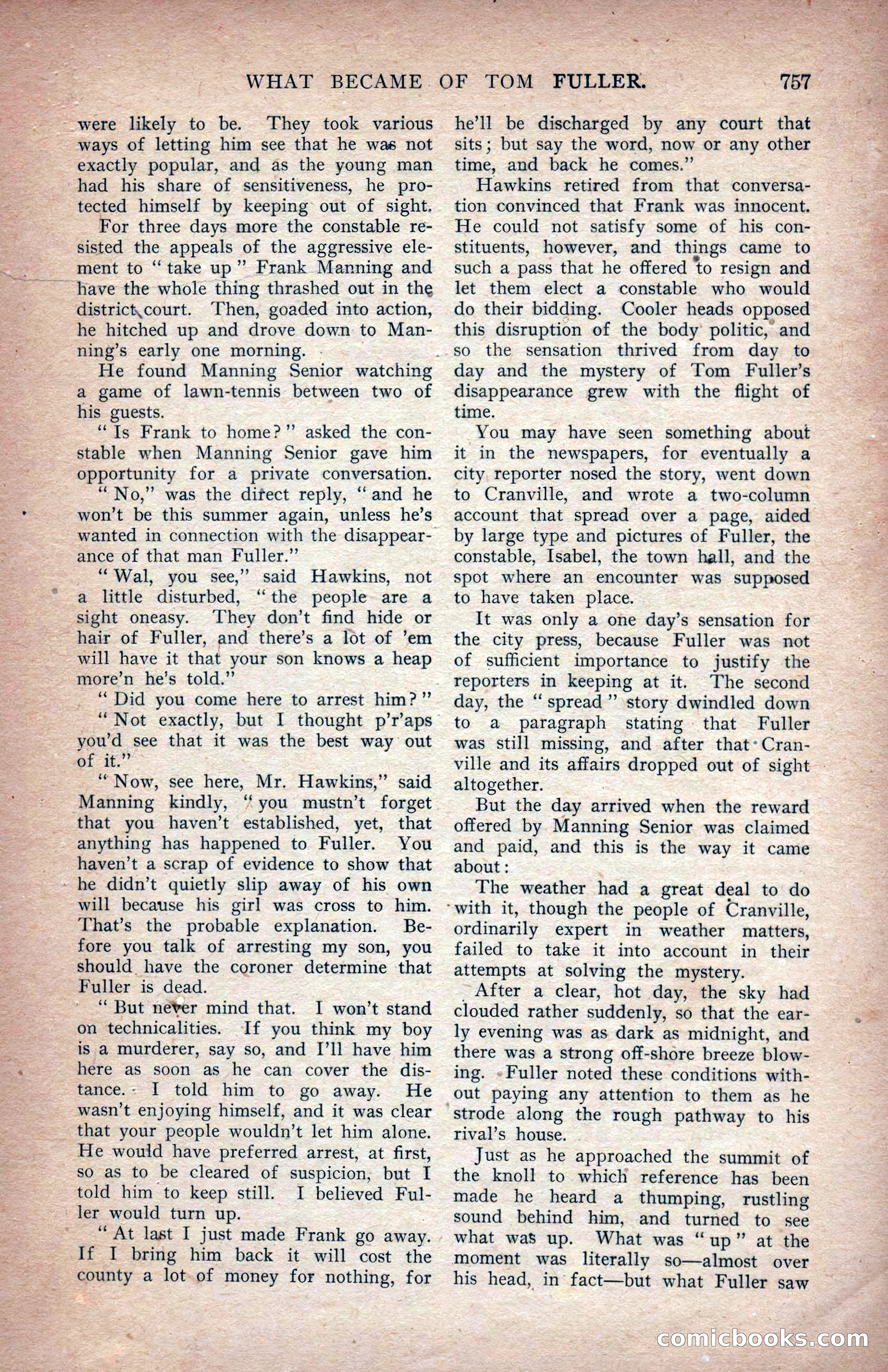
A restored page from Pulp Fiction, 1907. Page through the whole issue in the reader above.
📄 Transcribed text from this page (OCR, searchable)
Machine-transcribed from the original scan — historical spelling and the odd misread are preserved.
—< SV Rees ~_-were likely to be. They took various anything has happened to Fuller. ways of letting him see that he wae not exactly popular, and as the young man had his share of sensitiveness, he pro- tected himself by keeping out of sight. For three days more the constable re- sisted the appeals of the aggressive ele- ment to ‘take up” Frank Manning and have the whole thing thrashed out in the district.court. ‘Then, goaded into action, he hitched up and drove down to Man- ning’s early one morning. , He found Manning Senior watching a game of lawn-tennis between two of his guests. “Is Frank to home?” asked the con- stable when Manning Senior gave him opportunity for a private conversation. “No,” was the difect reply, “and he won't be this summer again, unless he’s wanted in connection with the disappear- ance of that man Fuller.”’ _ “Wal, you see,” said Hawkins, not a little disturbed, “the people are a sight oneasy. ‘They don’t find hide or hair of Fuller, and there’s a lot of ’em will have it that your son knows a heap more’n he’s told.” “Did you come here to arrest him?” “Not exactly, but I thought p’r’aps you’d see that it was the best way out et-u. | “Now, see here, Mr. Hawkins,” said Manning kindly, “ you mustn’t forget that you haven’t established, yet, that You haven’t a scrap of evidence to show that - he didn’t quietly slip away of his own will because his girl was cross to him. That’s the probable explanation. Be- fore you talk of arresting my son, you should have the coroner determine that Fuller is dead. ‘“ But never mind that. I won’t stand on technicalities. If you think my boy is a murderer, say so, and I’ll have him here as soon as he can cover the dis- tance.- I told him to go away. He wasn’t enjoying himself, and it was clear that your people wouldn’t let him alone. He would have preferred arrest, at first, so as to be cleared of suspicion; but I told him to keep still. ler would turn up. . “ At last I just made Frank go away. If I bring him back it will cost the county a lot of money for nothing, for I believed Ful- WHAT BECAME OF TOM FULLER. he’ll be discharged by any court that sits; but say the word, now or any other time, and back he comes.”’ Hawkins retired from that conversa- tion convinced that Frank was innocent. He could not satisfy some of his con- stituents, however, and things came to such a pass that he offered ‘to resign and let them elect a constable who would do their bidding. Cooler heads opposed this disruption of the body politic, and ..so the sensation thrived from day to day and the mystery of Tom Fuller’s disappearance grew with the flight of time. You may have seen something about it in the newspapers, for eventually a city reporter nosed the story, went down to Cranville, and wrote a two-column account that spread over a page, aided by large type and pictures of Fuller, the constable, Isabel, the town hall, and the spot where an encounter was supposed to have taken place. It was only a one day’s sensation for the city press, because Fuller was not of sufficient importance to justify the reporters in keeping at it. The second day, the “spread” story dwindled down to a paragraph stating that Fuller was still missing, and after that*Cran- Sey | 8 ville and its affairs dropped out of sight - altogether. . But the day arrived when the reward offered by Manning Senior was claimed and paid, and this is the way it came about : The weather had a great deal to do ‘with it, though the people of Cranville, ordinarily expert in weather matters, failed to take it into account in their attempts at solving the mystery. _ After a clear, hot day, the sky had clouded rather suddenly, so that the ear- ly evening was as dark as midnight, and there was a strong off-shore breeze blow- ing. «Fuller noted these conditions with- out paying any attention to them as he strode along the rough pathway to his rival’s house. Just as he approached the summit of the knoll to which reference has been made he heard a thumping, rustling sound behind him, and turned to see what was up. What was “up” at the moment was literally so—almost over his head, in fact—but what Fuller saw 0\(0\6) G com [S.cOom