
Pulp Fiction, 1907 · page 197 of 228
The Argosy, March 1907 — page 197: what you’re looking at
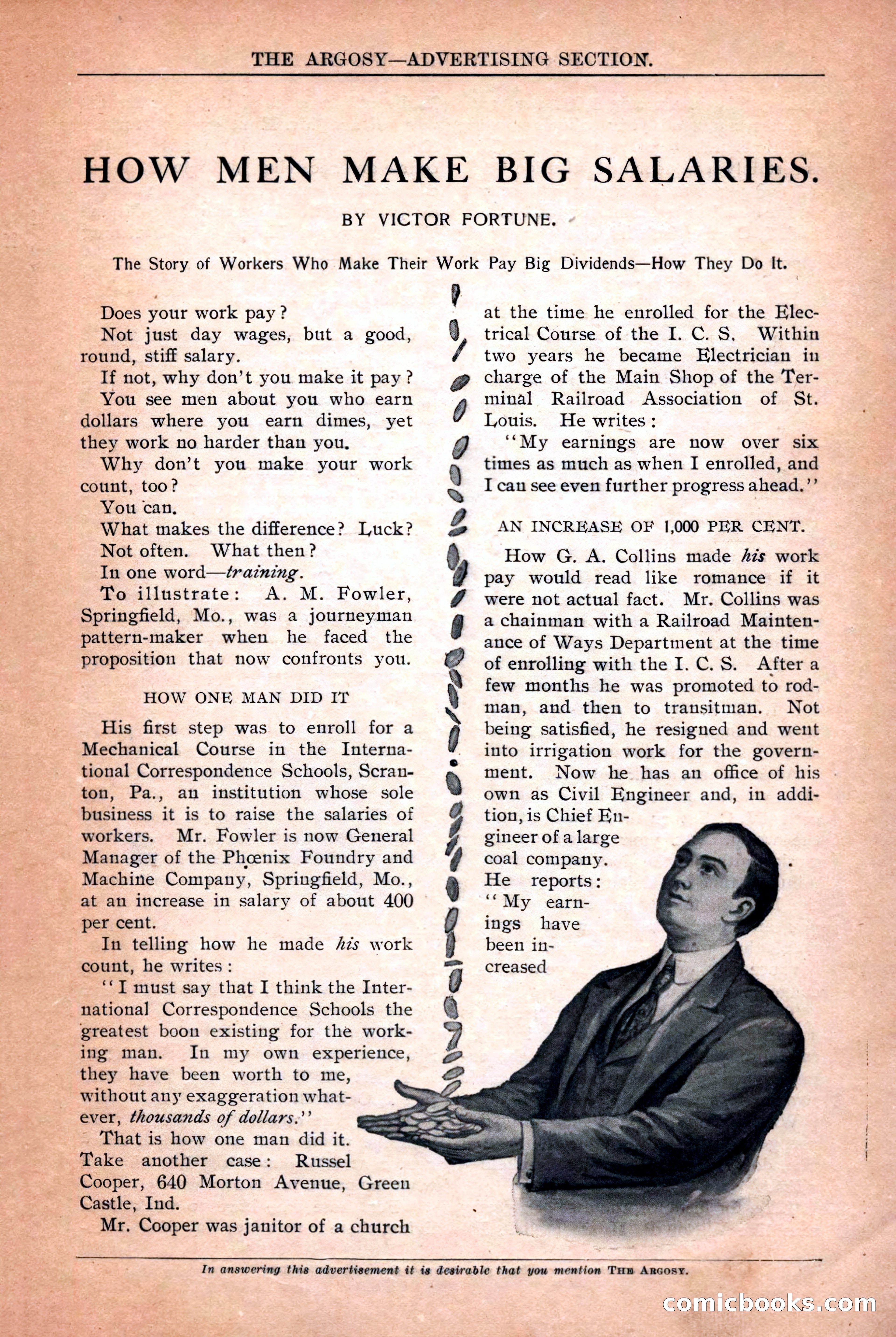
A restored page from Pulp Fiction, 1907. Page through the whole issue in the reader above.
📄 Transcribed text from this page (OCR, searchable)
Machine-transcribed from the original scan — historical spelling and the odd misread are preserved.
THE ARGOSY—ADVERTISING SECTION. HOW MEN MAKE BIG SALARIES. BY VICTOR FORTUNE. The Story of Workers Who Make Their Work Pay Big Dividends—How They Do It. | Does your work pay? Not just day wages, but a good, round, stiff salary. If not, why don’t you make it pay? You see men about you who earn dollars where you earn dimes, yet they work no harder than you. Why don’t you make your work count, too? You can, What makes the difference? Luck? Not often. What then? In one word—?razning. To illustrate: A. M. Fowler, Springfield, Mo., was a journeyman pattern-maker when he faced the proposition that now confronts you. HOW ONE MAN DID IT His first step was to enroll for a Mechanical Course in the Interna- tional Correspondence Schools, Scran- ton, Pa., an institution whose sole _ business it is to raise the salaries of workers. Mr. Fowler is now General Manager of the Phcenix Foundry and Machine Company, Springfield, Mo., at an increase in salary of about 400 _ per cent. In telling how he made Azs work count, he writes: ‘IT must say that I think the Inter- national Correspondence Schools the greatest boon existing for the work- ing man. In my own experience, they have been worth to me, without any exaggeration what- ever, thousands of dollars.’ . That is how one man did it. Take another case: Russel Cooper, 640 Morton Avenue, Green Castle, Ind. Mr. Cooper was janitor of a church In answering this advertisement it is desirable that you mention Tue ArGosy. AY Yu @ qqy eB @WPMUQ O° B/LZR @ La LL ISQ a Q0.Ce = at the time he enrolled for the Elec- trical Course of the I. C. S. Within two years he became Electrician in charge of the Main Shop of the Ter- minal Railroad Association of St. Louis. He writes: ‘““My earnings are now over six times as much as when I enrolled, and I can see even further progress ahead,”’ AN INCREASE OF 1,000 PER CENT. How G. A. Collins made zs work pay would read like romance if it were not actual fact. Mr. Collins was a chainman with a Railroad Mainten- ance of Ways Department at the time of enrolling with the I.C.S. Aftera few months he was promoted to rod- man, and then to transitman. Not being satisfied, he resigned and went into irrigation work for the govern- ment. Now he has an office of his own as Civil Engineer and, in addi- tion, is Chief En- gineer ofa large coal company. He reports: ‘““My earn- ings have been in- creased ee ee GComicbooks (EO)