
Pulp Fiction, 1907 · page 20 of 228
The Argosy, March 1907 — page 20: what you’re looking at
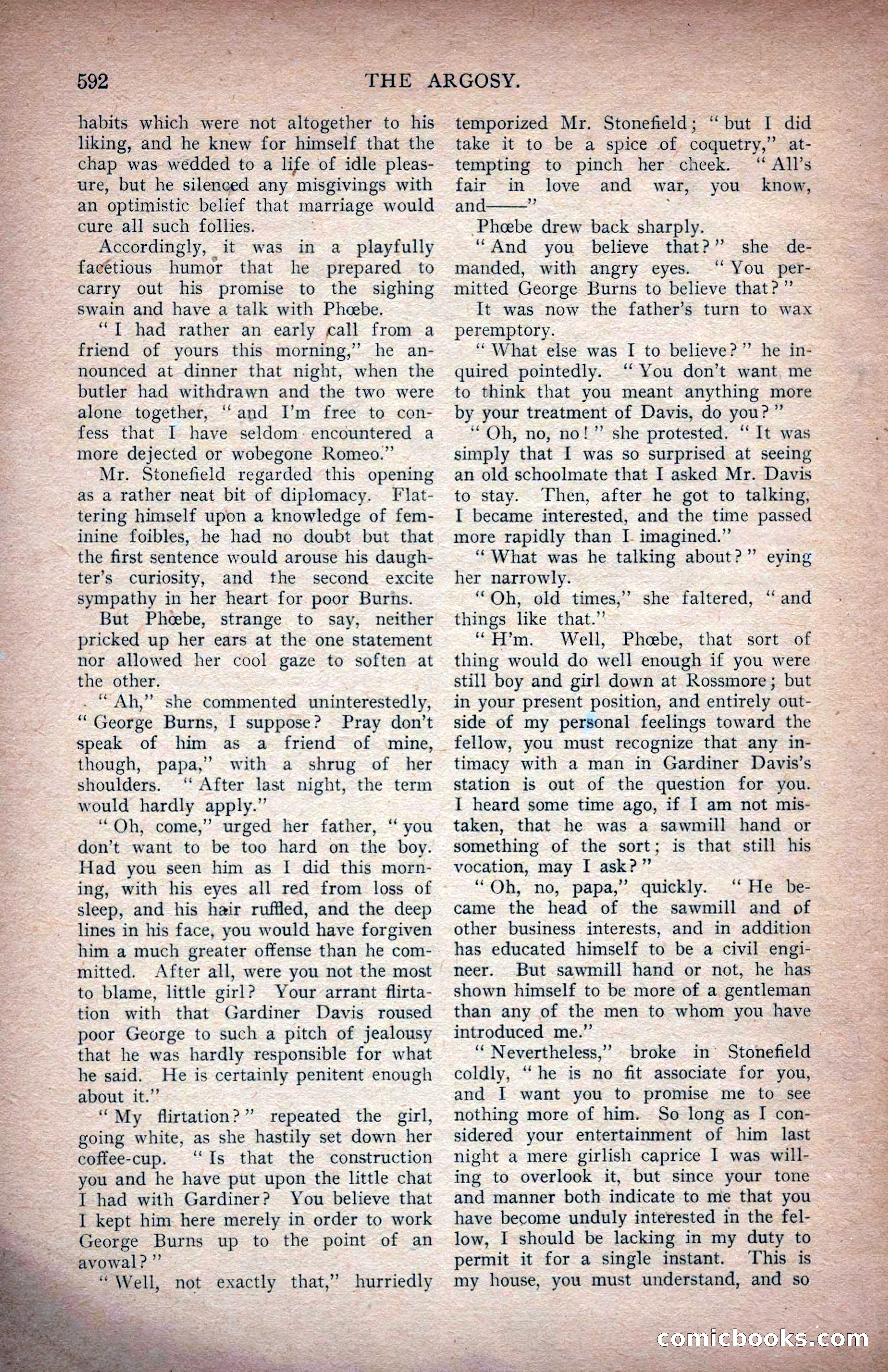
A restored page from Pulp Fiction, 1907. Page through the whole issue in the reader above.
📄 Transcribed text from this page (OCR, searchable)
Machine-transcribed from the original scan — historical spelling and the odd misread are preserved.
i : e (ie a a” : rrGAs aor Wa - t¢ aN Sees Habits. which ‘were not > plipaeilier t to ee liking, and he knew for himself that the chap was wedded to a life of idle pleas- ure, but he silenced any misgivings with an optimistic belief that marriage would cure all such follies. Accordingly, it was in a playfully faecétious humor that he prepared to carry out his promise to the sighing swain and have a talk with Phoebe. “YT had rather an early call from a friend of yours this morning,’ he an- nounced at dinner that night, when the butler had withdrawn and the two were alone together, “and I’m free to con- fess that I have seldom: encountered a more dejected or wobegone Romeo.”’ Mr. Stonefield regarded this opening as a rather neat bit of diplomacy. Flat- tering himself upon a knowledge of fem- inine foibles, he had no doubt but that the first sentence would arouse his daugh- ter’s curiosity, and the second excite sympathy in her heart for poor Burns. But Pheebe, strange to say, neither pricked up her ears at the one statement nor allowed her cool gaze to soften at the other. . “Ah,” she commented uninterestedly, “George Burns, I suppose? Pray don’t speak of him as a friend of mine, though, papa,” with a shrug of her shoulders. ‘After last night, the term would hardly apply.” “Oh, come,” urged her father, “ you don’t want to be too hard on the boy. Had you seen him as [ did this morn- ing, with his eyes all red from loss of sleep, and his hair ruffled, and the deep lines in his face, you would have forgiven him a much greater offense than he com- mitted. After all, were you not the most to blame, little girl? Your arrant flirta- tion with that Gardiner Davis roused poor George to such a pitch of jealousy that he was hardly responsible for what he said. He is certainly penitent enough about it.” “My flirtation?” repeated the girl, going white, as she hastily set down her coftee-cup. ‘Is that the construction you and he have put upon the little chat I had with Gardiner? You believe that I kept him here merely in order to work George Burns up to the point of an | ~ -avowal? _ — ~~ “Well, not exactly that,” hurriedly eT hon eeisenicd Mr. Stonefield ; take it to be a spice of coquetry,” at- tempting to pinch her cheek. ‘ All’s fair in love and war, you know, and 2 Phoebe drew back sharply. ‘And you believe that?” she de- manded, with angry eyes. ‘ You per- mitted George Burns to believe that?” It was now the father’s turn to wax peremptory. ‘What else was I to believe?” he in- quired pointedly. ‘“ You don’t want me to think that you meant anything more by your treatment of Davis, do you?” ‘Oh, no, no!” she protested. ‘ It was simply that I was so surprised at seeing an old schoolmate that I asked Mr. Davis to stay. Then, after he got to talking, I became interested, and the time passed more rapidly than I imagined.” ‘“What was he talking about?” eying her narrowly. “Oh, old times,” things like that.” 5 ‘“H’m. Well, Phoebe, that sort of thing would do well enough if you were still boy and girl down at Rossmore; but in your present position, and entirely out- side of my personal feelings toward the she faltered, “ and fellow, you must recognize that any in- timacy with a man in Gardiner Davis’s station is out of the question for you. I heard some time ago, if I am not mis- taken, that he was a sawmill hand or something of the sort; is that still his vocation, may I ask?” “Oh, no, papa,’ quickly. ‘ He be- came the head of the sawmill and of other business interests, and in addition has educated himself to be a civil engi- neer. shown himself to be more of a gentleman than any of the men to whom you have introduced me.”’ ‘“ Nevertheless,” broke coldly, “he is no fit associate for you, and I want you to promise me to see nothing more of him. So long as I con- sidered your entertainment of him last night a mere girlish caprice I was will- ing to overlook it, but since your tone ~ and manner both indicate to me that you have become unduly interested in the fel- — low, I should be lacking in my duty to permit it for a single instant. This is my house, you must understand, and so ~ “comicbook But sawmill hand or not, he has in’ Stonefield we f toe ie hee, thd } Pee ets ph e Soa wf HPA Ary ns 2 Were - ena a? / ! ' eke Sy a if. > * ey : re e. hist one + ar 7 A: \3 oe - E: