
Pulp Fiction, 1907 · page 56 of 228
The Argosy, March 1907 — page 56: what you’re looking at
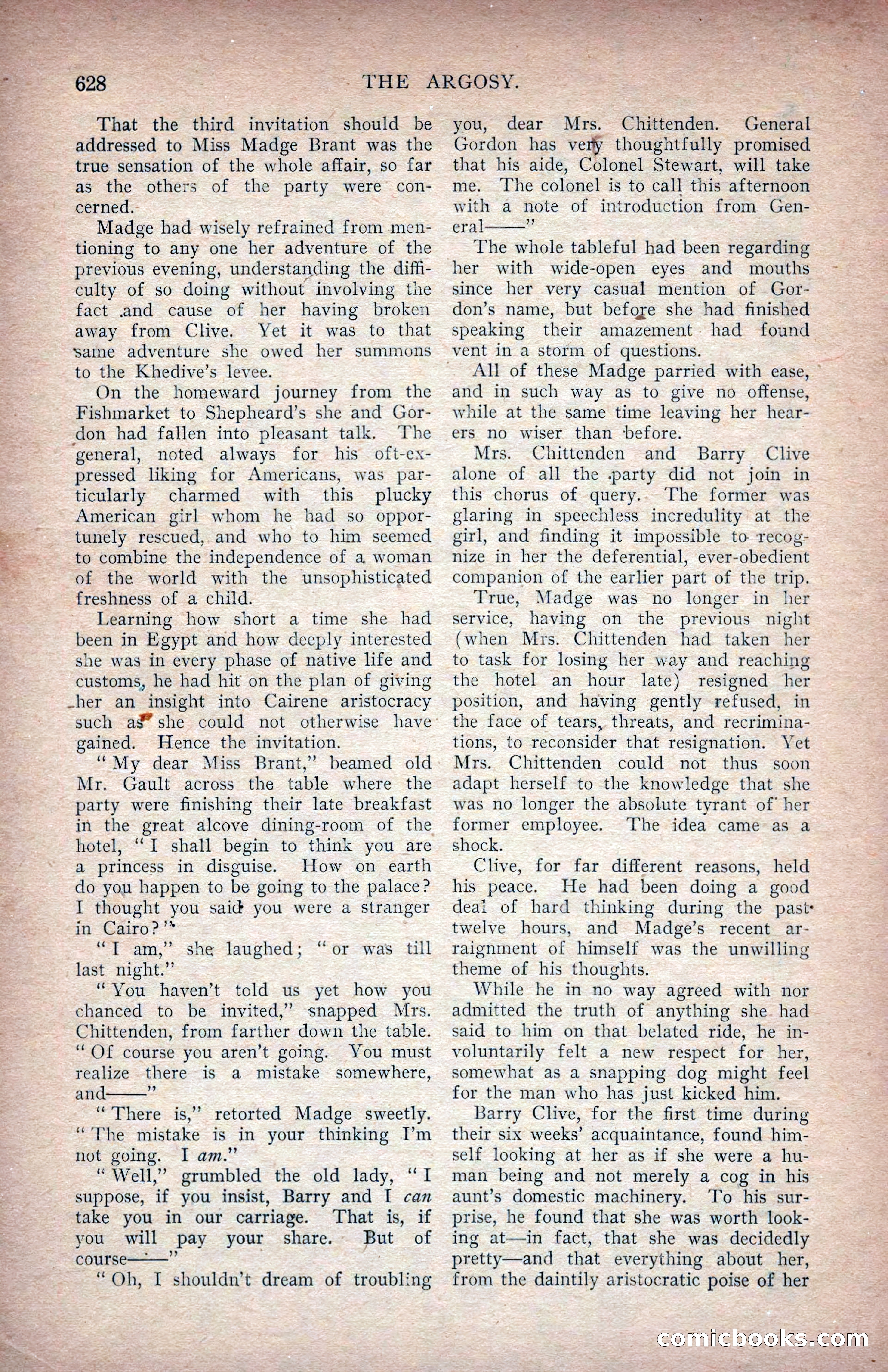
A restored page from Pulp Fiction, 1907. Page through the whole issue in the reader above.
📄 Transcribed text from this page (OCR, searchable)
Machine-transcribed from the original scan — historical spelling and the odd misread are preserved.
- = ae Ee == < n fee je eae = F “A ~ - ae A o> wows =~ =! %. oe ¥ ass 4 ead ny A i” de [ Bs hee ; hoa u ER ay f 628 That the third invitation should be addressed to Miss Madge Brant was the true sensation of the whole affair, so far as the others of the party were con- cerned. Madge had wisely refrained from men- tioning to any one her adventure of the previous evening, understanding the difh- culty of so doing without involving the fact and cause of her having broken away from Clive. Yet it was to that same adventure she owed her summons to the Khedive’s levee. On the homeward journey from the Fishmarket to Shepheard’s she and Gor- don had fallen into pleasant talk. The general, noted always for his oft-ex- pressed liking for Americans, was par- ticularly charmed with this plucky American girl whom he had so oppor- tunely rescued, and who to him seemed to combine the independence of a woman of the world with the unsophisticated freshness of a child. Learning how short a time she had been in Egypt and how deeply interested she was in every phase of native life and customs, he had hit on the plan of giving -her an insight into Cairene aristocracy such ag she could not otherwise have: gained. Hence the invitation. ‘“My dear Miss Brant,” beamed old Mr. Gault across the table where the party were finishing their late breakfast in the great alcove dining-room of the hotel, “I shall begin to think you are a princess in disguise. How on earth do you happen to be going to the palace? I thought you said you were a stranger in Cairo?” tar, last night.” “You haven’t told us yet how you chanced to be invited,” snapped Mrs. Chittenden, from farther down the table. “Of course you aren’t going. You must realize there is a mistake somewhere, and * - “There is,’ retorted Madge sweetly. “The mistake is in your thinking I’m not going. I am.” “Well,” grumbled the old lady, “I suppose, if you insist, Barry and I can take you in our carriage. That is, if you will pay your share. But of course s : | “Oh, I shouldn’t dream of troubling she laughed; “or was till . THE ARGOSY. you, dear Mrs. Chittenden. General Gordon has very thoughtfully promised that his aide, Colonel Stewart, will take me. The colonel is to call this afternoon with a note of introduction from Gen- eral = The whole tableful had been regarding her with wide-open eyes and mouths since her very casual mention of Gor- don’s name, but before she had finished speaking their amazement had found vent in a storm of questions. All of these Madge parried with ease, © and in such way as to give no offense, while at the same time leaving her hear- ers no wiser than before. Mrs. Chittenden and Barry Clive alone of all the .party did not join in this chorus of query.. The former was glaring in speechless incredulity at the girl, and finding it impossible to recog- nize in her the deferential, ever-obedient companion of the earlier part of the trip. True, Madge was no longer in her service, having on the previous night (when Mrs. Chittenden had taken her to task for losing her way and reaching the hotel an hour late) resigned her position, and having gently refused, in the face of tears, threats, and recrimina- tions, to reconsider that resignation. Yet Mrs. Chittenden could not thus soon adapt herself to the knowledge that she was no longer the absolute tyrant of her former employee. The idea came as a shock. Clive, for far different reasons, held his peace. He had been doing a good deai of hard thinking during the past: twelve hours, and Madge’s recent ar- raignment of himself was the unwilling theme of his thoughts. While he in no way agreed with nor admitted the truth of anything she. had said to him on that belated ride, he in- voluntarily felt a new respect for her, somewhat as a snapping dog might feel for the man who has just kicked him. Barry Clive, for the first time during their six weeks’ acquaintance, found him- self looking at her as if she were a hu- man being and not merely a cog in his aunt’s domestic machinery. To his sur- prise, he found that she was worth look- ing at—in fact, that she was decidedly pretty—and that everything about her, from the daintily aristocratic poise of her EComichboo ‘S.GOon