
Pulp Fiction, 1907 · page 61 of 228
The Argosy, March 1907 — page 61: what you’re looking at
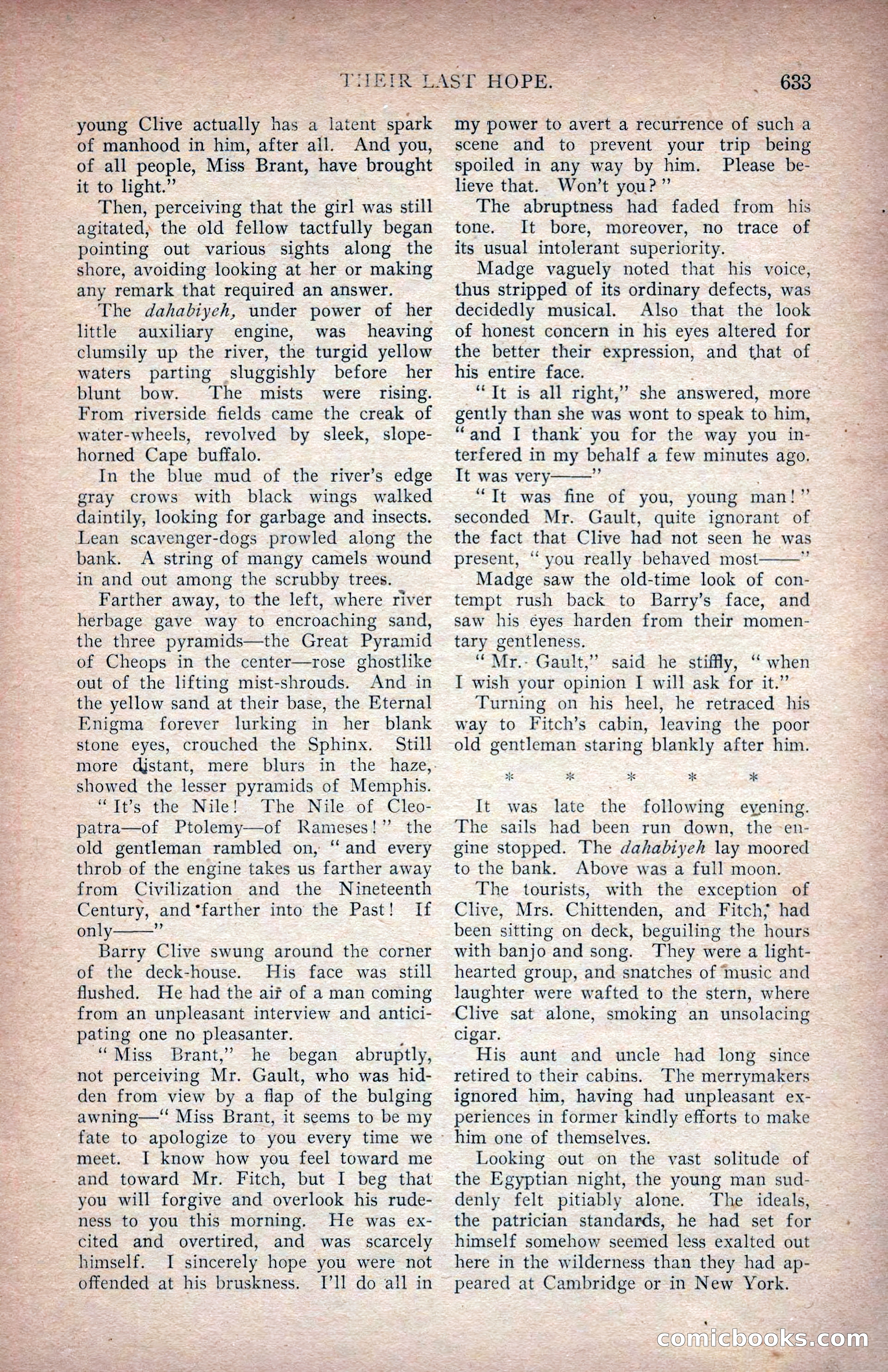
A restored page from Pulp Fiction, 1907. Page through the whole issue in the reader above.
📄 Transcribed text from this page (OCR, searchable)
Machine-transcribed from the original scan — historical spelling and the odd misread are preserved.
young Clive actually has a latent spark of manhood in him, after all. And you, of all people, Miss Brant, have brought it to light.” : Then, perceiving that the girl was still agitated, the old fellow tactfully began pointing out various sights along the shore, avoiding looking at her or making any remark that required an answer. ‘The dahabiyeh, under power of her little auxiliary engine, was heaving clumsily up the river, the turgid yellow waters parting sluggishly before her blunt bow. The mists were rising. From riverside fields came the creak of water-wheels, revolved by sleek, slope- horned Cape buffalo. In the blue mud of the river’s edge gray crows with black wings walked daintily, looking for garbage and insects. Lean scavenger-dogs prowled along the bank. A string of mangy camels wound in and out among the scrubby trees. Farther away, to the left, where river herbage gave way to encroaching sand, the three pyramids—the Great Pyramid of Cheops in the center—rose ghostlike out of the lifting mist-shrouds. And in the yellow sand at their base, the Eternal Enigma forever lurking in her blank stone eyes, crouched the Sphinx. Still more distant, mere blurs in the haze,. showed the lesser pyramids of Memphis. erts the Nae; Phe. Nile. of Cleo- patra—of Ptolemy—of Rameses!” the old gentleman rambled on, ‘and every throb of the engine takes us farther away from Civilization and the Nineteenth Century, and‘farther into the Past! If only = Barry Clive swung around the corner of the deck-house. His face was still flushed. He had the aif of a man coming from an unpleasant interview and antici- pating one no pleasanter. “Miss Brant,” he began abruptly, not perceiving Mr. Gault, who was hid- den from view by a flap of the bulging awning—‘“ Miss Brant, it seems to be my fate to apologize to you every time we - meet. I know how you feel toward me and toward Mr. Fitch, but I beg that you will forgive and overlook his rude- ness to you this morning. He was ex- cited and overtired, and was scarcely himself. I sincerely hope you were not offended at his bruskness. I'll do all in THEIR LAST HOPE. my power to avert a recurrence of such a scene and to prevent your trip being spoiled in any way by him. Please be- lieve that. Won’t you?” The abruptness had faded from his tone. It bore, moreover, no trace of its usual intolerant superiority. Madge vaguely noted that his voice, thus stripped of its ordinary defects, was decidedly musical. Also that the look of honest concern in his eyes altered for the better their expression, and that of his entire face. “It is all right,’ she answered, more 7 gently than she was wont to speak to him, “and I thank you for the way you in- terfered in my behalf a few minutes ago. It was very = | “Tt was fine of you, young man!” seconded Mr. Gault, quite ignorant of the fact that Clive had not seen he was present, “ you really behaved most “ Madge saw the old-time look of con- tempt rush back to Barry’s face, and saw his eyes harden from their momen- tary gentleness. “Mr.- Gault,” said he stiffly, “ when I wish your opinion I will ask for it.” Turning on his heel, he retraced his way to Fitch’s cabin, leaving the poor old gentleman staring blankly after him. It was late the following eyening. The sails had been run down, the -en- gine stopped. The dahabiyeh lay moored to the bank. Above was a full moon. The tourists, with the exception of Clive, Mrs. Chittenden, and Fitch; had been sitting on deck, beguiling the hours with banjo and song. They were a light- hearted group, and snatches of music and laughter were wafted to the stern, where Clive sat alone, smoking an unsolacing cigar. His aunt and uncle had long since retired to their cabins. The merrymakers ignored him, having had unpleasant ex- periences in former kindly efforts to make him one of themselves. Looking out on the vast solitude of the Egyptian night, the young man sud- denly felt pitiably alone. The ideals, the patrician standards, he had set for himself somehow seemed less exalted out here in the wilderness than they had ap- peared at Cambridge or in New York. Comicbooks.co > 5 ae on “as