
Pulp Fiction, 1907 · page 63 of 228
The Argosy, March 1907 — page 63: what you’re looking at
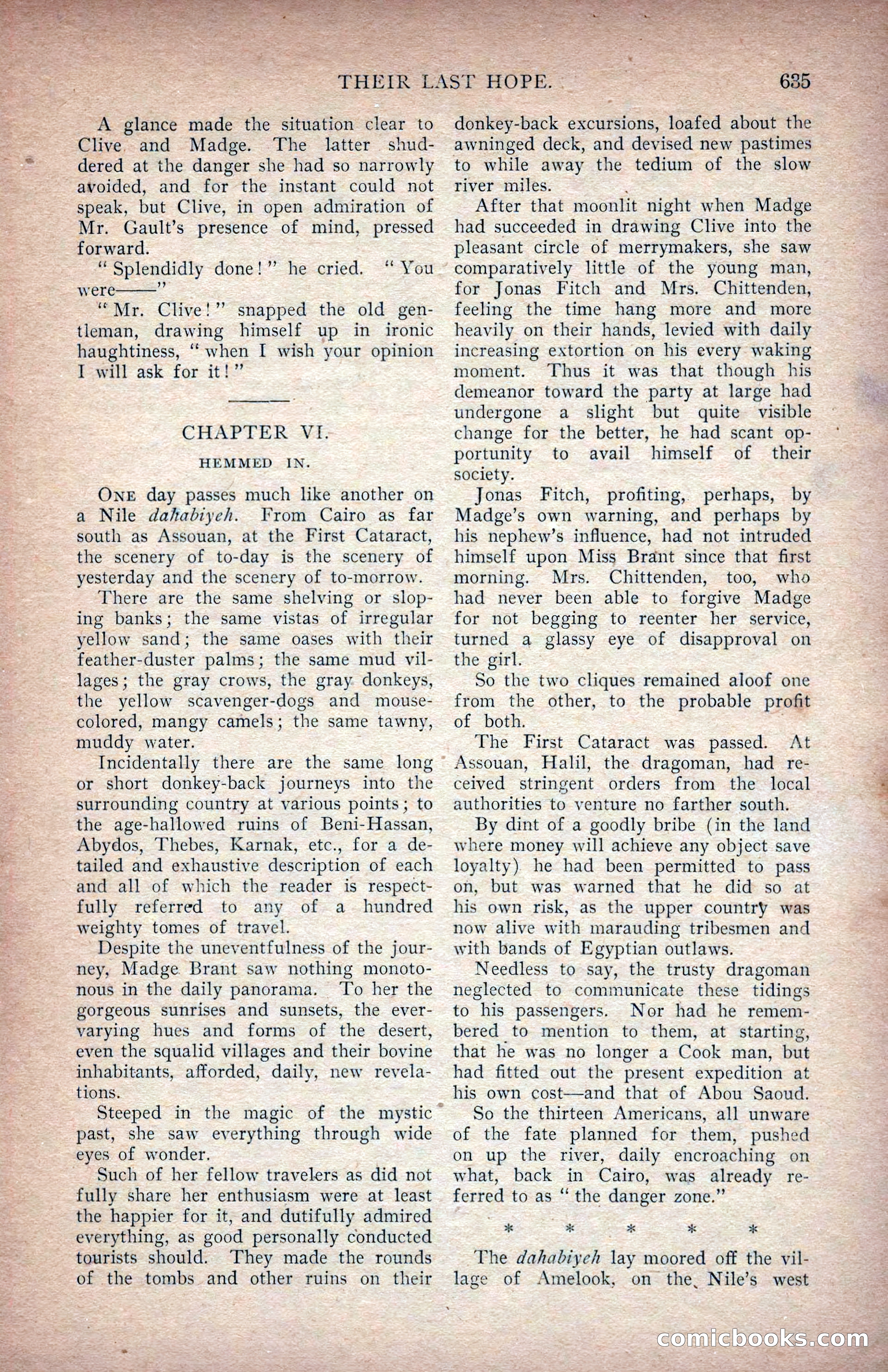
A restored page from Pulp Fiction, 1907. Page through the whole issue in the reader above.
📄 Transcribed text from this page (OCR, searchable)
Machine-transcribed from the original scan — historical spelling and the odd misread are preserved.
Oe et = * j he om —.. » a a ee . ye * tft MTS z ~ ee re - _ > ~~ or Pr ae 3 x ~ rs : ; - = SS C- “> =F — “ ats * - - : - THEIR LAST HOPE. “A glance made the situation clear to Clive. and Madge. The latter shud- dered at the danger she had so narrowly avoided, and for the instant could not speak, but Clive, in open admiration of Mr. Gault’s presence of mind, pressed forward. ““Splendidly done!” he cried. were & ‘“Mr. Clive!” snapped the old gen- tleman, drawing himself up in ironic haughtiness, ‘when I wish your opinion I will ask for it!” Vou CHAPTER VI. HEMMED IN. ONE day passes much like another on a Nile dahabiyeh. From Cairo as far south as Assouan, at the First Cataract, the scenery of to-day is the scenery of yesterday and the scenery of to-morrow. There are the same shelving or slop- ing banks; the same vistas of irregular yellow sand; the same oases with their feather-duster palms; the same mud vil- _ lages; the gray crows, the gray donkeys, the yellow scavenger-dogs and mouse- colored, mangy camels; the same tawny, muddy water. Incidentally there are the same long ~ or short donkey-back journeys into the surrounding country at various points; to the age-hallowed ruins of Beni-Hassan, Abydos, Thebes, Karnak, etc., for a de- tailed and exhaustive description of each and all of which the reader is respect- fully referred to any of a_ hundred weighty tomes of travel. Despite the uneventfulness of the jour- ney, Madge Brant saw nothing monoto- nous in the daily panorama. ‘To her the gorgeous sunrises and sunsets, the ever- varying hues and forms of the desert, even the squalid villages and their bovine inhabitants, afforded, daily, new revela- tions. Steeped in the magic of the mystic past, she saw everything through wide eyes of wonder. Such of her fellow travelers as did not fully share her enthusiasm were at least the happier for it, and dutifully admired everything, as good personally conducted tourists should. They made the rounds of the tombs and other ruins on their donkey-back excursions, loafed about the awninged deck, and devised new pastimes to while away the tedium of the slow river miles. After that moonlit night when Madge had succeeded in drawing Clive into the pleasant circle of merrymakers, she saw comparatively little of the young man, for Jonas Fitch and Mrs. Chittenden, feeling the time hang more and more heavily on their hands, levied with daily increasing extortion on his every waking moment. Thus it was that though his demeanor toward the party at large had undergone a slight but quite visible change for the better, he had scant op- portunity to avail himself of their society. Jonas Fitch, profiting, perhaps, by Madge’s own warning, and perhaps by his nephew’s influence, had not intruded himself upon Miss Brant since that first morning. Mrs. Chittenden, too, who had never been able to forgive Madge for not begging to reenter her service, turned a glassy eye of disapproval on the girl. So the two cliques remained aloof one from the other, to the probable profit of both. The First Cataract was passed. At Assouan, Halil, the dragoman, had re- ceived stringent orders from the local authorities to venture no farther south. By dint of a goodly bribe (in the land where money will achieve any object save loyalty) he had been permitted to pass on, but was warned that he did so at his own risk, as the upper country was now alive with marauding tribesmen and with bands of Egyptian outlaws. Needless to say, the trusty dragoman neglected to communicate these tidings to his passengers. Nor had he remem- bered to mention to them, at starting, that he was no longer a Cook man, but had fitted out the present expedition at his own cost—and that of Abou Saoud. So the thirteen Americans, all unware of the fate planned for them, pushed on up the river, daily encroaching on what, back in Cairo, was already re- ferred to as “ the danger zone.” The dahabiyeh lay moored off the vil- lage of Amelook, on the, Nile’s west .OO . x (E) AUS ‘SCO