
Pulp Fiction, 1907 · page 74 of 228
The Argosy, March 1907 — page 74: what you’re looking at
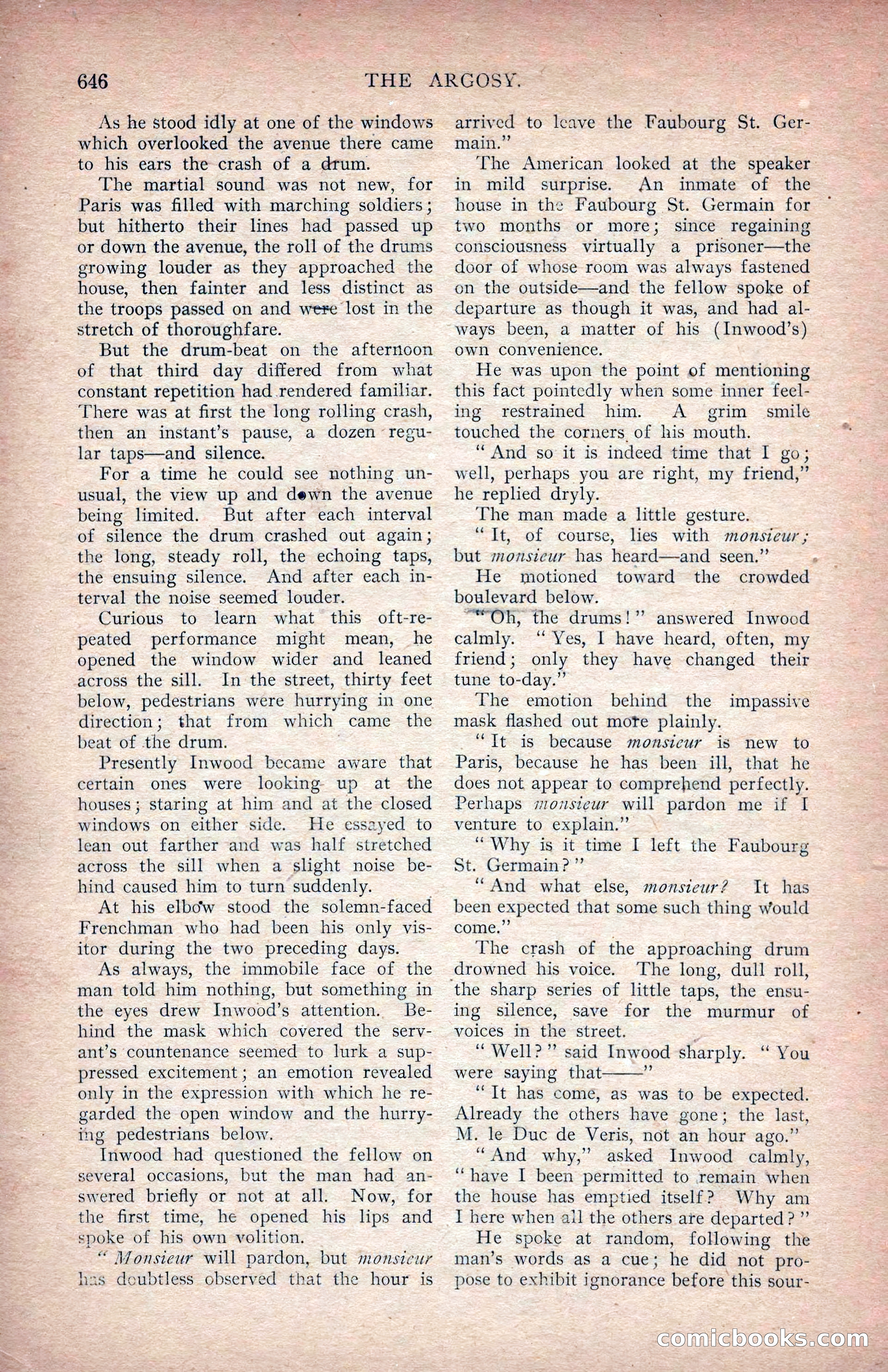
A restored page from Pulp Fiction, 1907. Page through the whole issue in the reader above.
📄 Transcribed text from this page (OCR, searchable)
Machine-transcribed from the original scan — historical spelling and the odd misread are preserved.
— 646 As he stood idly at one of the windows which overlooked the avenue there came to his ears the crash of a drum. The martial sound was not new, for Paris was filled with marching soldiers ; but hitherto their lines had passed up or down the avenue, the roll of the drums growing louder as they approached the house, then fainter and less distinct as the troops passed on and were lost in the stretch of thoroughfare. But the drum-beat on the afternoon of that third day differed from what constant repetition had rendered familiar. There was at first the long rolling crash, then an instant’s pause, a dozen regu- lar taps—and silence. For a time he could see nothing un- usual, the view up and dewn the avenue being limited. But after each interval of silence the drum crashed out again; the long, steady roll, the echoing taps, the ensuing silence. And after each in- terval the noise seemed louder. Curious to learn what this oft-re- peated performance might mean, he opened the window wider and leaned across the sill. In the street, thirty feet below, pedestrians were hurrying in one direction; that from which came the beat of the drum. : Presently Inwood became aware that certain ones were looking up at the houses ; staring at him and at the closed windows on either side. He essayed to lean out farther and was half stretched across the sill when a slight noise be- hind caused him to turn suddenly. | At his elbow stood the solemn-faced Frenchman who had been his only vis- itor during the two preceding days. As always, the immobile face of the man told him nothing, but something in the eyes drew Inwood’s attention. Be- hind the mask which covered the serv- ant’s countenance seemed to lurk a sup- pressed excitement; an emotion revealed only in the expression with which he re- garded the open window and the hurry- ing pedestrians below. Inwood had questioned the fellow on several occasions, but the man had an- swered briefly or not at all. Now, for the first time, he opened his lips and spoke of his own volition. “ Monsieur will pardon, but monsicur has doubtless observed that the hour is drowned his voice. ee A Oe * - —— ates _ a . — az oo nt wor $ - nO 2 . ee =. - - 2 - THE ARGOSY., arrived to leave the Faubourg St. Ger- main.” The American looked at the speaker in mild surprise. An inmate of the house in the Faubourg St. Germain for two months or more; since regaining consciousness virtually a prisoner—the door of whose room was always fastened on the outside—and the fellow spoke of departure as though it was, and had al- ways been, a matter of his (Inwood’s) own convenience. He was upon the point of mentioning this fact pointedly when some inner feel- ing restrained him. A_ grim smile touched the corners of his mouth. “ And so it is indeed time that I go; well, perhaps you are right, my friend,” he replied dryly. The man made a little gesture. “It, of course, lies with monsieur ; but monsieur has heard—and seen.” He motioned toward the crowded boulevard below. “Oh, the drums!” answered Inwood calmly. “ Yes, I have heard, often, my friend; only they have changed their tune to-day.” The emotion behind the impassive mask flashed out mote plainly. “It is because monsicur is new to Paris, because he has been ill, that he does not appear to comprehend perfectly. Perhaps maozsteur will pardon me if I venture to explain.” “Why is it time I left the Faubourg St. Germain?” ‘And what else, monsieur? It has been expected that some such thing would come.” The crash of the approaching drum The long, dull roll, the sharp series of little taps, the ensu- ing silence, save for the murmur of voices in the street. “Well?” said Inwood sharply. “ You be] were saying that——— “It has come, as was to be expected. Already the others have gone; the last, M. le Duc de Veris, not an hour ago.” “And why,” asked Inwood calmly, “have I been permitted to remain when the house has emptied itself? Why am 1 here when ail the others are departed? ” He spoke at random, following the man’s words as a cue; he did not pro- pose to exhibit ignorance before this sour- GOmicboo <SiiGO as et 8 yl ee Fe Se ee eee AS owen yy a Se ae SO a Siagt 9S OR nea ed : ~« =e ee ag Se es oO, nated ir hd ow C_ Sy eee A Rs v fog Sn mn