
Pulp Fiction, 1907 · page 76 of 228
The Argosy, March 1907 — page 76: what you’re looking at
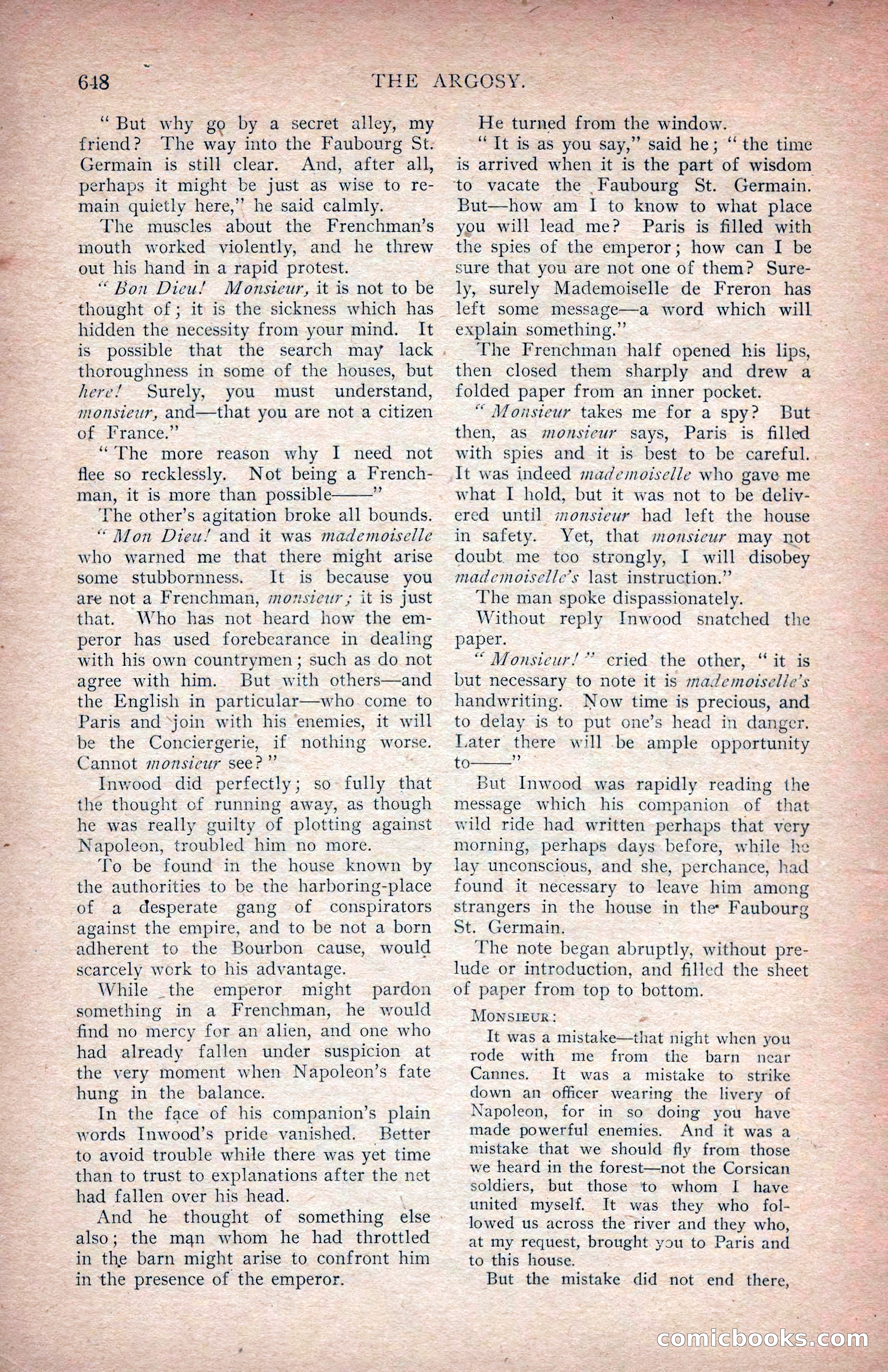
A restored page from Pulp Fiction, 1907. Page through the whole issue in the reader above.
📄 Transcribed text from this page (OCR, searchable)
Machine-transcribed from the original scan — historical spelling and the odd misread are preserved.
pig es THE ARGOSY.— “But why go by a secret ties my friend? The way into the Faubourg St. Germain is still clear. And, after all, perhaps it might be just as wise to re- main quietly here,’ he said calmly. The muscles about the Frenchman’s mouth worked violently, and he threw out his hand in a rapid protest. “Bon Dicu!l Monsieur, it is not to be thought of; it is the sickness which has hidden the necessity from your mind. It is possible that the search may lack . thoroughness in some of the houses, but here! Surely, you must understand, monsieur, and—that you are not a citizen of France.” ‘The more reason why I need not flee so recklessly. Not being a French- man, it is more than possible The other’s agitation broke all bounds. “Non Dieu! and it was mademoiselle who warned me that there might arise some stubbornness. It is because you are not a Frenchman, moznsteur; it 1s just that. Who has not heard how the em- peror has used forebearance in dealing with his own countrymen ; such as do not agree with him. But with others—and the English in particular—who come to Paris and ‘join with his enemies, it will be the Conciergerie, if nothing worse. Cannot monsicur see?” Inwood did perfectly; so- fully me the thought of running away, as though he was really guilty of plotting against Napoleon, troubled him no more. To be found in the house known by the authorities to be the harboring-place of a desperate gang of conspirators against the empire, and to be not a born adherent to the Bourbon cause, would scarcely work to his advantage. While _the emperor might pardon something in a Frenchman, he would find no mercy for an alien, and one who had already fallen under suspicion at the very moment when Napoleon’s fate hung in the balance. In the face of his companion’s plain words Inwood’s pride vanished. Better to avoid trouble while there was yet time than to trust to explanations after the net had fallen over his head. And he thought of something else - also; the man whom he had throttled in the barn might arise to confront him in the presence of the emperor. He turned from the window. “It is as you say,” said he; ‘‘ the time is arrived when it is the part of wisdom to vacate the Faubourg St. Germain. But—how am I to know to what place you will lead me? Paris is filled with the spies of the emperor; how can I be sure that you are not one of them? Sure- ly, surely Mademoiselle de Freron has left some message—a word which will explain something.” The Frenchman half opened his lips, then closed them sharply and drew a folded paper from an inner pocket. “ Mousteur takes me for a spy? But. then, as monsicur says, Paris is filled with spies and it is best to be careful... It was indeed mademoiselle who gave me what I hold, but it was not to be deliv- ered until monsieur had left the house in safety. Yet, that monsicur may not doubt me too strongly, I will disobey mademotselle’s last instruction.” The man spoke dispassionately. Without reply Inwood snatched the paper. “ Monsieur!” cried the other, “ it is but necessary to note it is mademoiselle’s handwriting. Now time is precious, and to delay is to put one’s head in danger. Later there will be ample opportunity to » be SP But Inwood was rapidly reading the message which his companion of that wild ride had written perhaps that very morning, perhaps days before, while he lay unconscious, and she, perchance, had found it necessary to leave him among strangers in the house In thes Faubourg St. Germain. The note began abruptly, without pre- lude or introduction, and filled the sheet of paper from top to bottom. MONSIEUR: 2 It was a mistake—that night when you rode with me from the barn near Cannes. It was a mistake to strike down an officer wearing the livery of Napoleon, for in so doing you have made powerful enemies. And it was a mistake that we should fly from those we heard in the forest—not the Corsican soldiers, but those to whom I have united myself. It was they who fol- lowed us across the river and they who, at my request, brought you to Paris and to this house. But the mistake did not end there, ECOMIGDOOKS- co mm