
Pulp Fiction, 1922 · page 102 of 180
Argosy All-Story Weekly, 4 February 1922 — page 102: what you’re looking at
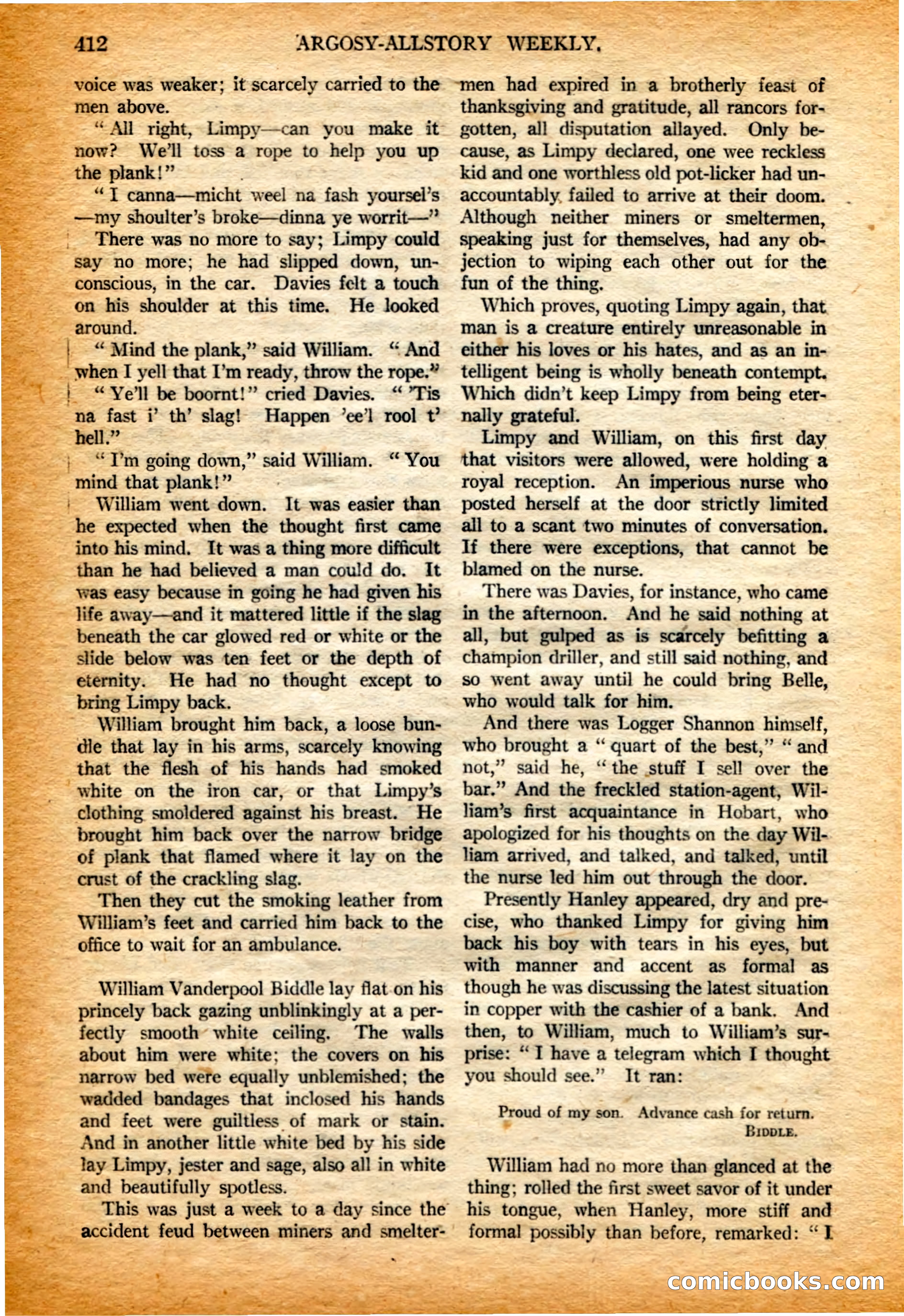
A restored page from Pulp Fiction, 1922. Page through the whole issue in the reader above.
📄 Transcribed text from this page (OCR, searchable)
Machine-transcribed from the original scan — historical spelling and the odd misread are preserved.
% | Le | yt nd ye <u : a t 7 7h Ve 44 1) HY 4 ry ( ri Ps Virveye “ay wre ve Vintner. ‘ ys | pay - Ward ' Vee Ta WAS. Tay ar wk we A a re ee RN PR wT STC : \ . on ‘| at VY. vere ; i7 4 - 7 é 7 na SS 15 aa ps = .% 7 J A12 ._ = = . voice was weaker; it scarcely carried to the men above. “All right, Limpy—can you make it _ now? We'll toss a rope to help you up the plank!” “T canna—micht weel na fash yoursel’s —my shoulter’s broke—dinna ye worrit—” There was no more to say; Limpy could say no more; he had slipped down, un- conscious, in the car. Davies felt a touch on his shoulder at this time. He looked around. “Mind the plank,” said William. “ And Te earn I yell that I’m ready, throw the rope.” “Ye'll be boornt!” cried Davies. na fast i’ th’ slag! hell. ” “T’m going down,” said William. mind that plank!” William went down. It was easier than he expected when the thought first came into his mind. It was a thing more difficult than he had believed a man could do. It was easy because in going he had given his life away—and it mattered little if the slag beneath the car glowed red or white or the slide below was ten feet or the depth of eternity. He had no thought except to << *Tis Happen ’ee’] rool t’ “You bring Limpy back. William brought him back, a loose bun- dle that lay in his arms, scarcely knowing that the flesh of his hands had smoked white on the iron car, or that Limpy’s clothing smoldered against his breast. He brought him back over the narrow bridge of plank that flamed where it lay on the crust of the crackling slag. Then they cut the smoking leather from William’s feet and carried him back to the office to wait for an ambulance. William Vanderpool Biddle lay flat.on his princely back gazing unblinkingly at a per- fectly smooth’ white ceiling. The walls about him were white: the covers on his narrow bed were equally unblemished; the wadded bandages that inclosed his hands and feet were guiltless of mark or stain. And in another little white bed by his side lay Limpy, jester and sage, also all in white and beautifully spotless. This was just a week to a day since the _ accident feud between miners and smelter- => ey =e = x = —— le — ARGOSY-ALLSTORY WEEKLY, ‘men had expired in a brotherly feast of thanksgiving and gratitude, all rancors for- gotten, all disputation allayed. Only be- cause, as Limpy declared, one wee reckless kid and one worthless old pot-licker had un- accountably, failed to arrive at their doom. Although neither miners or smeltermen, speaking just for themselves, had any ob- jection to wiping each other out for the fun of the thing. Which proves, quoting Limpy again, that man is a creature entirely umreasonable in either his loves or his hates, and as an in- telligent being is wholly beneath contempt. Which didn’t keep Limpy from being eter- nally grateful. Limpy and William, on this first day that visitors were allowed, were holding a royal reception. An imperious nurse who posted herself at the door strictly limited all to a scant two minutes of conversation. If there were exceptions, that cannot be blamed on the nurse. There was Davies, for instance, who came in the afternoon. And he said nothing at all, but gulped as is scarcely befitting a champion driller, and still said nothing, and so went away until he could bring Belle, who would talk for him. And there was Logger Shannon himself, who brought a “ quart of the best,” “and not,” said he, “ the stuff I sell over the bar.” And the freckled station-agent, Wil- liam’s first acquaintance in Hobart, who apologized for his thoughts on the day Wil- liam arrived, and talked, and talked, until the nurse led him out through the door. Presently Hanley appeared, dry and pre- cise, who thanked Limpy for giving him back his boy with tears in his eyes, but with manner and accent as formal as though he was discussing the latest situation in copper with the cashier of a bank. And then, to William, much to William’s sur- prise: “I have a telegram which I thought you should see.” It ran: Proud of my son. Advance cash for return. BivDLe. William had no more than glanced at the thing; rolled the first sweet savor of it under his tongue, when Hanley, more stiff and formal possibly than before, remarked: “I oO e¢om (ail ofefe) oS) = “p Se 2 Zz = i =| =, =—, « - — oo - ee es ee Se ;