
Pulp Fiction, 1922 · page 150 of 180
Argosy All-Story Weekly, 4 February 1922 — page 150: what you’re looking at
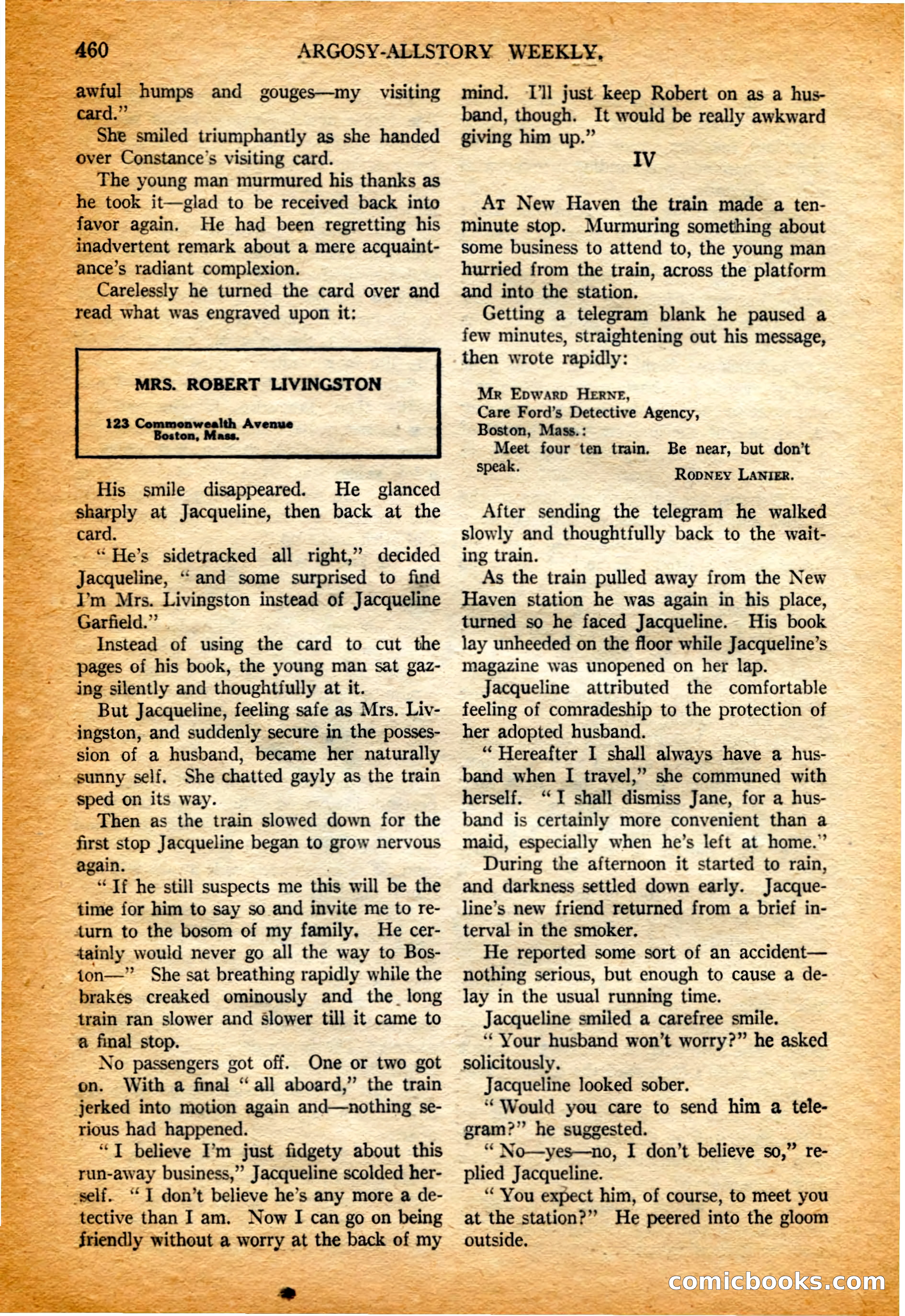
A restored page from Pulp Fiction, 1922. Page through the whole issue in the reader above.
📄 Transcribed text from this page (OCR, searchable)
Machine-transcribed from the original scan — historical spelling and the odd misread are preserved.
ae ~ i , iy 7 . L > o ye = 2s, a eo — ee ae or = hee =< a ans ies *” ks lo | ae.) fea | ; , é awful humps and gouges—my visiting card.” She smiled triumphantly as she handed over Constance’s visiting card. The young man murmured his thanks as - he took it—glad to be received back into favor again. He had been regretting his inadvertent remark about a mere acquaint- ance’s radiant complexion. Carelessly he turned the card over and read what was engraved upon it: MRS. ROBERT LIVINGSTON 123 Commonwealth Avenue Boston, Mass. His smile disappeared. He glanced sharply at Jacqueline, then back at the card. “He’s sidetracked all right,” decided Jacqueline, “and some surprised to find I’m Mrs. Livingston instead of Jacqueline Garfield.”’ Instead of using the card to cut the pages of his book, the young man sat gaz- ing silently and thoughtfully at it. - But Jacqueline, feeling safe as Mrs. Liv- jngston, and suddenly secure in the posses- sion of a husband, became her naturally - sunny self. She chatted gayly as the train ~ $ped on its way. Then as the train slowed down for the first stop Jacqueline began to grow nervous again. ; “Tf he still suspects me this will be the time for him to say so and invite me to re- durn to the bosom of my family, He cer- tainly would never go all the way to Bos- _. ton—” She sat breathing rapidly while the brakes creaked ominously and the_ long train ran slower and Slower till it came to a final stop. No passengers got off. One or two got on. With a final “all aboard,” the train jerked into motion again and—nothing se- rious had happened. “TI believe I’m just fidgety about this run-away business,” Jacqueline scolded her- self. “I don’t believe he’s any more a de- tective than I am. Now I can go on being friendly without a worry at the back of my * i _eee ARGOSY-ALLSTORY WEEKLY, mind. ‘'ll just keep Robert on as a hus- band, though. It would be really awkward giving him up.” IV At New Haven the train made a ten- minute stop. Murmuring something about some business to attend to, the young man hurried from the train, across the platform and into the station. Getting a telegram blank he paused a few minutes, straightening out his message, then wrote rapidly: Mr Epwarp Hern, Care Ford’s Detective Agency, Boston, Mass. : Meet four ten train. Be near, but don’t speak. RopNEy LANIER. After sending the telegram he walked slowly and thoughtfully back to the wait- ing train. As the train pulled away from the New Haven station he was again in his place, turned so he faced Jacqueline. His book lay unheeded on the floor while Jacqueline’s magazine was unopened on her lap. Jacqueline attributed the comfortable feeling of comradeship to the protection of her adopted husband. “Hereafter I shall always have a hus- band when I travel,” she communed with herself. “I shall dismiss Jane, for a hus- band is certainly more convenient than a maid, especially when he’s left at home.” During the afternoon it started to rain, and darkness settled down early. Jacque- line’s new friend returned from a brief in- terval in the smoker. He reported some sort of an accident— nothing serious, but enough to cause a de- Jay in the usual running time. Jacqueline smiled a carefree smile. ‘Your husband won’t worry?” he asked solicitously. Jacqueline looked sober. ‘Would you care to send him a tele- gram?” he suggested. “ No—yes—no, I don’t believe so,” re- plied Jacqueline. “You expect him, of course, to meet you at the station?’”’ He peered into the gloom outside. Lt ecboo com cS com oe