
Pulp Fiction, 1922 · page 161 of 180
Argosy All-Story Weekly, 4 February 1922 — page 161: what you’re looking at
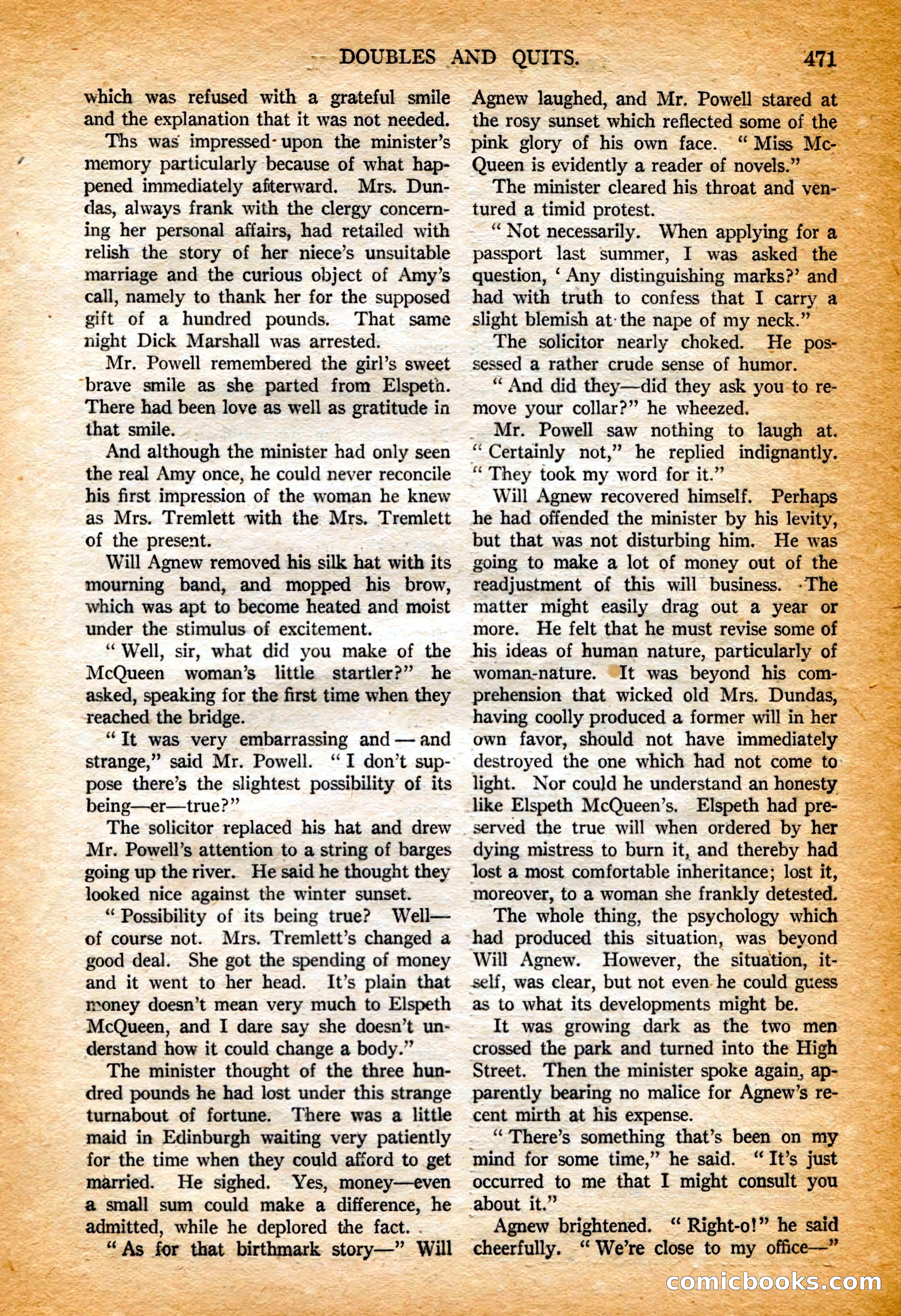
A restored page from Pulp Fiction, 1922. Page through the whole issue in the reader above.
📄 Transcribed text from this page (OCR, searchable)
Machine-transcribed from the original scan — historical spelling and the odd misread are preserved.
-- DOUBLES AND QUITS. which was refused with a grateful smile and the explanation that it was not needed. Ths was impressed- upon the minister’s memory particularly because of what hap- pened immediately afterward. Mrs. Dun- das, always frank with the clergy concern- ing her personal affairs, had retailed with relish the story of her niece’s unsuitable marriage and the curious object of Amy’s call, namely to thank her for the supposed gift of a hundred pounds, That same night Dick Marshall was arrested. Mr. Powell remembered the girl’s sweet ‘brave smile as she parted from Elspeta. There had been love as well as gratitude in that smile. And although the minister had only seen the real Amy once, he could never reconcile his first impression of the woman he knew as Mrs. Tremlett with the Mrs. Tremlett of the present. Will Agnew removed his silk hat with its mourning band, and mopped his brow, which was apt to become heated and moist under the stimulus of excitement. “Well, sir, what did you make of the McQueen woman’s little startler?” he asked, speaking for the first time when they reached the bridge. “It was very embarrassing and — and strange,” said Mr. Powell. ‘I don’t sup- pose there’s the slightest possibility of its being—er—true?” The solicitor replaced his hat and drew Mr. Powell’s attention to a string of barges going up the river. He said he thought they looked nice against the winter sunset. “Possibility of its being true? Well— of course not. Mrs. Tremlett’s changed a good deal. She got the spending of money and it went to her head. It’s plain that money doesn’t mean very much to Elspeth McQueen, and I dare say she doesn’t un- derstand how it could change a body.” The minister thought of the three hun- dred pounds he had lost under this strange turnabout of fortune. There was a little maid in Edinburgh waiting very patiently for the time when they could afford to get married. He sighed. Yes, money—even a small sum could make a difference, he admitted, while he deplored the fact. . “As for that birthmark story—” Will mind for some time,” he said. Agnew laughed, and Mr. Powell stared at the rosy sunset which reflected some of. the pink glory of his own face. Queen is evidently a reader of novels.” The minister cleared his throat and yen- tured a timid protest. “ Not necessarily. When applying for a passport last summer, I was asked the aT “ Miss Mc question, ‘ Any distinguishing marks?’ and had with truth to confess that I carry a slight blemish at: the nape of my neck.” The solicitor nearly choked. He pos- sessed a rather crude sense of humor. “And did they—did they ask you-to re- move your collar?” he wheezed. . __ Mr. Powell saw nothing to laugh at. “Certainly not,” he replied indignantly. ‘They took my word for it.” Will Agnew recovered himself. Perhaps he had offended the minister by his levity, but that was not disturbing him. He was going to make a lot of money out of the readjustment of this will business. -The matter might easily drag out a year or more. He felt that he must revise some of his ideas of human nature, particularly of woman-nature. It was beyond his com- prehension that wicked old Mrs. Dundas, having coolly produced a former will in her ~ own favor, should not have immediately destroyed the one which had not come to: light. Nor could he understand an honesty like Elspeth McQueen’s. Elspeth had pre- served the true will when ordered by her dying mistress to burn it, and thereby had lost a most comfortable inheritance; lost it, moreover, to a woman she frankly detested. The whole thing, the psychology which had produced this situation, was beyond Will Agnew. However, the situation, it- self, was clear, but not even. he could guess as to what its developments might be. It was growing dark as the two men crossed the park and turned into the High Street. Then the minister spoke again, ap- parently bearing no malice for Agnew’s re- cent mirth at his expense. “There’s something that’s been on my “Tt’s just occurred to me that I might consult you about it.” Agnew brightened. ‘“‘ Right-o!” he said cheerfully. “ We’re close to my office—” “SCO Eomicbool » 2