
Pulp Fiction, 1922 · page 165 of 180
Argosy All-Story Weekly, 4 February 1922 — page 165: what you’re looking at
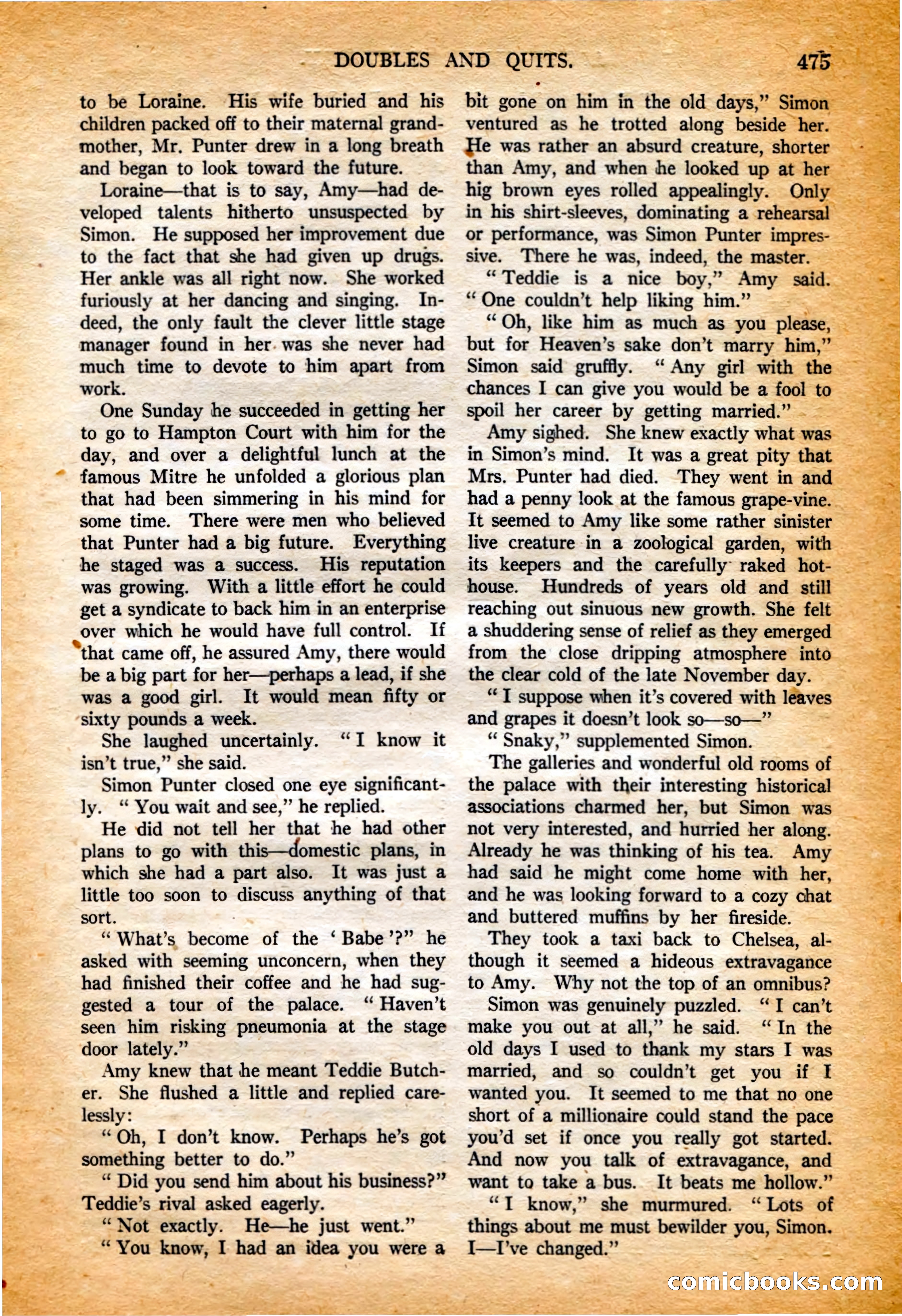
A restored page from Pulp Fiction, 1922. Page through the whole issue in the reader above.
📄 Transcribed text from this page (OCR, searchable)
Machine-transcribed from the original scan — historical spelling and the odd misread are preserved.
DOUBLES AND QUITS. to be Loraine. His wife buried and his children packed off to their maternal grand- mother, Mr. Punter drew in a long breath and began to look toward the future. Loraine—that is to say, Amy—had de- veloped talents hitherto unsuspected by Simon. He supposed her improvement due to the fact that she had given up drugs. Her ankle was all right now. She worked furiously at her dancing and singing. In- deed, the only fault the clever little stage manager found in her. was she never had much time to devote to him apart from work. One Sunday he succeeded in getting her to go to Hampton Court with him for the day, and over a delightful lunch at the famous Mitre he unfolded a glorious plan that had been simmering in his mind for some time. There were men who believed that Punter had a big future. Everything he staged was a success. His reputation was growing. With a little effort he could get a syndicate to back him in an enterprise over which he would have full control. If that came off, he assured Amy, there would be a big part for her—perhaps a lead, if she was a good girl. It would mean fifty or sixty pounds a week. She laughed uncertainly. isn’t true,” she said. Simon Punter closed one eye significant- ly. “ You wait and see,” he replied. He did not tell her that he had other plans to go with this—domestic plans, in which she had a part also. It was just a little too soon to discuss anything of that sort. “What’s become of the ‘ Babe’?” he asked with seeming unconcern, when they had finished their coffee and he had sug- gested a tour of the palace. “ Haven’t seen him risking pneumonia at the stage door lately.” Amy knew that he meant Teddie Butch- er. She flushed a little and replied care- lessly: “Oh, I don’t know. Perhaps he’s got something better to do.” “ Did you send him about his business?” Teddie’s rival asked eagerly. “Not exactly. He—he just went.” “You know, I had an idea you were a “IT know it ventured as he trotted along beside her. He was rather an absurd creature, shorter than Amy, and when he looked up at her hig brown eyes rolled appealingly. Only in his shirt-sleeves, dominating a rehearsal or performance, was Simon Punter impres- sive. There he was, indeed, the master. “Teddie is a nice boy,” Amy said. “One couldn’t help liking him.” “Oh, like him as much as you please, but for Heaven’s sake don’t marry him,” Simon said gruffly. “Any girl with the chances I can give you would be a fool to spoil her career by getting married.” Amy sighed. She knew exactly what was in Simon’s mind. It was a great pity that Mrs, Punter had died. They went in and had a penny !ook at the famous grape-vine. It seemed to Amy like some rather sinister live creature in a zoological garden, with its keepers and the carefully raked hot- house. Hundreds of years old and still reaching out sinuous new growth. She felt a shuddering sense of relief as they emerged from the close dripping atmosphere into the clear cold of the late November day. “‘T suppose when it’s covered with leaves and grapes it doesn’t look so—so—”’ “‘ Snaky,” supplemented Simon. The galleries and wonderful old rooms of the palace with their interesting historical associations charmed her, but Simon was not very interested, and hurried her along. Already he was thinking of his tea. Amy had said he might come home with her, and he was looking forward to a cozy chat and buttered muffins by her fireside. They took a taxi back to Chelsea, al- though it seemed a hideous extravagance to Amy. Why not the top of an omnibus? Simon was genuinely puzzled. “TI can’t make you out at all,” he said. “In the old days I used to thank my stars I was married, and so couldn’t get you if I wanted you. It seemed to me that no one short of a millionaire could stand the pace you’d set if once you really got started. And now you talk of extravagance, and want to take a bus. It beats me hollow.” “IT know,” she murmured. “Lots of things about me must bewilder you, Simon. I—I’ve changed.” — bit gone on him in the old days,” Simon Eomicbooks.co ar . | vie £