
Pulp Fiction, 1922 · page 32 of 180
Argosy All-Story Weekly, 4 February 1922 — page 32: what you’re looking at
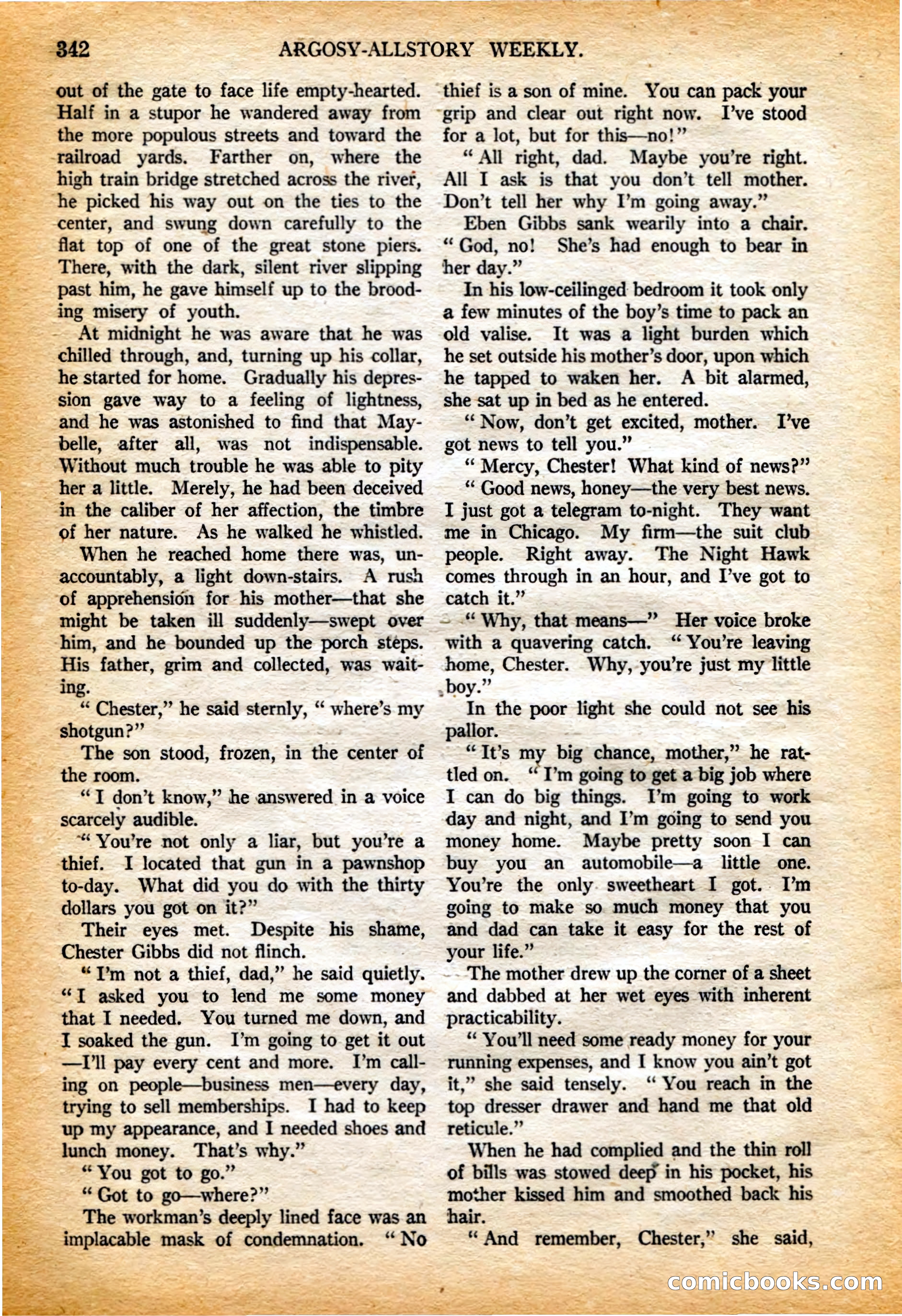
A restored page from Pulp Fiction, 1922. Page through the whole issue in the reader above.
📄 Transcribed text from this page (OCR, searchable)
Machine-transcribed from the original scan — historical spelling and the odd misread are preserved.
t of the gate to face life empty-hearted. ‘Half in a stupor he wandered away from 3 the more populous streets and toward the railroad yards. Farther on, where the high train bridge stretched across the river, zt he picked his way out on the ties to the Eacnieh, and swung down carefully to the flat top of one of the great stone piers. There, with the dark, silent river slipping = ~ past him, he gave himself up to the brood- ing misery of youth. = — At midnight he was aware that he was chilled through, and, turning up his collar, he started for home. Gradually his depres- 2 sion gave way to a feeling of lightness, - -and he was astonished to find that May- Si _ belle, after all, was not indispensable. es Without much trouble he was able to pity sz her a little. Merely, he had been deceived Zz 4m the caliber of her affection, the timbre = ss 8 her nature. As he walked he whistled. When he reached home there was, un- semmiaiy, a light down-stairs. A rush = - -of apprehension for his mother—that she = Sight be taken ill suddenly—swept over _-him, and he bounded up the porch steps. “His father, grim and collected, was wait- O& Chester,” he said sternly, “ where’s my shotgun?” The son stood, frozen, in the center of 2 ~ the room. 3 2 “TJ don’t know,” he answered in a voice : scarcely audible. ~ “You're not only a liar, but you're a thief. I located that gun in a pawnshop _ to-day. What did you do with the thirty se - dollars you got on it?” Their eyes met. Despite his shame, = Eo. _ Chester Gibbs did not flinch. | = <4 “I’m not a thief, dad,” he said quietly. “J asked you to lend me some money = “that I needed. You turned me down, and -I soaked the gun. I’m going to get it out 3 ~—I’ll pay every cent and more. I’m call- : 3 ing on people—business men—every day, te _ trying to sell memberships. I had to keep _ up my appearance, and I needed shoes and =< & lunch money. That’s why.” == © You got to go.” Se “ Got to go—where?”’ _ The workman’s deeply lined face was an acable mask of condemnation. “ No Se 22 7 a. ~~ + Ne: = = a = *. _ se imp SF <i Ss e —~ ee a on ARGOSY-ALLSTORY. WEEELY. ee ae ‘i =e -thief is a son of mine. You can pack your “grip and clear out right now. I’ve stood for a lot, but for this—no!” * All right, dad. Maybe you’re right. All I ask is that you don’t tell mother. Don’t tell her why I’m going away.” Eben Gibbs sank wearily into a chair. “God, no! She’s had enough to bear in her day.” In his low-ceilinged bedroom it took only a few minutes of the boy’s time to pack an old valise. It was a light burden which he set outside his mother’s door, upon which he tapped to waken her. A bit alarmed, she sat up in bed as he entered. “Now, don’t get excited, mother. got news to tell you.” “ Mercy, Chester! What kind of news?” ** Good news, honey—the very best news. I just got a telegram to-night. They want me in Chicago. My firm—the suit club people. Right away. The Night Hawk comes through in an hour, and I’ve got to catch it.” ~ .“ Why, that means—” Her voice broke with a quavering catch. ‘“ You’re leaving home, Chester. Why,-you’re just my little I’ve boy.” Th the poor light she could not see his pallor. “It’s my big chance, mother,” he rat- tled on. “I’m going to get a big job where I can do big things. I’m going to work day and night, and I’m going to send you money home. Maybe pretty soon I can buy you an automobile—a little one. You’re the only. sweetheart I got. I’m going to make so much money that you and dad can take it easy for the rest of your life.” The mother drew up the corner of a sheet and dabbed at her wet eyes with inherent practicability. “You'll need some ready money for your running expenses, and I know you ain’t got it,” she said tensely. ‘“ You reach in the top dresser drawer and hand me that old reticule.”’ When he had complied and the thin roll of bills was stowed deep in his pocket, his mother kissed him and smoothed back his hair. “And remember, Chester,” she said, — = ae “a a a> - 2 eee —— 7 mae i -