
Pulp Fiction, 1922 · page 38 of 180
Argosy All-Story Weekly, 4 February 1922 — page 38: what you’re looking at
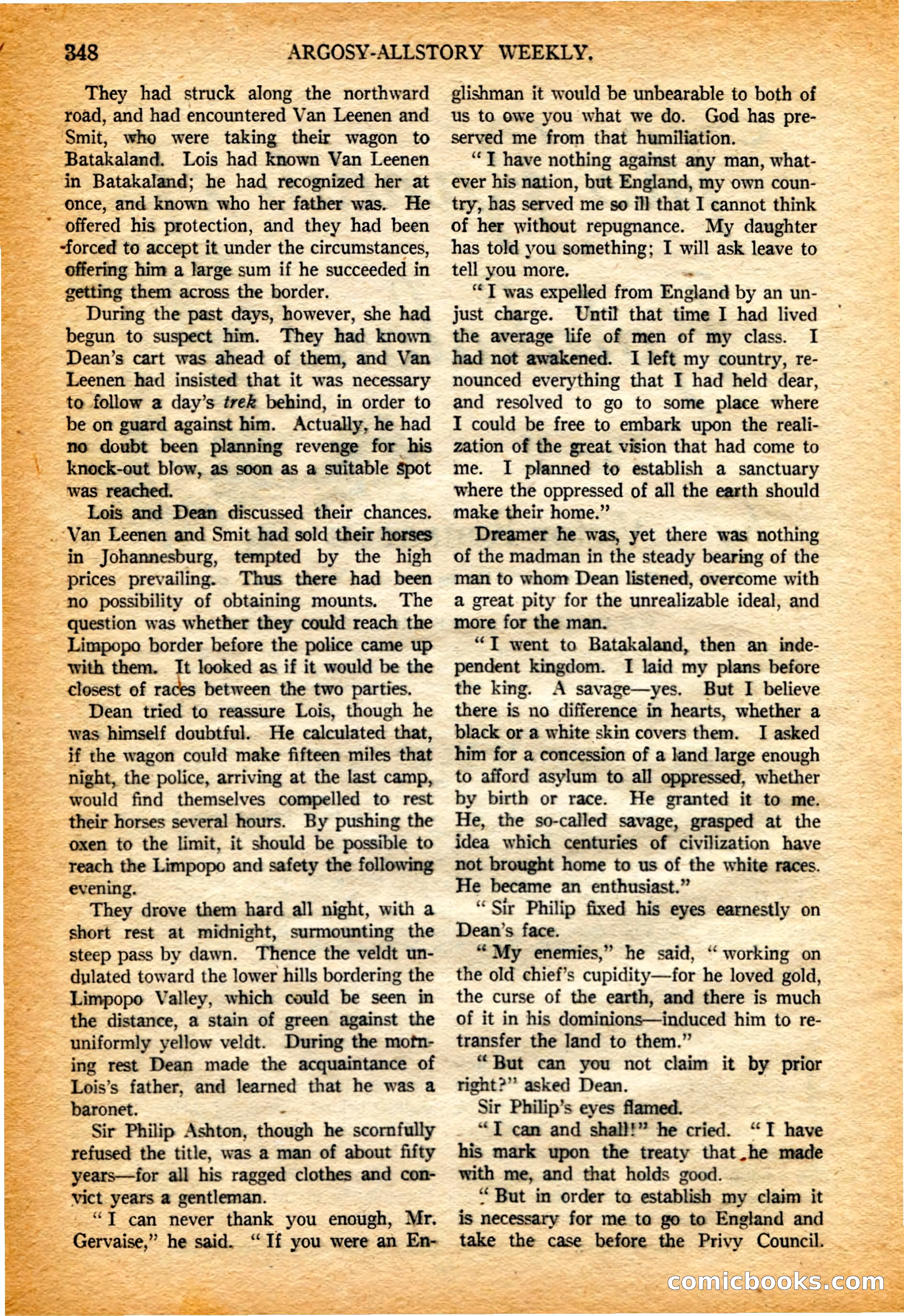
A restored page from Pulp Fiction, 1922. Page through the whole issue in the reader above.
📄 Transcribed text from this page (OCR, searchable)
Machine-transcribed from the original scan — historical spelling and the odd misread are preserved.
348 They had struck along the northward road, and had encountered Van Leenen and Smit, who were taking their wagon to Batakaland. Lois had known Van Leenen in Batakaland; he had recognized her at once, and known who her father was. He offered his protection, and they had been -forced to accept it under the circumstances, offering him a large sum if he succeeded in getting them across the border. During the past days, however, she had begun to suspect him. They had known Dean’s cart was ahead of them, and Van Leenen had insisted that it was necessary to follow a day’s trek behind, in order to be on guard against him. Actually, he had no doubt been planning revenge for his knock-out blow, as soon as a suitable Spot was reached. Lois and Dean discussed their chances. _-Van Leenen and Smit had sold their horses in Johannesburg, tempted by the high prices prevailing. Thus there had been no possibility of obtaining mounts. The question was whether they could reach the Limpopo border before the police came up with them. It looked as if it would be the closest of races between the two parties. Dean tried to reassure Lois, though he was himself doubtful. He calculated that, if the wagon could make fifteen miles that night, the police, arriving at the last camp, would find themselves compelled to rest their horses several hours. By pushing the oxen to the limit, it should be possible to reach the Limpopo and safety the following evening. They drove them hard all night, with a short rest at midnight, surmounting the steep pass by dawn. Thence the veldt un- dulated toward the lower hills bordering the Limpopo Valley, which could be seen in the distance, a stain of green against the uniformly yellow veldt. During the mofn- ing rest Dean made the acquaintance of Lois’s father, and learned that he was a baronet. : Sir Philip Ashton, though he scornfully refused the title, was a man of about fifty years—for all his ragged clothes and con- vict years a gentleman. _ “TJ can never thank you enough, Mr. Gervaise,” he said. ‘If you were an En- ARGOSY-ALLSTORY WEEKLY, glishman it would be unbearable to both of us to owe you what we do. God has pre- served me from that humiliation. “T have nothing against any man, what- ever his nation, but England, my own coun- try, has served me so il} that I cannot think of her without repugnance. My daughter has told you something; I will ask leave to tell you more. . “I was expelled from England by an un- just charge. Until that time I had lived the average life of men of my class. I had not awakened. I left my country, re- nounced everything that I had held dear, and resolved to go to some place where I could be free to embark upon the reali- zation of the great vision that had come to me. I planned to establish a sanctuary where the oppressed of all the earth should make their home.” Dreamer he was, yet there was nothing of the madman in the steady bearing of the man to whom Dean listened, overcome with a great pity for the unrealizable ideal, and more for the man. “TI went to Batakaland, then an inde- pendent kingdom. I laid my plans before the king. A savage—yes. But I believe there is no difference in hearts, whether a black or a white skin covers them. I asked him for a concession of a land large enough to afford asylum to all oppressed, whether by birth or race. He granted it to me. He, the so-called savage, grasped at the idea which centuries of civilization have not brought home to us of the white races. He became an enthusiast.” “Sir Philip fixed his eyes earnestly on Dean’s face. “My enemies,” he said, “ working on the old chief’s cupidity—for he loved gold, the curse of the earth, and there is much of it in his dominions—induced him to re- transfer the land to them.” “But can you not claim it by prior right?” asked Dean. Sir Philip’s eyes flamed. ““T can and shall!” he cried. “I have his mark upon the treaty that_he made with me, and that holds good. “But in order ta establish my claim it is necessary for me ta go to England and take the case before the Privy Council. oO Eomichbooks