
Pulp Fiction, 1922 · page 84 of 180
Argosy All-Story Weekly, 4 February 1922 — page 84: what you’re looking at
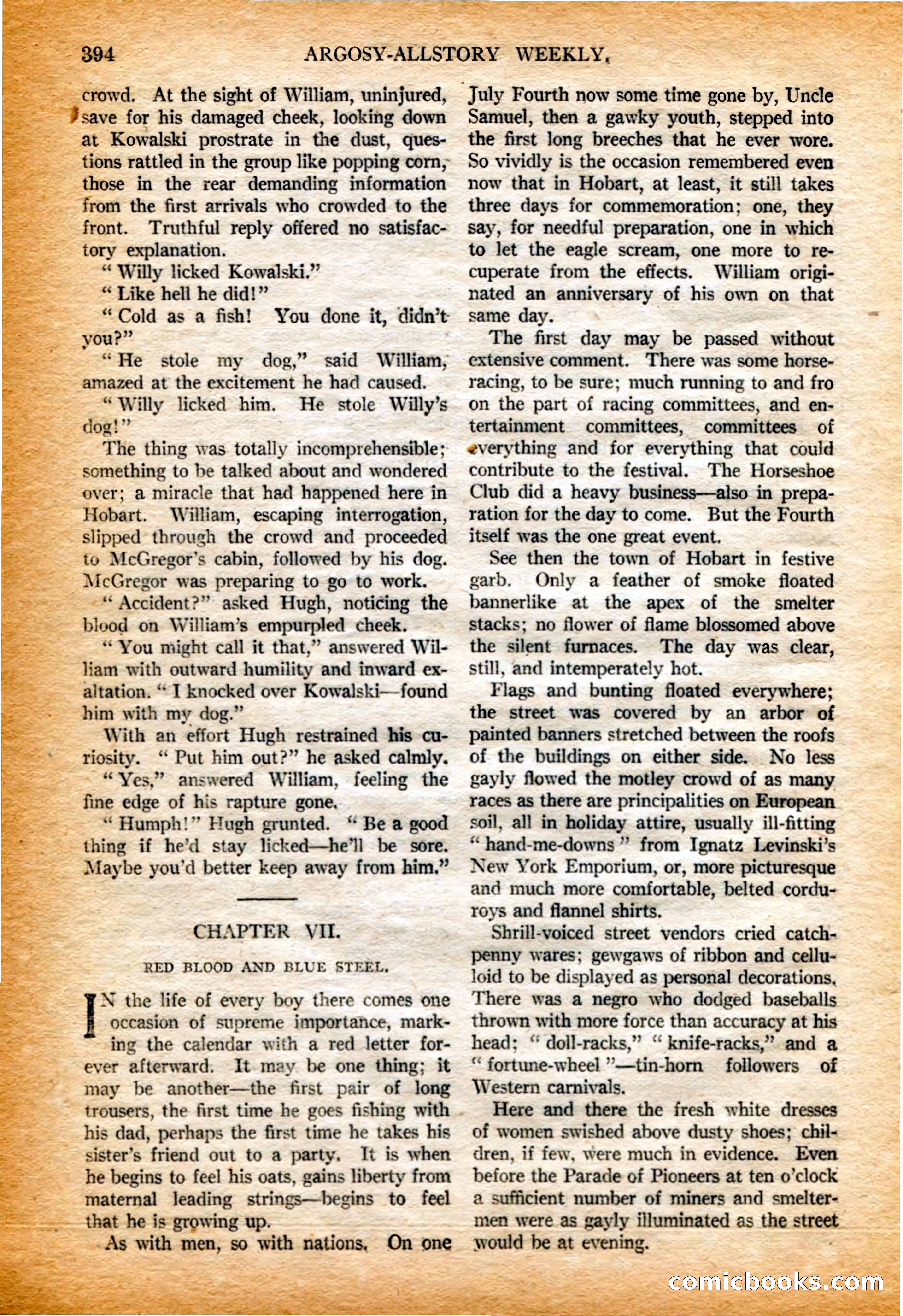
A restored page from Pulp Fiction, 1922. Page through the whole issue in the reader above.
📄 Transcribed text from this page (OCR, searchable)
Machine-transcribed from the original scan — historical spelling and the odd misread are preserved.
x Lag 3 CARA Wi , ‘a ia re Ly Mi A, Di ag a Y Wye aw d ' . ty he se Gey ‘2 vale fA) cae ie st ns ORL IY y % ar? ) if ’ aia ] : We } iL Tan riot Vn ST ae, Nia (he St a, vy RS Uh any it ty wy ¢ (o ). 4 ‘ BA) } Ce! : Disha tebe, ; : ?: hy 5 ? fe RAY Ah 7 ryt 1, i" { - eT. he a M ee | T We oe me 1 y . > 4 ye Mei oie Si Yee | Ae iy wes rus 4 Byin) Wye 1, : : 4 *) BN Pa 4 vy vi ie | ‘ Bb i UE rks) = pl Fi —~% . o PS ee i _ = 4 -*_ » * “ 7 crowd, At the sight of William, uninjured, save for his damaged cheek, looking down at Kowalski prostrate in the dust, ques- tions rattled in the group like popping corn; those in the rear demanding information from the first arrivals who crowded to the front. Truthful reply offered no satisfac- tory explanation. “ Willy licked Kowalski.” “ Like hell he did!” “Cold as a fish! you?” “He stole my dog,” said William, amazed at the excitement he had caused. “Willy licked him. He stole Willy’s dog!” The thing was totally incomprehensible; something to be talked about and wondered ever; a miracle that had happened here in Hobart. William, escaping interrogation, slipped through the crowd and proceeded to McGregor’s cabin, followed by his dog. You done it, didn’t _ McGregor was preparing to go to work. * Accident?” asked Hugh, noticing the bleod on William’s empurpled cheek. “You might call it that,” answered Wil- liam with outward humility and inward ex- altation. “ I knocked over Kowalski—found him with my dog.” With an effort Hugh restrained his cu- riosity. ‘‘ Put him out?” he asked calmly. “Yes,” answered William, feeling the fine edge of his rapture gone, “ Humph!” Hugh grunted. “ Be a good thing if he’d stay licked—he’ll be sore. Maybe you'd better keep away from him.” CHAPTER VIL. RED BLOOD AND BLUE STEEL. N the life of every boy there comes one occasion of supreme importance, mark- ing the calendar with a red letter for- ever afterward. It may be one thing; it may be another—the first pair of long trousers, the first time he goes fishing with his dad, perhaps the first time he takes his sister’s friend out to a party. It is when he begins to feel his oats, gains liberty from maternal leading strings—begins to feel that he is growing up. .As with men, so with nations, On one E = a 7 Oe 7 a ~ =~ ~ ARGOSY-ALLSTORY WEEKLY, July Fourth now some time gone by, Uncle Samuel, then a gawky youth, stepped into the first long breeches that he ever wore. So vividly is the occasion remembered even now that in Hobart, at least, it still takes three days for commemoration; one, they say, for needful preparation, one in which to let the eagle scream, one more to re- cuperate from the effects. William origi- nated an anniversary of his own on that same day. The first day may be passed without extensive comment. There was some horse- racing, to be sure; much running to and fro on the part of racing committees, and en- tertainment committees, committees of everything and for everything that could contribute to the festival. The Horseshoe Club did a heavy business—also in prepa- ration for the day to come. But the Fourth itself was the one great event. See then the town of Hobart in festive garb. Only a feather of smoke floated bannerlike at the apex of the smelter stacks; no flower of flame blossomed above the silent furnaces. The day was clear, still, and intemperately hot. Flags and bunting floated everywhere; the street was covered by an arbor of painted banners stretched between the roofs of the buildings on either side. No less gayly flowed the motley crowd of as many races as there are principalities on European soil, all in holiday attire, usually ill-fitting “ hand-me-downs ” from Ignatz Levinski’s New York Emporium, or, more picturesque and much more comfortable, belted cordu- roys and flannel shirts. Shrill-voiced street vendors cried catch- penny wares; gewgaws of ribbon and cellu- loid to be displayed as personal decorations, There was a negro who dodged baseballs thrown with more force than accuracy at his head; “ doll-racks,” “ knife-racks,” and a “ fortune-wheel ’’—tin-horn followers of Western carnivals. Here and there the fresh white dresses of women swished above dusty shoes; chil- dren, if few, were much in evidence. Even before the Parade of Pioneers at ten o’clock a sufficient number of miners and smelter- mien were as gayly illuminated as the street would be at evening. MIE (E(0)