
Pulp Fiction, 1909 · page 102 of 227
The Argosy for May — page 102: what you’re looking at
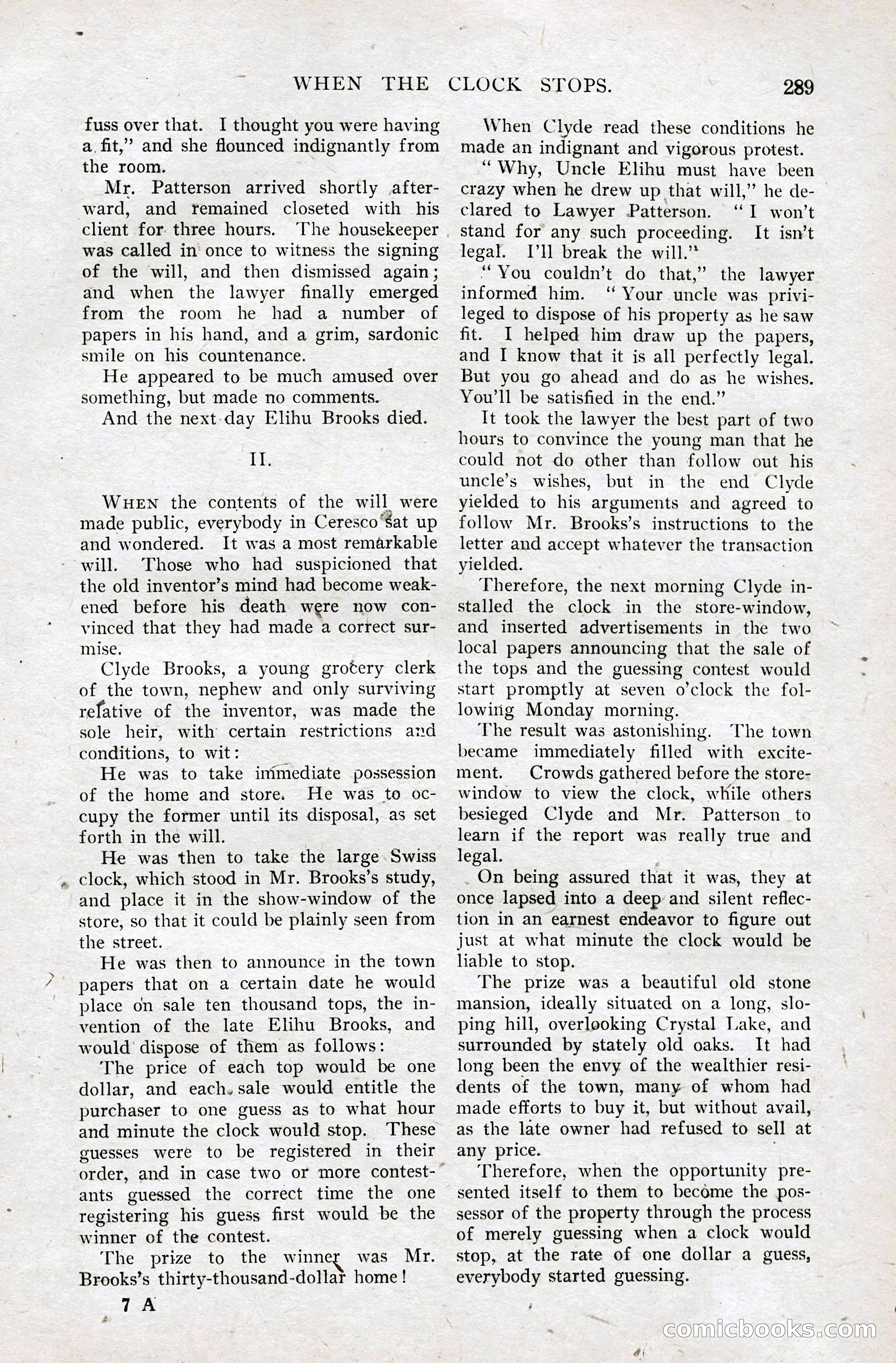
A restored page from Pulp Fiction, 1909. Page through the whole issue in the reader above.
📄 Transcribed text from this page (OCR, searchable)
Machine-transcribed from the original scan — historical spelling and the odd misread are preserved.
LES WHEN THE CLOCK fuss over that. I thought you were having a. fit,’ and she flounced indignantly from the room. Mr. Patterson arrived shortly after- ward, and remained closeted with his client for three hours. was called in once to witness the signing of the will, and then dismissed again ; and when the lawyer finally emerged from the room he had a number of papers in his hand, and a grim, sardonic smile on his countenance. He appeared to be much amused over something, but made no comments. And the next-day Elihu Brooks died. Il. WHEN the contents of the will were made public, everybody in Ceresco‘Sat up and wondered. It was a most remarkable will. Those who had suspicioned that the old inventor’s mind had become weak- ened before his death were now con- vinced that they had made a correct sur- mise. Clyde Brooks, a young grotery clerk of the town, nephew and only surviving refative of the inventor, was made the sole heir, with certain restrictions and conditions, to wit: He was to take inimediate possession of the home and store. He was to oc- cupy the former until its disposal, as set forth in the will. He was then to take the large Swiss clock, which stood in Mr. Brooks’s study, and place it in the show-window of the store, so that it could be plainly seen from the street. He was then to announce in the town papers that on a certain date he would place on sale ten thousand tops, the in- vention of the late Elihu Brooks, and would dispose of them as follows: The price of each top would be one dollar, and each. sale would entitle the purchaser to one guess as to what hour and minute the clock would stop. These guesses were to be registered in their order, and in case two or more contest-— ants guessed the correct time the one registering his guess first would be the winner of the contest. The prize to the winnet was Mr. Brooks’s thirty-thousand-dollar home! 7A é The housekeeper | STOPS. 289 When Clyde read these conditions he made an indignant and vigorous protest. “Why, Uncle Elihu must have been crazy when he drew up that will,” he de- clared to Lawyer Patterson. ‘I won't stand for any such proceeding. It isn’t legal. I'l] break the will.” “You couldn’t do that,” the lawyer informed him. “ Your uncle was privi- leged to dispose of his property as he saw ft. I helped him draw up the papers, and I know that it is all perfectly legal. But you go ahead and do as he wishes. You'll be satisfied in the end.” It took the lawyer the best part of two hours to convince the young man that he could not do other than follow out his uncle’s wishes, but in the end Clyde yielded to his arguments and agreed to follow Mr. Brooks’s instructions to the letter and accept whatever the transaction yielded. Therefore, the next morning Clyde in- stalled the clock in the store-window, and inserted advertisements in the two local papers announcing that the sale of the tops and the guessing contest would start promptly at seven o’clock the fol- lowing Monday morning. The result was astonishing. The town became immediately filled with excite- ment. Crowds gathered before the store- window to view the clock, while others besieged Clyde and Mr. Patterson to learn if the report was really true and legal. On being assured that it was, they at once lapsed into a deep and silent reflec- tion in an earnest endeavor to figure out just at what minute the clock would be hable to stop. The prize was a beautiful old stone mansion, ideally situated on a long, slo- ping hill, overlooking Crystal Lake, and surrounded by stately old oaks. It had long been the envy of the wealthier resi- dents of the town, many of whom had made efforts to buy it, but without avail, as the late owner had refused to sell at any price. . Therefore, when the opportunity pre- sented itself to them to become the pos- sessor of the property through the process of merely guessing when a clock would stop, at the rate of one dollar a guess, everybody started guessing. 1OOOLK GO