
Pulp Fiction, 1909 · page 104 of 227
The Argosy for May — page 104: what you’re looking at
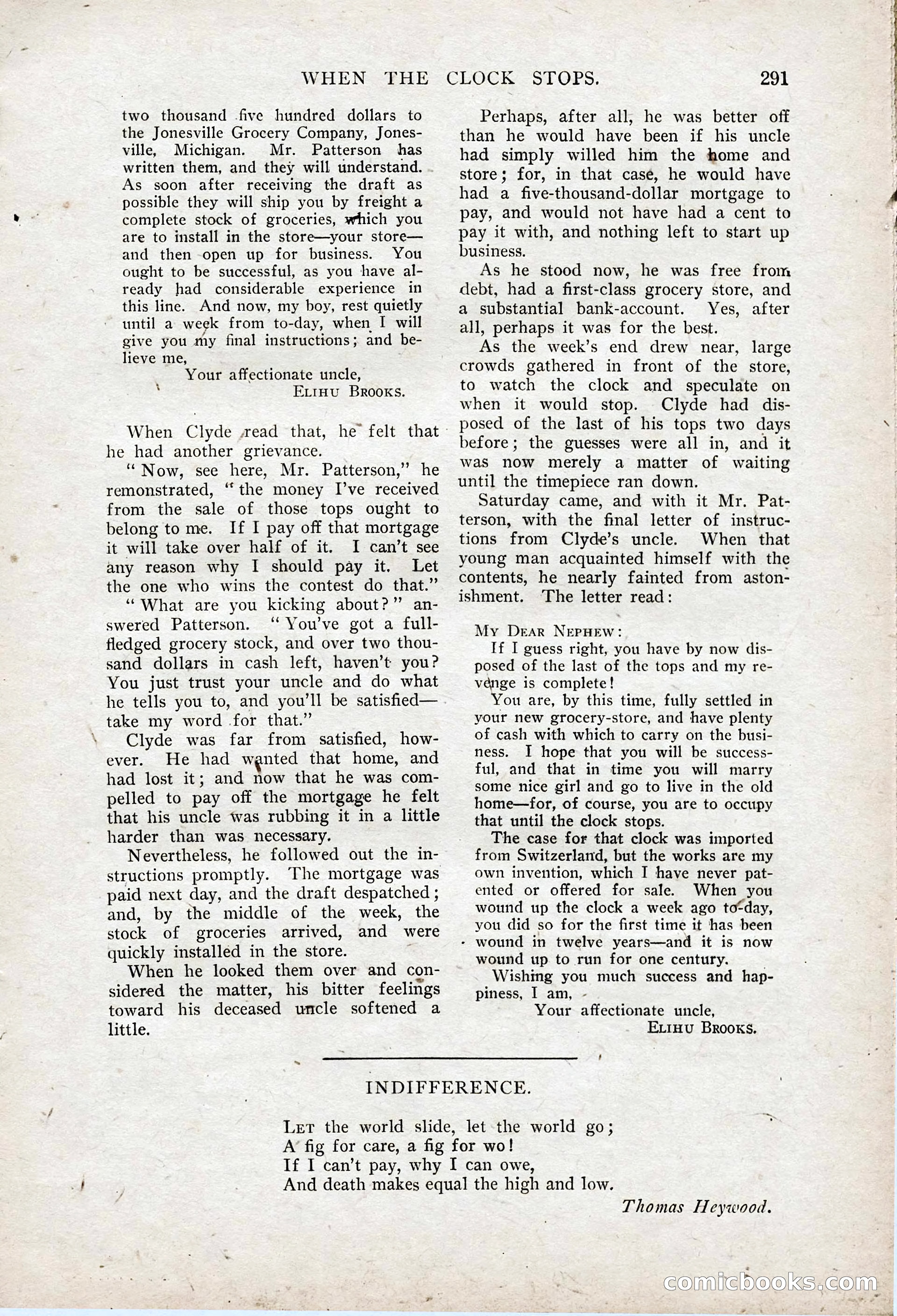
A restored page from Pulp Fiction, 1909. Page through the whole issue in the reader above.
📄 Transcribed text from this page (OCR, searchable)
Machine-transcribed from the original scan — historical spelling and the odd misread are preserved.
WHEN THE two thousand -five hundred dollars to the Jonesville Grocery Company, Jones- ville, Michigan. Mr. Patterson has written them, and they will understand. As soon after receiving the draft as possible they will ship you by freight a complete stock of groceries, which you are to install in the store—your store— and then open up for business. You ought to be successful, as you have al- ready had considerable experience in this line. And now, my boy, rest quietly until a week from to-day, when I will give you my final instructions; and be- lieve me, Your affectionate uncle, t ELttnvu Brooks. When Clyde -read that, he felt that he had another grievance. ‘Now, see here, Mr. Patterson,’ he remonstrated, “the money I’ve received from the sale of those tops ought to belong to me. If I pay off that mortgage it will take over half of it. I can’t see any reason why I should pay it. Let the one who wins the contest do that.” ‘““What are you kicking about?” an- swered Patterson. ‘‘ You've got a full- fledged grocery stock, and over two thou- sand dollars in cash left, haven’t you? You just trust your uncle and do what he tells you to, and you'll be satisfied— take my word for that.” Clyde was far from satisfied, how- ever. He had wanted that home, and had lost it; and now that he was com- pelled to pay off the mortgage he felt that his uncle was rubbing it in a little harder than was necessary. Nevertheless, he followed out the in- structions promptly. The mortgage was paid next day, and the draft despatched ; and, by the middle of the week, the stock of groceries arrived, and were quickly installed in the store. When he looked them over and con- sidered the matter, his bitter feelings toward his deceased umcle softened a little. CLOCK STOPS. 291 Perhaps, after all, he was better off than he would have been if his uncle had simply willed him the home and store; for, in that case, he would have had a five-thousand-dollar mortgage to pay, and would not have had a cent to pay it with, and nothing left to start up business. As he stood now, he was free from debt, had a first-class grocery store, and a substantial bank-account. Yes, after all, perhaps it was for the best. As the week’s end drew near, large crowds gathered in front of the store, to watch the clock and speculate on when it would stop. Clyde had dis- posed of the last of his tops two days before; the guesses were all in, and it was now merely a matter of waiting until the timepiece ran down. Saturday came, and with it Mr. Pat- terson, with the final letter of instruc- tions from Clyde’s uncle. When that young man acquainted himself with the contents, he nearly fainted from aston- ishment. ‘The letter read: My Dear NEPHEW: If I guess right, you have by now dis- posed of the last of the tops and my re- véenge is complete! You are, by this time, fully settled in your new grocery-store, and have plenty of cash with which to carry on the busi- ness. I hope that you will be success- ful, and that in time you will marry some nice girl and go to live in the old home—for, of course, you are to occupy that until the clock stops. The case for that clock was imported from Switzerland, but the works are my own invention, which I have never pat- ented or offered for sale. When you wound up the clock a week ago today, you did so for the first time it ‘has been - wound in twelve years—and it is now wound up to run for one century. | Wishing you much success and hap- piness, I am, - Your affectionate uncle, Exinvu Brooks. INDIFFERENCE. Let the world slide, let the world go; A’ fig for care, a fig for wo! If I can’t pay, why I can owe, And death makes equal the high and low. Thomas Heywood. (C@) TOOK (Co) aw