
Pulp Fiction, 1909 · page 11 of 227
The Argosy for May — page 11: what you’re looking at
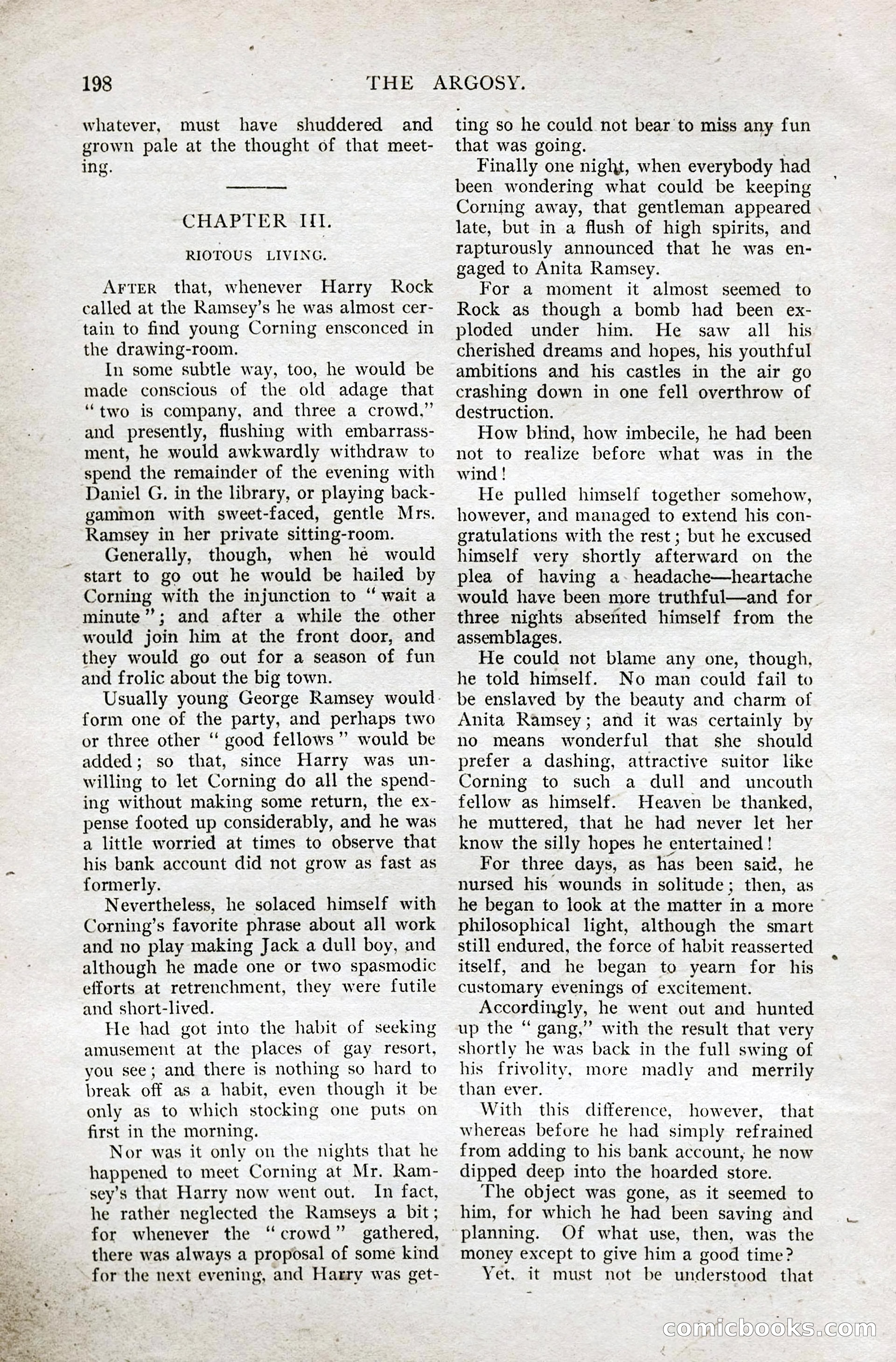
A restored page from Pulp Fiction, 1909. Page through the whole issue in the reader above.
📄 Transcribed text from this page (OCR, searchable)
Machine-transcribed from the original scan — historical spelling and the odd misread are preserved.
198 whatever, must have shuddered and grown pale at the thought of that meet- ing. CHAPTER IfI. RIOTOUS LIVING. AFTER that, whenever Harry Rock called at the Ramsey’s he was almost cer- tain to find young Corning ensconced in the drawing-room. In some subtle way, too, he would be made conscious of the old adage that “two is company, and three a crowd,” and presently, flushing with embarrass- ment, he would awkwardly withdraw to spend the remainder of the evening with Daniel G. in the library, or playing back- gammon with sweet-faced, gentle Mrs. Ramsey in her private sitting-room. Generally, though, when he would start to go out he would be hailed by Corning with the injunction to “ wait a minute”; and after a while the other would join him at the front door, and they would go out for a season of fun and frolic about the big town. Usually young George Ramsey would. form one of the party, and perhaps two or three other ‘‘ good fellows” would be added; so that, since Harry was un- willing to let Corning do all the spend- ing without making some return, the ex- pense footed up considerably, and he was a little worried at times to observe that his bank account did not grow as fast as formerly. Nevertheless, he solaced himself with Corning’s favorite phrase about all work and no play making Jack a dull boy, and although he made one or two spasmodic efforts at retrenchment, they were futile and short-lived. He had got into the habit of seeking amusement at the places of gay resort, you see; and there is nothing so hard to break off as a habit, even though it be only as to which stocking one puts on first in the morning. Nor was it only on the nights that he happened to meet Corning at Mr. RKam- sey’s that Harry now went out. In fact, he rather neglected the Ramseys a bit; for whenever the ‘‘crowd”’ gathered, there was always a proposal of some kind for the next evening, and Harry was get- THE ARGOSY. ting so he could not bear to miss any fun that was going. Finally one night, when everybody had been wondering what could be keeping Corning away, that gentleman appeared . late, but in a flush of high spirits, and rapturously announced that he was en- gaged to Anita Ramsey. For a moment it almost seemed to Rock as though a bomb had been ex- ploded under him. He saw all his cherished dreams and hopes, his youthful ambitions and his castles in the air go crashing down in one fell overthrow of destruction. How blind, how imbecile, he had been not to realize before what was in the wind! He pulled himself together somehow, however, and managed to extend his con- gratulations with the rest; but he excused himself very shortly afterward on the plea of having a~-headache—heartache would have been more truthful—and for three nights absented himself from the assemblages. He could not blame any one, though, he told himself. No man could fail to be enslaved by the beauty and charm of Anita Ramsey; and it was certainly by no means wonderful that she should prefer a dashing, attractive suitor like Corning to such a dull and uncouth fellow as himself. Heaven be thanked, he muttered, that he had never let her know the silly hopes he entertained! For three days, as has been said, he nursed his wounds in solitude; then, as he began to look at the matter in a more © philosophical light, although the smart still endured, the force of habit reasserted itself, and he began to yearn for his customary evenings of excitement. Accordingly, he went out and hunted up the “ gang,” with the result that very shortly he was back in the full swing of his frivolity, more madly and merrily than ever. With this difference, however, that whereas before he had simply refrained from adding to his bank account, he now dipped deep into the hoarded store. The object was gone, as it seemed to him, for which he had been saving and “planning. Of what use, then, was the money except to give him a good time? Yet. it must not be understood that = (C@ S| Conmcooolks