
Pulp Fiction, 1909 · page 135 of 227
The Argosy for May — page 135: what you’re looking at
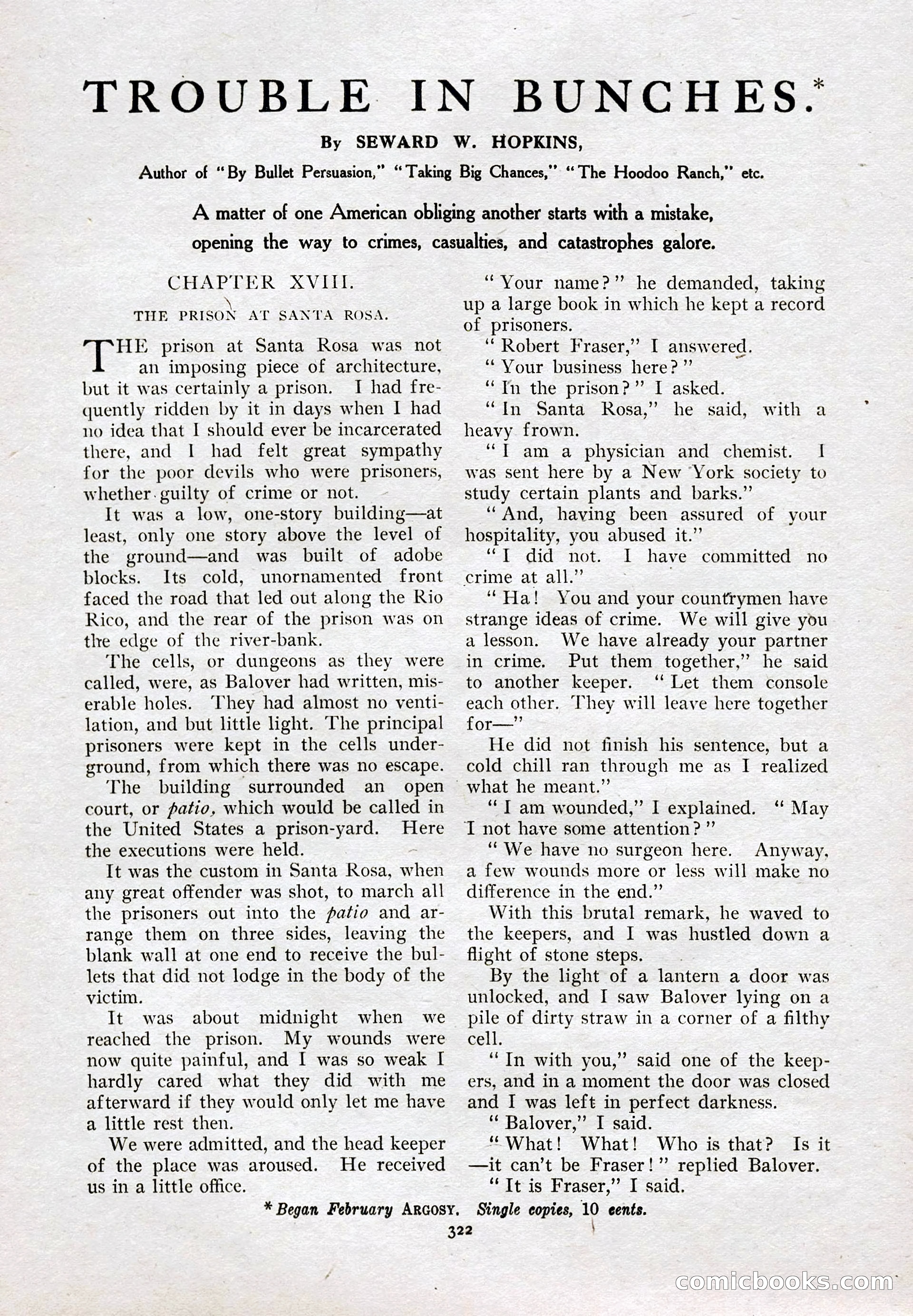
A restored page from Pulp Fiction, 1909. Page through the whole issue in the reader above.
📄 Transcribed text from this page (OCR, searchable)
Machine-transcribed from the original scan — historical spelling and the odd misread are preserved.
TROUBLE IN BUNCHES. By SEWARD W. HOPKINS, Author of “By Bullet Persuasion,” “Taking Big Chances,”” “The Hoodoo Ranch,’ etc A matter of one American obliging another starts with a mistake, opening the way to crimes, casualties, and catastrophes galore. CHAPTER XVIII. \ THE PRISON AT SANTA ROSA. HE prison at Santa Rosa was not an imposing piece of architecture, but it was certainly a prison. I had fre- quently ridden by it in days when I had no idea that I should ever be incarcerated there, and | had felt great sympathy for the poor devils who were prisoners, whether. guilty of crime or not. It was a low, one-story building—at least, only one story above the level of the ground—and was built of adobe blocks. Its cold, unornamented front faced the road that led out along the Rio Rico, and the rear of the prison was on the edge of the river-bank. The cells, or dungeons as they were called, were, as Balover had written, mis- erable holes. They had almost no venti- lation, and but little light. The principal prisoners were kept in the cells under- ground, from which there was no escape. The building surrounded an open court, or patio, which would be called in the United States a prison-yard. Here the executions were held. It was the custom in Santa Rosa, lice any great offender was shot, to march all the prisoners out into the patio and ar- range them on three sides, leaving the blank wall at one end to receive the bul- lets that did not lodge in the body of the victim. It was about midnight when we reached the prison. My wounds were now quite painful, and I was so weak I hardly cared what they did with me afterward if they would only let me have a little rest then. We were admitted, and the head keeper of the place was aroused. He received us in a little office. ‘Your name?” he demanded, taking up a large book in which he kept a record of prisoners. ‘Robert Fraser,” I answered. “Your business here? ”’ “Tn the prison?”’ I asked. “In Santa Rosa,” he said, heavy frown. ‘Tam a physician and chemist. [| was sent here by a New York society to study certain plants and barks.” “And, having been assured of your hospitality, you abused it.” “{T did not. I have with a committed no crime at all.” ‘Ha! You and your countrymen have strange ideas of crime. We will give you a lesson. We have already your partner in crime. Put them together,” he said to another keeper. ‘“ Let them console each other. They will leave here together for—”’ He did not finish his sentence, but a cold chill ran through me as I realized what he meant.” ‘“T am wounded,” I explained. ‘ May I not have some attention? ”’ ‘We have no surgeon here. Anyway, a few wounds more or less will make no difference in the end.” With this brutal remark, he waved to the keepers, and I was hustled down a flight of stone steps. By the light of a lantern a door was unlocked, and I saw Balover lying on a pile of dirty straw in a corner of a filthy cell. “In with you,” said one of the keep- ers, and in a moment the door was closed and I was left in perfect darkness. ‘“‘ Balover,” I said. “What! What! Who is that? Is it —it can’t be Fraser!” replied Balover. “It is Fraser,” I said. * Began February Arcosy. Single copies, 10 eents. \ 322 1 OOOL< (CO)